


Table of contents: Engine coolant filling capacity…↓ Filling capacity of the tank (at the…↓ Flushing the cooling system ↓ Raise the heater hose as high as…↓
1. If removed, install the tank and screw the plug into the radiator drain hole.
Attention:
- Clean the drain plug and screw it in, installing a new O-ring.
- Radiator drain plug. See chapter "Lubrication system and engine cooling system".
- If the plugs were removed from the drain holes in the cylinder block, screw them back in and tighten them. See chapter "Mechanical part of the engine".
2. Make sure the hose clamps are tight.
3. Remove the air duct and resonator assembly and move the electric throttle actuator to the side. See Chapter "Mechanical part of the engine".
4. Disconnect the heater hose (1) at the location indicated by the arrow in the figure.
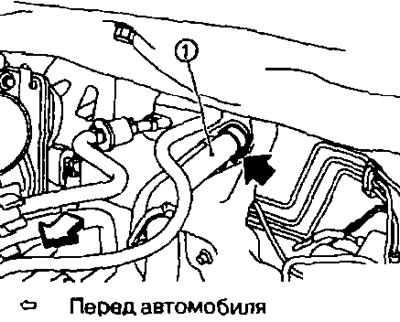
- Raise the heater hose as high as possible.
5. Fill the radiator (1) to the required level.
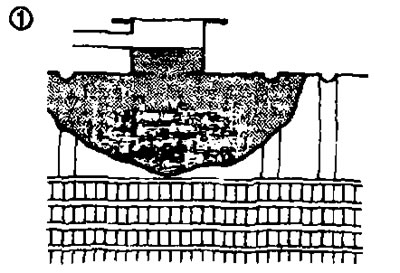
Caution: Do not allow coolant to come into contact with electronic components (generator, etc.).
- Pour the coolant slowly at a rate of less than 2 liters per minute to allow air to escape from the system.
- When coolant begins to flow out of the heater, reconnect the heater hose and continue filling.
- Use genuine Nissan coolant or equivalent quality mixed with water (distilled or desalted). See above.
Engine coolant filling capacity (with the tank at the "MAX" level).
See chapter "Lubrication system and engine cooling system".
6. Fill the tank with coolant up to the "MAX" mark.
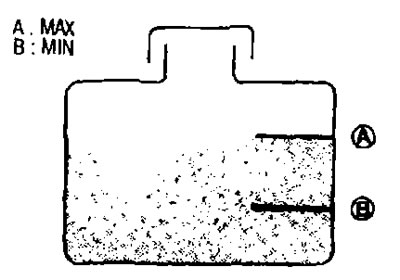
Filling capacity of the tank (at the "MAX" level)*.
See chapter "Lubrication system and engine cooling system".
7. Screw the cap back on the radiator.
8. Install the electric throttle actuator, air duct and resonator assembly. See Chapter "Mechanical part of the engine".
9. Warm up the engine until the thermostat opens. The standard warm-up time is about 10 minutes at an engine speed of 3000 rpm.
- To determine if the thermostat is opening, touch the lower radiator hose with your hand and make sure that warm liquid is flowing through it.
Caution: To avoid overheating the engine, watch the coolant temperature gauge.
10. Stop the engine and cool down to below 50°C.
- To save time, cool with a fan.
- If necessary, fill the radiator with coolant up to the filler neck.
Caution: Do not allow coolant to come into contact with electronic components (generator, etc.).
11. Fill the coolant reservoir up to the "MAX" mark.
12. Repeat steps 5-10 two or more times, tightening the radiator cap until the coolant level stops dropping.
13. Check for leaks in the cooling system with the engine running.
14. Warm up the engine and check for the sound of leaking coolant by increasing the engine speed from idle to 3000 rpm and setting the heater temperature control to several positions between "COOL" and "WARM".
- A sound may be heard from the heater.
15. Repeat step 14 three times.
16. If a sound is heard, bleed the cooling system by repeating steps 5-10 until the coolant level stops dropping.
Flushing the cooling system
1. If removed, install the tank and screw the plug into the radiator drain hole.
Attention:
- Clean the drain plug and screw it in, installing a new O-ring.
- Radiator Drain Plug: See Chapter "Lubrication system and engine cooling system".
- If the plugs were removed from the drain holes in the cylinder block, screw them back in and tighten them. See chapter "Mechanical part of the engine".
2. Remove the air duct and resonator assembly and move the electric throttle actuator to the side. See Chapter "Mechanical part of the engine".
3. Disconnect the heater hose (1) at the location indicated by the arrow in the figure.
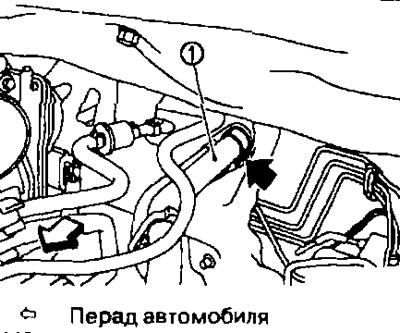
Raise the heater hose as high as possible.
4. Fill the radiator and reservoir with engine coolant and tighten the radiator cap.
- When coolant begins to flow out of the heater hose, reconnect the heater hose and continue filling.
5. Install the electric throttle actuator, air duct and resonator assembly. See Chapter "Mechanical part of the engine".
6. Start the engine and warm it up to normal operating temperature.
7. Press the accelerator pedal two or three times without load.
8. Turn off the engine and wait until it cools down.
9. Drain the water from the system. See above.
10. Repeat steps 1-9 until clean water starts flowing out of the radiator.