


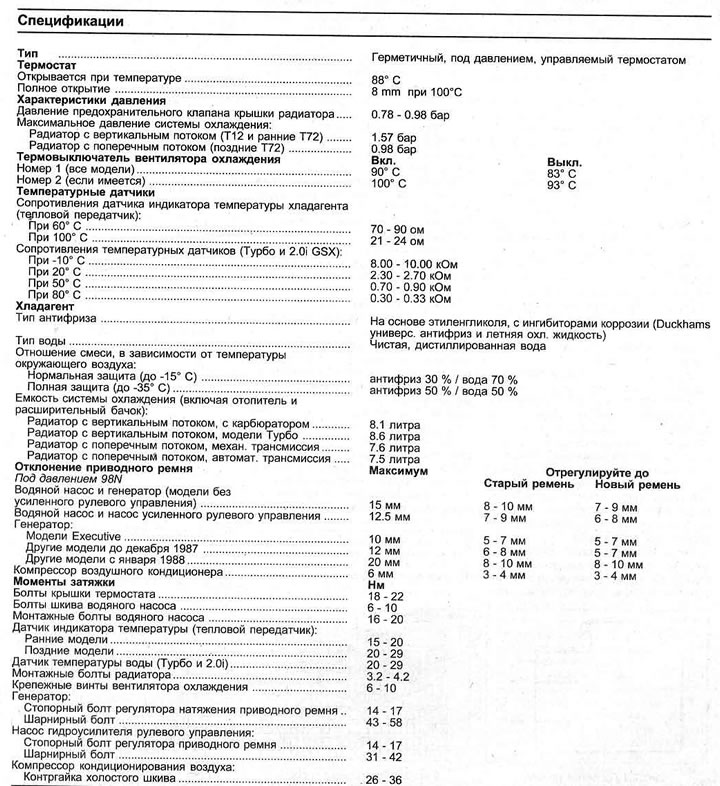
The cooling system is sealed and consists of a radiator, water pump, thermostat, electric cooling fan, expansion tank and connecting hoses.
The system works as follows. Cold coolant from the radiator passes through hoses and pipes to the water pump, which pumps the coolant through the cylinder block and cylinder head. After cooling the engine cylinders, combustion chamber and valve seats, the coolant goes to the manifold and thermostat, which is initially closed, and is directed through a bypass hose back to the pump (turbo and 2.0 liter fuel injection models) and/or to the heater, oil radiator and other related systems.
When the engine is cold, the thermostat is closed, the coolant circulates in a small circle. When the coolant reaches a certain temperature, the thermostat opens, the coolant flows through the upper hose to the radiator. The coolant in the radiator is cooled by air when the car is moving. The air flow is increased by the action of an electric cooling fan, if necessary. After the coolant reaches the other side of the radiator, the cycle is repeated.
When the engine is at normal operating temperature, the coolant expands, some of it moving into the expansion tank. This coolant collects in the reservoir and returns to the radiator when the system cools down.
The T12 and early T72 models use a vertical flow radiator with upper and lower reservoirs, while the later T72 models use a (since July 1987) a cross-flow radiator is used, which has tanks on the right and left.
The water pump is mounted on the right side of the engine and is driven by the crankshaft pulley via a drive belt. The cooling fan is mounted on the radiator and is driven by an electric motor. It is controlled by a thermal switch and a relay. With a two-speed fan motor, there is an additional relay and switch.
There are some differences between the cooling systems installed on the various models. Automatic transmission vehicles have a transmission fluid cooler located underneath (or to the left) of the reservoir, connected to the transmission by flexible hoses and pipes. Turbo and automatic transmission models have an engine oil cooler located on the rear of the engine block and connected to the main cooling system. On 2.0L and Turbo fuel injection models, there is a cooling system connection to the throttle body.
The text was borrowed from here: nissanbook.ru