


2. The engine must be at normal operating temperature, the battery must be fully charged, and the spark plugs must be removed. The assistance of another person will be required.
3. Disconnect the ignition system by disconnecting the crankshaft angle sensor wiring from the distributor on carburetor and Turbo models (photo). On 2.0L fuel injection models, disconnect the distributor ignition coil high-voltage cable at the crankshaft angle sensor and the ground wire. On Turbo and 2.0L fuel injection models, remove the fuel pump fuse.
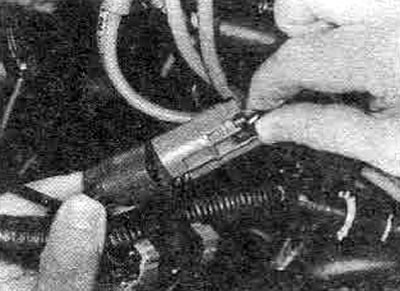
25.3 Before checking the compression, turn off the ignition system
4. Install the compression gauge into the spark plug hole of cylinder No.1.
5. Crank the engine with the starter. Take the highest reading.
6. Repeat the test on the remaining cylinders, recording the pressure.
7. The nominal pressures are given in the Specifications. If the pressure in any cylinder is low, pour engine oil into the spark plug hole and repeat the test.
8. If adding oil temporarily improves compression, this indicates wear in the cylinder bore or piston. If there is no improvement, there may be a leak either through burnt valves or through the cylinder head gasket.
9. Low compression in two adjacent cylinders is most likely due to a burnt-out cylinder head gasket between them.
10. At the end of the test, install the spark plugs, connect the ignition system and the fuel pump.