


2. Clean the spark plug recesses from dirt and debris. Remove the spark plugs.
3. Disconnect the electrical connector on the carburetor to prevent the fuel shut-off solenoid valve from operating.
4. On 3.0L models, disconnect the distributor electrical connector to de-energize the ignition system.
5. On 4.2L models, disconnect the positive cable from the ignition coil to de-energize the ignition system. Tape the positive cable end to prevent accidental short circuiting.
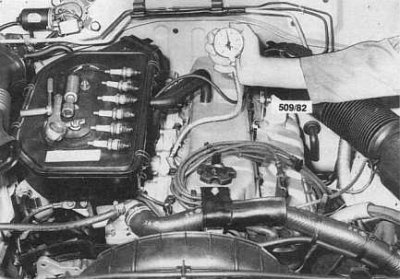
6. Install the compression gauge into the spark plug socket of the first cylinder (see accompanying illustration) (follow the appliance manufacturer's instructions).
7. Ask an assistant to fully open the throttle valve and crank the engine with the starter. After reading the maximum reading on the meter, (usually this is achieved on the third or fourth revolution of the engine) the starter can be turned off.
8. Record the result and repeat the test for the remaining cylinders.
9. Compare all the readings taken (the required values and the permissible difference between the cylinders are given in tables of sizes and adjustments at the end of the Guide).
10. If the compression pressure in one or more cylinders is low, perform the following additional check:
- Pour a small amount of engine oil into the corresponding spark plug hole and turn the engine to ensure even distribution of the oil in the cylinder.
- Repeat the compression pressure check for this cylinder.
A significant increase in compression pressure after filling the cylinder with oil is a sign of wear or damage to the piston rings, piston or cylinder bore.
The absence of any noticeable change in readings can be considered a sign of jammed, burnt, or damaged valves or a leaky cylinder head gasket.
Late-model 4.2 L models equipped with fuel injection (EFI)
1. Start the engine and warm it up to normal operating temperature. Turn off the ignition.
2. Relieve pressure in the fuel system.
3. Remove the air cleaner filter element and spark plugs.
4. Disconnect the ignition coil high voltage wire from the distributor cap and ground it to ground.
5. Install the compression gauge into the spark plug hole of the first cylinder (follow the appliance manufacturer's instructions).
6. Ask an assistant to fully open the throttle valve and crank the engine with the starter until the maximum reading on the instrument is reached (usually three or four turns are enough).
7. Record the reading and repeat the test for the remaining cylinders.
8. Compare all the readings taken (the required values and the permissible difference between the cylinders are given in tables of sizes and adjustments at the end of the Guide).
9. If the compression pressure in one or more cylinders is low, perform the following additional check:
- Pour a small amount of engine oil into the corresponding spark plug hole and turn the engine to ensure even distribution of the oil in the cylinder.
- Repeat the compression pressure check for this cylinder.
A significant increase in compression pressure after filling the cylinder with oil is a sign of wear or damage to the piston rings, piston or cylinder bore.
The absence of any noticeable changes in the readings can be considered a sign of jammed, burnt, or damaged valves or a leaky cylinder head gasket.
(The publication is reprinted from this resource: nissanbook.ru)