


Note: The engine must be at normal operating temperature and the battery must be fully charged.
2. Start by cleaning the spark plug niches (blow them out with compressed air, a regular bicycle pump is a great source of air in this case). The main objective is to prevent debris from entering the cylinders during measurements.
3. Release the pressure in the fuel system (see Chapter Power and exhaust systems). The fuel pump must be disconnected during this procedure.
4. Remove all spark plugs from the engine (see Chapter Settings and ongoing maintenance). Fix the throttle valve in the fully open position.
5. On models equipped with an ignition distributor, disconnect the central element from the distributor cover (coil wire) and ground it to the engine block. On models without a distributor, disconnect the wiring from each of the ignition coils.
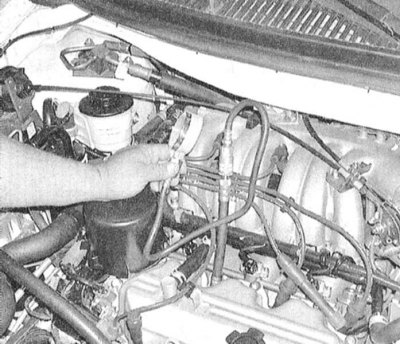
(Information copied from the portal: Nissanbook.ru)
6. Install the compression gauge into the spark plug hole of the first cylinder.
7. Crank the engine for at least seven strokes and read the meter reading. On a serviceable engine, the pressure should increase fairly quickly. Low pressure on the first stroke, accompanied by a gradual increase on subsequent ones, indicates wear of the piston rings. If the pressure does not increase with further cranking of the shaft, this can be regarded as evidence of valve leaks or a breach of the cylinder head gasket (the possibility of cracks in the head is also possible). Deposits on the valve head faces can also cause a decrease in compression pressure. Record the maximum compression tester reading.
8. Repeat the procedure for the remaining engine cylinders. Compare the results with the standard requirements (see Specifications).
9. If the measurement results are excessively low, pour some engine oil into each cylinder through the spark plug hole (two to three teaspoons) and check again.
10. If adding oil increases the pressure, this indicates wear of the piston rings. If the compression does not increase, the reason for its decrease is valve leaks or a leak in the head gasket. Valve leaks may be associated with burnout of their seats, or deformation/burnout or mechanical damage to the working chamfers.
11. If the compression pressure is equally low in two adjacent cylinders, then with a high degree of probability we can talk about a violation of the integrity of the head gasket within its bridge between these cylinders. The presence of coolant in the engine oil will confirm this assumption.
12. If the pressure in one of the cylinders is approximately 20% lower than in the others and this is accompanied by a violation of the stability of the idle speed, the degree of wear of the cams of the corresponding valve drive on the camshaft should be assessed.
13. An unusual increase in compression pressure is usually the result of excessive carbon formation in the combustion chambers. In this case, the cylinder head must be removed for decarbonization.
14. If the measurement results are excessively low, or if the pressure distribution between the cylinders is not uniform, it would be useful to test the engine for leaks in a car service workshop. Such a test will allow you to accurately determine the source of the leak and assess its severity.