


2. Remove the spark plugs. Open the throttle and air valves fully.
3. Disconnect the central high-voltage wire from the ignition distributor cap and connect it to ground.
4. Insert a compression gauge into the spark plug hole of cylinder 1 (photo). Turn on the starter and monitor the pressure gauge readings. On a serviceable engine, the pressure should increase quickly. Low pressure after the first piston stroke and a slow increase during subsequent compression strokes indicates wear of the piston rings. If the pressure is low after the first piston stroke and does not increase during subsequent compression strokes, then the cause is a leak in the valves or a leak in the cylinder head gasket (the cause may also be the formation of cracks in the head). Record the highest compression reading and repeat the procedure for the remaining cylinders.
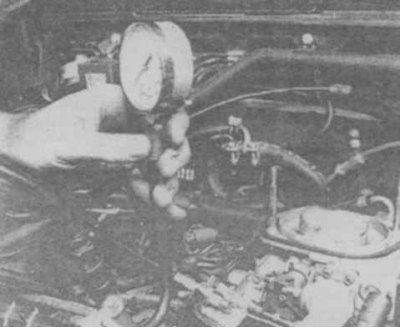
2.4 Compression measurement
5. Repeat the procedure on the remaining cylinders.
6. If after introducing oil into the cylinder (10-15g) the compression has increased, then we can conclude that the piston rings are worn out. If the compression increases slightly, then the leak occurs through the valves or the cylinder head gasket.
7. If the compression is equally low only in two adjacent cylinders, then the most likely cause is a burnt gasket between these cylinders.
8. If the compression value exceeds the norm, then the combustion chamber is covered with carbon deposits. In this case, the cylinder head must be removed and the carbon deposits removed.
9. If there is a significant difference in compression in the cylinders, the vehicle should be taken to a service station to have the cylinder block checked using the pressure testing method.