


Caution: Before removing the pistons and connecting rods, remove the cylinder head, oil pan and oil pump.
1. Remove the flange at the top of the cylinder (photo).
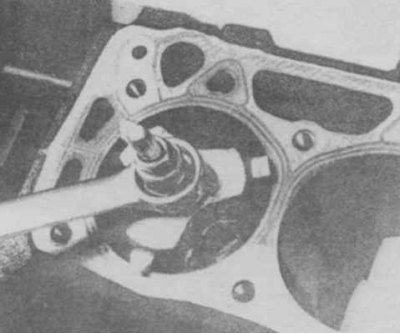
11.1 Removing a flange in a cylinder using a reamer
2. Turn the engine over and check the axial play of the connecting rods (photo) by inserting feeler gauges between the crankshaft and the connecting rod. The axial play will be equal to the total thickness of the feeler gauges, at which the play disappears. If the axial play of the connecting rod exceeds the standard value, the connecting rod should be replaced. If new connecting rods are installed (or crankshaft), then the axial clearance may be less than normal (in this case, you need to grind the connecting rods, if necessary, consult a car service workshop). Repeat the procedure for the remaining connecting rods.
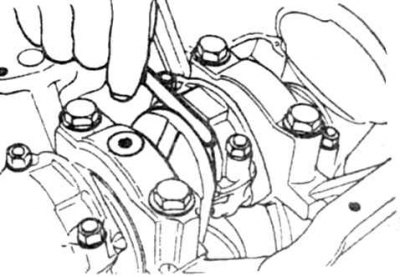
11.2 Checking the connecting rod axial play
3. If there are no marks on the connecting rods and connecting rod caps, punch the number of the corresponding cylinder onto them (photo).
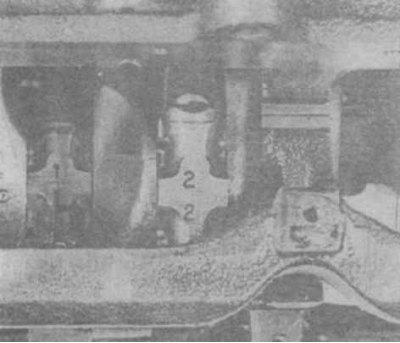
11.3 Connecting rod marking with cylinder number
4. Loosen the cap nuts by turning them 1/2 turn at a time until the nuts can be turned by hand. Remove the cap from the connecting rod of the first cylinder together with the liner; do not remove the liner from the cap. Push the piston with the connecting rod and liner out through the top of the cylinder, having first put the sections of hose on the bolts (photo).
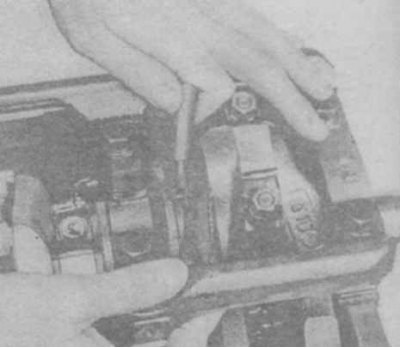
11.4a Place the hose sections on the bolts.
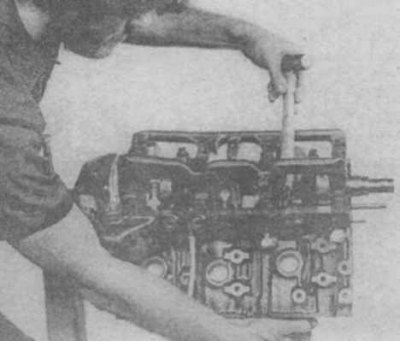
11.4b... and carefully remove the piston and connecting rod
5. Repeat the procedure for all remaining cylinders.
6. Assemble the connecting rods with the caps, tighten the cap nuts by hand.