


Correct relative orientation of the piston and connecting rod
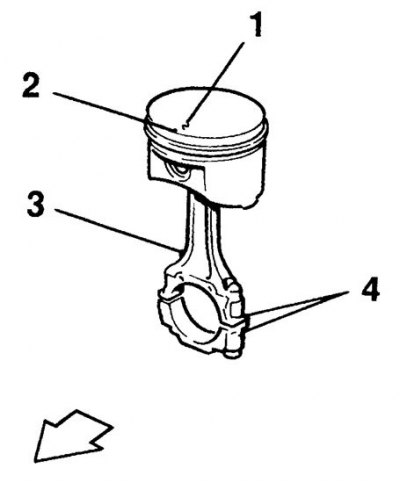
1. Piston size group number; 2. Orientation mark (in the form of an arrow); 3. Lubrication hole in the connecting rod body; 4. Place of application of the cylinder number to which the connecting rod belongs (it may be on the opposite side too)
1. Before checking, the connecting rods and pistons should be cleaned and the old rings should be removed from the piston.
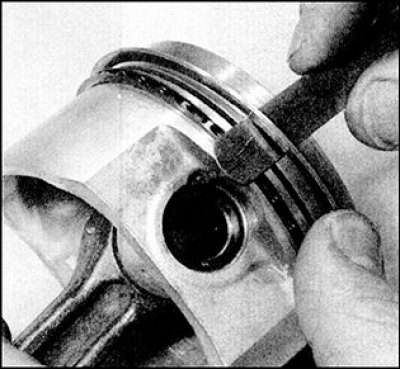
2. Carefully spread the ring, moving it to the top of the piston. To prevent the ring from falling into an empty groove when removing it, place two or three old feeler gauges under the ring.
3. When removing the rings, do not damage the piston surfaces with sharp edges. The rings are very fragile and can break if spread too far apart at the joint. Also, take care not to cut your fingers on the ring edges. Remove the rings only through the top of the piston. If you are installing old rings, store the removed rings together with the piston from which they were removed.
4. Scrape off any carbon deposits from the piston crowns. After removing the top rough layer of carbon, clean the piston crowns by hand with a wire brush (or with sandpaper on a cloth backing).
5. Remove carbon deposits from the piston grooves using an old broken piston ring. To do this, break the old ring in half (while being careful of sharp edges). Remove only carbon deposits, do not remove metal. When cleaning, do not scratch the walls of the grooves.
[Original publication on the portal: NISSANBOOK.RU]
6. After removing the carbon deposits, wash the piston assembly with the connecting rod in kerosene or solvent, dry thoroughly. Make sure that the oil drain grooves in the piston ring grooves are clean.
7. Measure the piston diameter perpendicular to the piston pin axis with a micrometer (at a given distance from the edge of the piston skirt) and compare the result with the value specified in subsection 3.2.1.1). The piston size group is stamped on its bottom. If the piston wear exceeds the maximum permissible value, the piston must be replaced.
8. Check the clearance between the piston ring and the wall of the piston groove. To do this, insert the ring from the outside into the corresponding groove and measure the clearance between the upper surface of the ring and the wall of the groove with a feeler gauge. If the clearance exceeds the norm even with a new ring, replace the piston.
9. Check the gap in the piston ring joint by inserting the ring into the corresponding cylinder and pushing it with the piston bottom to prevent the ring from skewing during measurement. Push the ring to such a depth that the edge of the piston skirt is aligned with the split plane of the cylinder block, then remove the piston. Measure the gap with a feeler gauge. If the gap exceeds the norm, replace the rings and repeat the procedure. If the gap exceeds the norm even with new rings, the cylinder should be bored and honed.
10. Carefully check for cracks on the piston skirt, on the piston pin bosses and in the areas between the piston ring grooves.
11. Check for chips and scoring on the friction area of the piston skirt surface, traces of burning along the edges of the bottom. If there are chips and scoring, this indicates frequent overheating of the engine, one of the causes of which may be abnormal combustion of the fuel mixture. In this case, a thorough check of the lubrication and cooling systems is required. Traces of melting on the side surface of the piston indicate a breakthrough of gases from the combustion chamber. Burning of the piston bottom or burnt areas along the edges of the bottom indicate abnormal engine operation due to incorrect ignition timing (too early ignition), or as a result of detonation. If the above defects are detected, their cause must be found and eliminated, otherwise the causes of such wear may continue to manifest themselves in the future. The causes of abnormal engine operation may be air leakage on the intake manifold, incorrect ignition timing, or fuel injection system failure.
12. Piston corrosion in the form of small pits (pitting) indicates penetration into the combustion chamber (and also in the crankshaft housing) coolant. Here again, it is necessary to find the cause and eliminate it, otherwise corrosion will appear on the repaired engine.
13. Carefully check the connecting rods for damage such as cracks in the heads near the piston pins and in the places where the connecting rod bearings are installed. Check for deformation of the connecting rod body (twisting or bending). Damage to the connecting rods is unlikely and only occurs in cases of engine seizure or severe overheating. A thorough inspection of the connecting rods can only be performed at a dealer's auto service workshop or at a specialized workshop that has the necessary equipment.
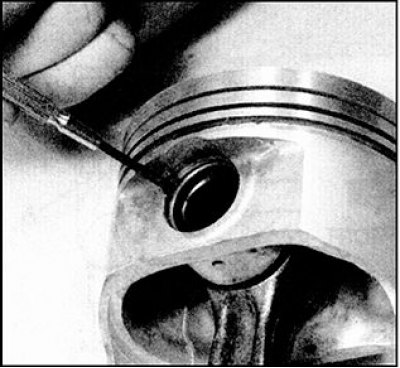
14. If necessary, the piston can be removed from the connecting rod and assembled with the connecting rod as follows: remove the piston pin retaining rings with a flat-blade screwdriver and push out the piston pin, if necessary, support the piston and knock out the pin by hitting it with a hammer on a drill. Do not damage the holes in the piston and connecting rod for the piston pin.
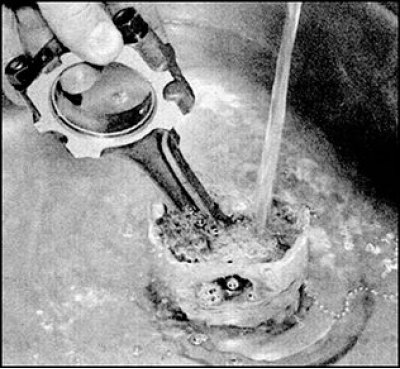
15. Removing the piston pin is made much easier if the piston is preheated to 60–70°C. Dip the piston in hot water, remove and press out the piston pin, being careful to avoid injury.
16. Mark the piston, connecting rod and pin to assemble all parts together later. The retaining rings must be replaced.
17. Check the piston pin and connecting rod bore for signs of wear or damage. If you have the necessary measuring tools, you can determine the piston pin and connecting rod clearance by directly measuring the pin and bore diameters.
18. If the connecting rod head bushing and piston pin are badly worn, or if the pin clearance in the connecting rod head exceeds the norm, then the pin and bushing should be replaced. Replacing connecting rod head bushings should be done in a workshop, since a press will be needed to extract them and to ream out new pressed-in bushings.
19. If the clearance between the piston and the pin significantly exceeds the norm, then the piston and pin should be replaced as a set. Keep in mind that the clearance between the piston and the pin does not play such a significant role as the clearance in the connecting rod head, since the pin is secured with retaining rings.
20. The connecting rods themselves do not require replacement, except in cases of engine seizure or other serious breakdowns. Check the condition of the connecting rods by inspection, if deformation of the connecting rods is detected, take them to a car service workshop for inspection and repair by an experienced specialist.
21. Check the condition of all parts, if necessary, purchase new ones by contacting the dealer's car service.
22. Orient the piston and connecting rod so that the mark on the part of the piston that should be facing the front of the engine (in the form of an arrow or a line) correctly positioned relative to the lubrication hole in the connecting rod body (see Fig. Correct relative orientation of the piston and connecting rod). When the relative orientation is correct, the mark on the piston should face the timing chain, and the lubrication hole in the connecting rod body should face the rear of the cylinder block.
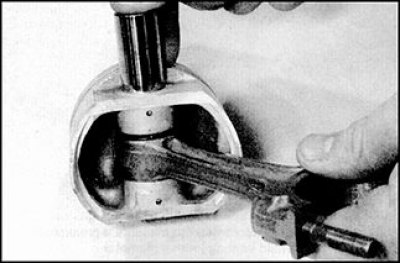
23. Lightly lubricate the piston pin with fresh engine oil, insert the piston pin into the holes in the piston and in the connecting rod head.
Attention! In order to facilitate installation of the piston pin, it is recommended to heat the piston.
24. If necessary, press the pin back into place with light blows of a hammer on the drill, having first secured the piston.
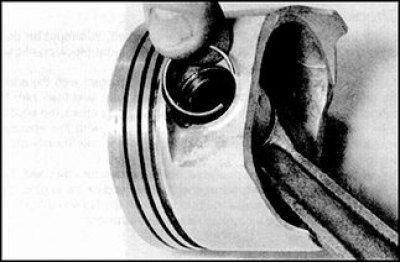
25. Check the free rotation of the pin in the piston bosses, then install the retaining rings. Make sure the retaining rings engage the grooves next to the piston pin holes.