


Table of contents: Disassembly procedure ↓ Assembly order ↓
Cylinder block, crankshaft and connecting rod-piston group
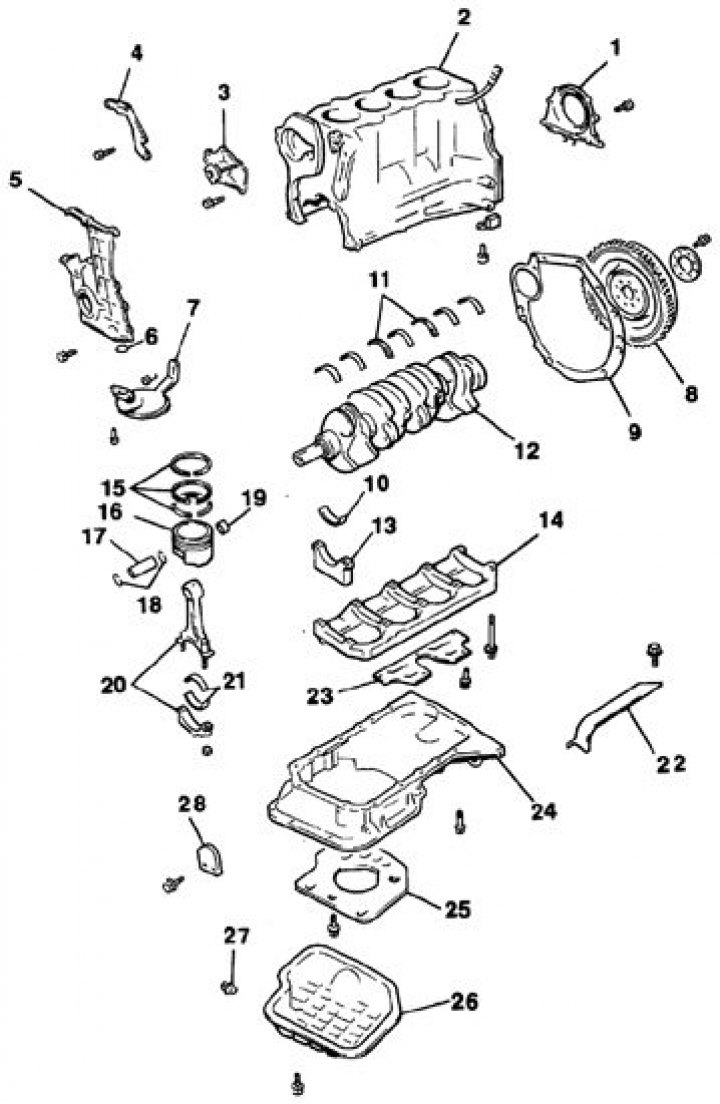
1. Seal holder; 2. Cylinder block; 3. Coolant pump; 4. Generator bracket; 5. Timing chain cover; 6. O-ring gasket; 7. Oil receiver with coarse filter; 8. Flywheel (torque converter drive disk); 9. Mounting plate; 10. Main bearings; 11. Thrust half rings; 12. Crankshaft; 13. Main bearing caps; 14. Main bearing cap frame; 15. Piston rings; 16. Piston; 17. Piston pin; 18. Retaining rings; 19. Connecting rod head bushing; 20. Connecting rod and connecting rod cap; 21. Connecting rod bearings; 22, 23, 25. Oil deflector plate; 24. Aluminum tray; 26. Steel pallet; 27. Drain plug; 28. Mounting plate
Disassembly procedure
The easiest way to disassemble the engine and perform all types of work is on a portable stand specially designed for engine repair. Such stands can often be rented. Before mounting the engine on the stand, it is necessary to remove the flywheel with the clutch mechanism in order to screw the stand bolts into the cylinder block (crankshaft housing).
If there is no stand, then you can disassemble the engine by securing it on a strong workbench or on the floor. When disassembling without using a stand, be very careful when manipulating the engine.
If you are going to buy a ready-made rebuilt engine, you will first need to remove all the attachments in order to install them later in exactly the same order as during an independent overhaul. Such attachments include:
- generator, and brackets for the power steering pump and / or air conditioner compressor (depending on the vehicle configuration);
- distributor, spark plugs and high-voltage wires;
- coolant pump and thermostat and radiator hoses;
- carburetor or fuel injection system parts;
- all sensors and solenoid valves with wiring;
- intake and exhaust manifolds;
- oil filter;
- fuel pump - for carburetor engines;
- engine mount parts;
- flywheel/drive disk of the torque converter.
Attention! When removing attachments from the engine, pay special attention to those small details that can facilitate engine assembly. Mark gaskets, seals, spacers, pins, bolts, washers, nuts, etc., so that they can be installed in their original position during assembly.
If an incomplete cylinder block is to be installed (i.e. a cylinder block with fitted and installed crank mechanism and piston group), then you should also remove the cylinder head, oil pan, oil pump and camshaft drive chains.
If a major overhaul with complete disassembly is planned, the engine must be completely disassembled and the internal parts of the engine must be removed in the following order (unless otherwise specified, see. subsection 3.1.1 and subsection 3.1.2.2.1).
- intake and exhaust manifolds;
- oil pan;
- camshaft drive chains with sprockets;
- cylinder head;
- flywheel;
- connecting rod and piston group;
- crankshaft.
Before disassembling and performing major repair procedures, ensure that you have all the necessary equipment and tools. A list of the necessary tools is provided at the beginning of this manual.
(Original text on the website: NISSANBOOK.ru)
Assembly order
Before you begin assembly, prepare all the necessary new parts, gaskets and seals, as well as the necessary tools and devices. Review the description of the assembly procedures to imagine the scope of the upcoming work and once again make sure that you have everything you need. In addition to traditional tools and materials, you will also need a locking compound for threaded connections. You will also need a liquid sealant to seal detachable connections in which the installation of gaskets is not provided. The manufacturer recommends using Genuine Liquid Gasket (available for sale at Nissan service stations).
To save time and labor, it is recommended to carry out assembly in the following order:
- crankshaft;
- pistons with connecting rods;
- cylinder head and tappets;
- timing chain(s);
- oil pan;
- flywheel;
- mounted units.
Before assembly, all parts must be thoroughly cleaned and dried, all defects eliminated. Parts should be laid out on a completely clean work table (or contain in individual packaging).