


Table of contents: Cleaning ↓ Examination ↓
A thorough cleaning of the cylinder head and valve train components followed by inspection will allow you to assess the scope of work required to repair the valves and valve drive mechanism during a major engine overhaul.
Caution! If the engine has been overheating frequently, the cylinder head may have become warped. Check carefully for signs of head deformation.
Cleaning
1. Remove all remaining gasket material from the separating surfaces of the cylinder head with the cylinder block, intake and exhaust manifolds.
2. Scrape off any carbon deposits from the combustion chambers, clean all openings and passages, then flush the cylinder head with solvent.
3. Scrape off heavy carbon deposits from all areas of the valves, use a power brush to remove carbon deposits from the valve heads and stems.
Examination
Warning! Before deciding whether parts need to be re-ground in the workshop, be sure to complete all of the inspection procedures described below. Make a list of what requires special attention.
Cylinder head
1. Carefully inspect the head for cracks, signs of coolant penetration, and other damage. If cracks are found, replace the cylinder head.
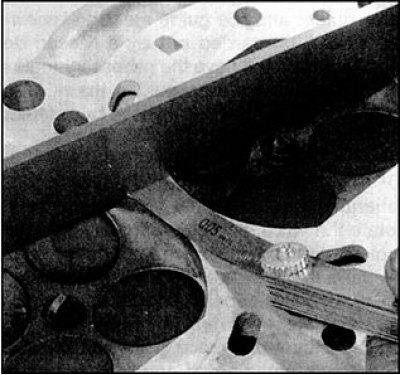
2. Check the deviation of the cylinder head split surface from the plane using a feeler gauge and a calibration block. If a distortion of the split plane is detected, the head must be ground. If the deformation of the split plane is such that the height of the head after grinding becomes less than that specified in subsection 3.2.1.1, then replace the head.
3. Check the condition of the valve seats in each combustion chamber. In the presence of pitting (pits), cracks, traces of burnout, you will need to repair the head in the workshop of a car service station. Minor defects can be removed by lapping the valve to the seat on a fine composition.
4. Check the wear of the guide bushings. To do this, insert the valve into the corresponding guide bushing and rock it from side to side. A small, barely noticeable play is acceptable. If the valve play in the bushing is significant, measure the valve diameter. If the valve diameter has noticeably decreased due to wear, replace the valve. If the valve stem diameter is normal, replace the guide bushing. This work is best done in a car service workshop or entrusted to a qualified mechanic.
5. If the guide bushings are to be changed, the valve seats must be reground (or to over-center) only after pressing in new bushings.
Valves
6. Carefully inspect the head of each valve, check for cracks, wear, and burn marks. Check the valve stems for scoring and a rib formed due to wear. Check the valve for bending by turning it. Check the wear on the ends of the valve stems. Replace the valve if any signs of wear or damage are found.
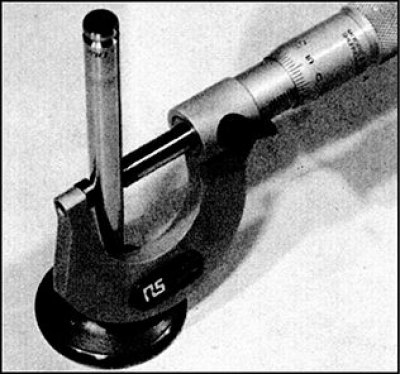
7. If this check reveals that the valve is in good condition, measure the valve diameter in several places. A noticeable difference in diameter indicates wear on the valve stem. If a noticeable difference in diameter is found in at least two places, the valve (or valves) replace.
8. If the valves are in satisfactory condition, they should be ground to the seats to ensure a tight seal that prevents gas leakage. If the seats are only slightly damaged, or the seat has been reground, then lapping can be done with a fine abrasive compound. A coarse lapping compound should only be used if traces of deep wear or severe burnout of the seats are detected. In this case, the cylinder head and valves should be checked by an experienced specialist to determine whether the seats should be re-countersunk or even the seat liners replaced (if provided).
9. The valve grinding is performed as follows: Place the cylinder head on a flat surface so that the combustion chambers are facing upwards.
10. Apply a thin layer of lapping paste to the seat chamfer (corresponding dispersion) and press the suction cup of the valve lapping tool onto the valve head.
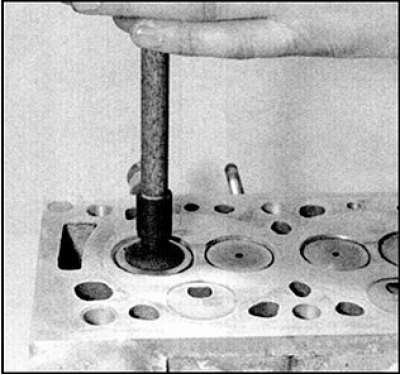
11. Perform lapping by turning the device 180° in both directions. During lapping, sometimes lift the valve to evenly redistribute the abrasive material. Lapping is significantly easier if you place a not very stiff spring under the valve head.
12. Lapping with a coarse abrasive compound should be completed after a monotonous matte belt has formed on the valve and seat chamfers, then wipe the valve and seat from the remaining paste and continue lapping with a fine-grained compound. Lapping is considered complete when a uniform, solid grayish belt has formed on the valve and seat chamfers. Further lapping is not allowed, since excessive wear of the seat may make subsequent repairs impossible.
13. After finishing grinding all valves, remove any remaining abrasive material by thoroughly rinsing all parts with kerosene or solvent.
Valve Mechanism Parts
14. Check the springs for signs of chipping and damage. The manufacturer recommends checking the valve springs by measuring the force that causes the spring to compress to a certain length. This method is only possible with special equipment. Therefore, springs should be checked at the dealer's service center. A rough check of the spring's condition can be made by comparing the free length of the spring with that specified in subsection 3.2.1.1.
15. Place each spring on a flat surface and place a square next to it. Measure the distance between the spring coil and the square at the top and compare with the value given in subsection 3.2.1.1.
16. If at least one of the springs is damaged, has an increased deviation from the vertical, or has lost elasticity, then replace all the springs in the set. In general, during major repairs, it is recommended to change the valve springs regardless of their condition.
17. Valve stem seals are changed regardless of their condition.