


Table of contents: Removal ↓ Installation ↓ Disassembling the cylinder head. ↓ Cleaning and checking the condition…↓ Restoration of working surfaces of…↓ Checking the condition of valve…↓ Cylinder head assembly ↓
Note: The following special equipment is required to perform the following procedures: valve spring compressor, micrometer, and flatness gauge (steel ruler edge).
Removal
Note: The cylinder head can, in principle, be removed as a complete assembly with the intake manifold and exhaust manifold, however, due to the significant weight and size characteristics of such an assembly, the authors of this Manual recommend adhering to the procedure described below.
1. Disconnect the negative cable from the battery.
2. Take care to protect the paintwork around the engine compartment from damage.
3. Drain the cooling system.
4. Remove the rocker arm assembly with pushrods, intake manifold and exhaust manifold.
5. Loosen the hose clamps and disconnect the cooling and heating system hoses that interfere with removing the cylinder head.
6. Loosen the generator adjusting bracket mounting bolt on the cylinder head.
Note: To avoid deformation of the cylinder head, do not loosen its mounting bolts until the engine has completely cooled down.
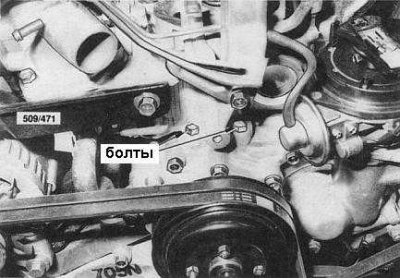
7. Remove the front cylinder head bolts next to the water pump (see accompanying illustration).
8. Gradually loosen the head mounting bolts in the reverse order to that shown in the accompanying illustration. When removing the bolts, be careful not to drop the washer from bolt No.23 into the engine.
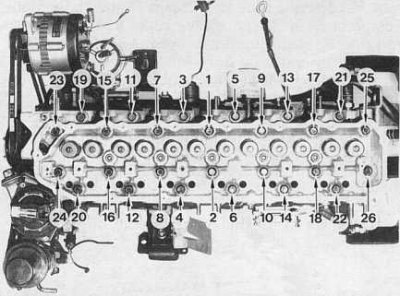
Cylinder head bolt tightening order - the front bolts are not visible and should be tightened after the main bolts are complete.
9. With the help of an assistant, remove the cylinder head from the engine compartment. Try not to accidentally damage the mating surfaces.
Installation
Installation is carried out in reverse order.
1. Make sure that the mating surfaces of the block and cylinder head are absolutely clean - there should be no burrs, scratches or traces of old gasket material left on them.
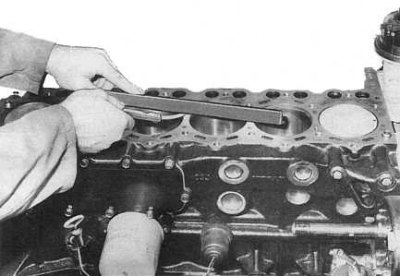
2. Check the cylinder head for deformations by measuring the amount of non-planarity diagonally and along the mating surface (use a flatness gauge (steel ruler edge) and a blade-type feeler gauge - see accompanying illustration). If signs of deformation are detected, the head should be reground to bring its condition into compliance with regulatory requirements (see size and adjustment tables at the end of the Guide), or replace.
3. Similarly, check the flatness of the mating surface of the cylinder block. Perform the necessary repairs (turning) or replace the block.
4. Place the new head gasket on the engine block, making sure that its holes are correctly aligned with the guide pins and working holes in the block.
5. Install the cylinder head on the block, lightly lubricate the threads of the bolts and washers with oil and screw in the fasteners.
Note: Washers must be installed with the chamfers facing the bolt heads.
6. Loosely screw in the front head bolts.
7. Tighten the main mounting bolts in the order shown in the illustration according to the following diagram:
- At the first stage, tighten the bolts (main) with a force of 29 Nm;
- Then tighten them to 78 Nm;
- Loosen the bolts completely in reverse order;
- Retighten them to 29 Nm;
- Tighten the bolts to 64÷74 Nm, or (which is preferable) using a protractor another 69°÷70°.
8. Tighten the front head bolts to 6.4÷7.5 Nm.
9. Install the rocker arm and pushrod assembly, as well as the intake manifold and exhaust manifold.
10. Start the engine and check for leaks.
Disassembling the cylinder head
.Note. Performing a major overhaul of the cylinder head requires the use of special equipment. Purchasing or renting such equipment is usually not cost-effective when repairing only one head. In view of the above, it would be advisable to entrust the performance of a major overhaul of the cylinder head to specialists at the workshop of the dealership of the car manufacturer or a service station. In some branded workshops, you can purchase a replacement reconditioned head on an exchange basis, which allows you to significantly reduce the downtime of the car.
1. Remove the cylinder head from the engine.
2. Remove the thermostat cover from the cylinder head, take out the thermostat and remove any traces of the old gasket material from the mating surfaces.
3. Before removing the valves, remove carbon deposits from the combustion chambers. This will minimize the risk of damage to the valves and their seats.
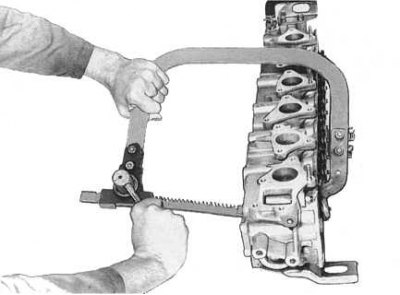
4. Place the cylinder head on its side and use a special tool to compress the springs of the first valve (see accompanying illustration).
5. Remove the split lock crackers from the valve spring plate (valve components are shown in the accompanying illustration).
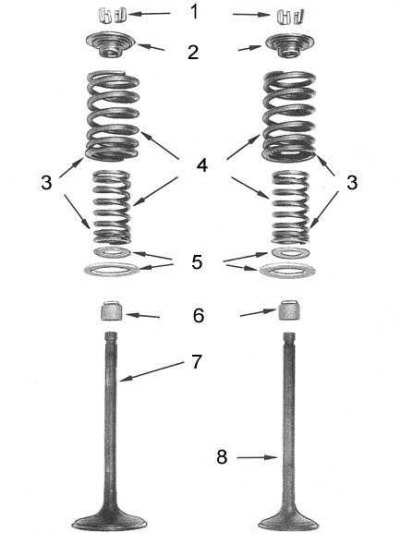
1 - crackers; 2 - valve spring plates; 3 - short pitch turns; 4 - springs; 5 - saddles; 6 - oil deflector caps; 7 - inlet valve; 8 - exhaust valve
6. Release the tool and remove the spring plate, springs and spring seats.
7. Using a file, remove any visible burrs and roughness from the edges of the groove for installing the split lock crackers on the valve stem, then remove the valve from the cylinder head body.
8. Using the described scheme, remove all remaining valves, stacking them in an orderly manner, tying them to their installation locations.
Note: A rack with twelve numbered holes, into which the valves should be inserted with rods in the order in which they are installed in the head, is ideal for orderly storage of the valves.
9. Carefully pry the valve stem oil seals off. Discard them.
Cleaning and checking the condition of the head and its components
1. Clean the valves thoroughly and discard any defective ones (with burnouts, cracks and deformation of rods).
2. Carefully remove any accumulated deposits from the head intake and exhaust ports, valve stems and valve guides. Be careful not to damage the mating surfaces.
3. Clean the mating surface of the head, water jacket channels, support and thermostat mounting seat.
4. Wash the cylinder head in kerosene, rinse with water from a hose, then dry thoroughly to prevent corrosion.
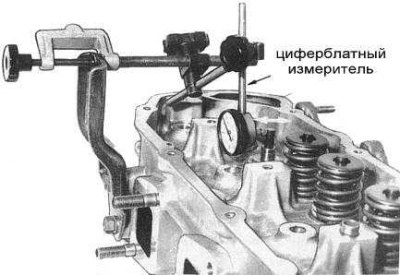
5. Insert each valve into its guide bushing. Raise the valve so that the end of its stem protrudes by 30 mm. Fix the dial gauge so that its plunger rests against the forming surface of the valve stem tail (see accompanying illustration).
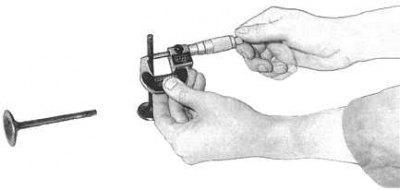
6. Rock the valve back and forth parallel to the plane of the rocker arm. If the gauge registers a stroke greater than 0.2 mm, measure the inner diameter of the guide bushing and the outer diameter of the valve stem using a micrometer (see accompanying illustration). Compare the measurement results with the regulatory requirements (see size and adjustment tables at the end of the Manual), replace worn components if necessary. Repeat the procedures for all valves.
Note. Since the head must be heated to a temperature of 150°÷160°C to remove and install the guide bushings, and the bushings themselves must be properly turned after installation, it is advisable to entrust this work to a specialist.
7. Replace all spherical plugs (water jacket squeeze plugs) cylinder heads whose serviceability is questionable.
8. Check the flatness of the mating surfaces of the cylinder head and block (see subsection Removal and installation). If necessary, resurface or replace components that cannot be repaired.
9. Check the proper functioning of the thermostat.
Restoration of working surfaces of valve plates and seats
Note: This work should be performed by a qualified mechanic with the proper tools. The authors of this guide recommend that this work be performed by a professional car service workshop.
1. Turn the plate of each valve at the angle specified by the standards (see size and adjustment tables at the end of the Manual). If necessary, grind the valve stem to a plane, but do not remove more than 0.2 mm of material. If the width of the cylindrical part of the forming surface of the plate (belt) is beyond the lower permissible limit, the valve must be replaced.

1 - seat chamfer; 2 - valve plate belt; 3 - rod; 4 - groove for the crackers of the split lock
2. Check the straightness of the valve stem. If excessive bending is detected, also replace the valve.
3. When turning valve seats, be sure to equip the cutter with a special guide. The result of the processing should be a smooth, continuous working chamfer.
4. Excessively worn saddles must be replaced.
5. After finishing the processing of the seats, the width of their working chamfers must comply with the regulatory requirements, which are different for inlet and outlet valves (see size and adjustment tables at the end of the Guide).
6. To check the development of the contact patch, lubricate the working surface of the valve plate with Prussian blue, then install the valve in the head and rotate it, pressing it against the seat. After the valve plate is torn off, a uniform, continuous ring should form on the working chamfer of the seat, coaxial with the seat axis. Check the quality of processing of all valves/seats in a similar manner.
Checking the condition of valve springs
1. Measure the free length of the valve springs. Compare the measurement results with the standard requirements (see size and adjustment tables at the end of the Guide).
2. Check the springs for signs of deformation.
3. If you do not have a special diagnostic tool at hand, compare the length of the loaded spring with that of the new spring. To do this, press the springs end-on against each other, placing a flat plate or washer between them, then squeeze the assembly in a vice. After bringing the vice jaws together by approximately 13 mm, the length of the serviceable spring should not differ from the length of the new one by more than 5%. Replace the spring if necessary.
Cylinder head assembly
Assembly is carried out in the reverse order of disassembly.
1. Before starting assembly, make sure that the ports and valve seats are absolutely clean - there should be no traces of foreign materials on their surfaces. Lightly lubricate the valve guides with oil and install the spring seats.
2. Using a suitable piece of tubing, seat the valve stem oil caps onto the guide bushings. The seating depth must be maintained with maximum precision (see accompanying illustration).
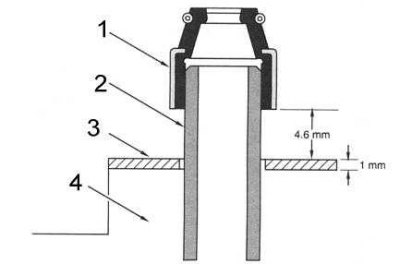
1 - oil deflector cap; 2 - guide bushing; 3 - spring seat; 4 - cylinder head
3. Lubricate the valve stems and insert them into the corresponding guide bushings.
4. Place the springs and their plate on the valve stem, making sure that the springs are facing the shortened pitch coils towards the head. Compress the assembly using a special tool.
5. Install the split lock crackers into the groove on the rod and release the tool. Lightly tap the end of the rod with a hammer to seat the crackers in the groove.
6. Repeat the procedure for the remaining valves. Install the head on the cylinder block.