


Note: To perform the work described below, you will need the following special tools: micrometer (for measuring the diameters of the camshaft journals), plunger type dial gauge (to check shaft runout).
Removal
Note: The camshaft can be removed from the engine installed in the vehicle. However, the grille, radiator, and air conditioner condenser must first be removed (if included in the package) and a cattle guard, which is why the authors of this Guide recommend that if you have access to lifting equipment, you should still remove the engine.
1. Remove the engine from the vehicle.
2. Remove the cylinder head with the gasket.
3. Remove the tappets from the cylinder block, stacking them in the order they were installed on the block.
4. Place the dial gauge with the plunger against the surface of the camshaft sprocket (see accompanying illustration), then, moving the shaft with the lever in the longitudinal direction, measure the value of its axial clearance. If the clearance exceeds 0.05 mm, replace the shaft thrust plate.
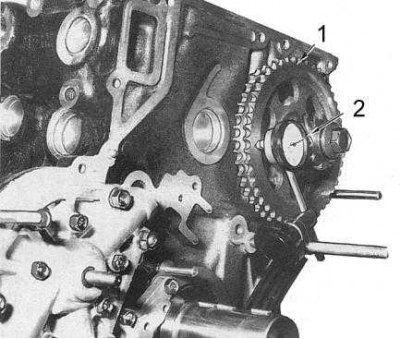
1 - camshaft sprocket
2 - dial gauge
5. Remove the chains and sprockets.
6. Remove the camshaft thrust plate mounting bolts. Have a piece of strong wire ready that can be inserted into the cylinder block to lift the camshaft while it is being removed.
7. Temporarily install the camshaft sprocket in place to facilitate its removal.
8. Carefully remove the camshaft, using the prepared wire to support the rear end of the shaft in a raised position to prevent damage to the soft bearing material.
Checking the status
Note: An explanatory illustration may help to understand the procedures described below.
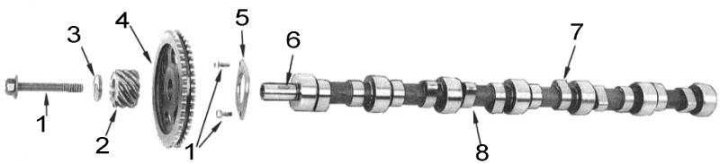
1 - bolts; 2 - distributor drive gear; 3 - washer; 4 - star; 5 - thrust plate; 6 - key; 7 - working projection of the cam; 8 - camshaft
1. Wash the camshaft and tappets in a suitable solvent, then dry them by blowing them with compressed air.
2. Inspect the cam lobes and bearing journals for signs of wear such as pitting and wear of the surface hardening layer. Using a micrometer, measure the height of each cam and the diameters of the bearing journals on the shaft. Record the results and compare them with the standard requirements (see size and adjustment tables at the end of the Manual). Replace the camshaft if necessary.
Note: If cavities or other signs of excessive wear are found on the camshaft cams, the working surfaces of the tappets must also be carefully inspected. When replacing the shaft, it is correct to replace the tappets as well.
3. Support the camshaft on two V-blocks and measure its runout using a dial gauge. Replace the shaft if necessary.
4. Check the camshaft bearings for scratches, scoring, and material peeling. If you suspect that the bearings are worn, measure their diameters with a micrometer. The authors of this Guide recommend that bearing replacement be performed at a car service workshop specializing in engine restoration, which has all the necessary equipment to perform this task.
5. Measure the outside diameters of all tappets and compare the measurement results with the standard requirements (see size and adjustment tables at the end of the Manual). Replace the pushers if necessary.
Installation
Installation is carried out in the reverse order of removal.
1. Install the camshaft into the cylinder block as you did when removing it, using a temporarily attached sprocket and a piece of strong wire to make the procedure easier. Make sure all bearing surfaces are lubricated with clean engine oil.
2. Install the pushers into their original sockets (if you haven't made a replacement).
3. Install the camshaft thrust plate (a new one if the axial play of the shaft exceeded the permissible value). Tighten the plate mounting bolts with a force of 7÷8 Nm.
4. Install other components removed during disassembly.