


Attention! The camshaft drive mechanism in early engines is distinguished by the presence of a horizontal guide bar and an upper chain damper, which are absent in later engines.
Removal
1. Set the piston of the 1st cylinder to TDC of the compression stroke.
2. Remove the cylinder head cover.
3. Remove the front cover (see subsection 3.1.1.6).
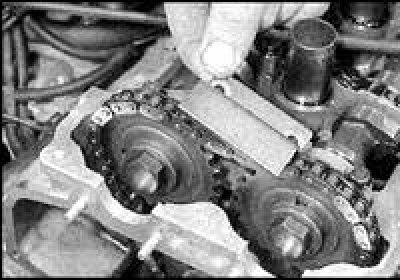
4. On early production vehicles, remove the bolts and remove the upper chain guide bar.
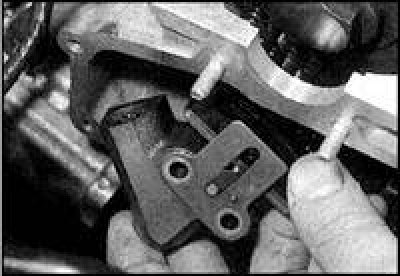
5. Hook the tensioner shoe and move it away from the upper chain, fix the shoe in this position. Unscrew the two bolts and remove the tensioner shoe.
6. On later engines, move the tensioner shoe away from the upper chain and secure it with a rod. Remove the two bolts and remove the shoe.
(See the source on the portal: nissanbook)
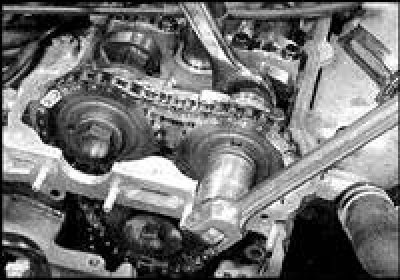
7. Holding the camshaft with a wrench by the flats at the front, unscrew the bolts securing the camshaft sprockets.
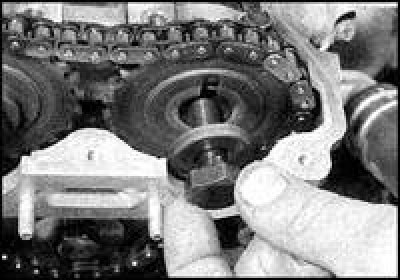
8. Remove the bolts and washers.
9. Disengage both camshaft sprockets from the chain and manipulate the sprockets to remove them.
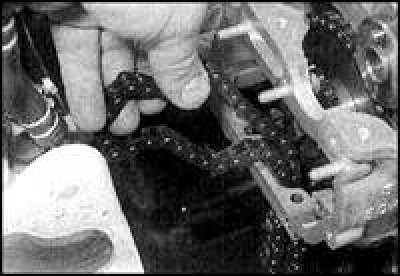
10. Disengage the top chain from the intermediate sprocket and manipulate it out of the cylinder head.
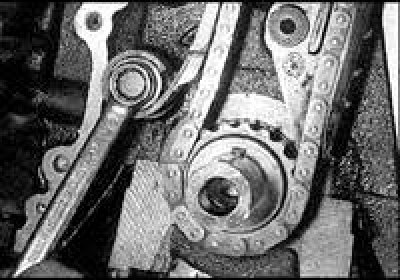
11. Loosen the lower chain tensioner axle bolt and remove the shoe.
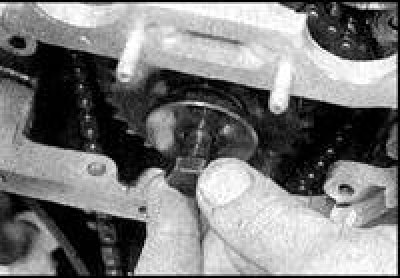
12. Unscrew the intermediate sprocket bolt, remove the bolt together with the washer, take out the sprocket and shaft.
13. Remove the lower chain from the crankshaft drive sprocket and remove it from the engine.
14. Remove the drive sprocket and key from the crankshaft nose (if weakened), store the key together with the sprocket.
Caution! When removing the camshaft drive chains, do not rotate the crankshaft.
Examination
1. Check the drive, driven and intermediate sprockets for signs of wear and defects such as chips, hooks or missing teeth. If any of these signs of wear or damage are found, all sprockets and both chains should be replaced. Chains and sprockets are replaced as a set.
2. Inspect the chain links, check the wear of the rollers. The degree of chain wear can be determined by the deflection in the horizontal plane. In a new chain, there is almost no deflection. If there is noticeable lateral play in the chain links, then both chains should be replaced.
3. Please note that the chain should also be replaced regardless of whether there are any external signs of wear after a significant mileage, or if noticeable noise is heard from the chains when the engine is running. It is strongly recommended that the chain be replaced together with the sprockets. Otherwise, if a new chain is installed on worn sprockets, the wear of the new chain will increase. If the condition of the chains and sprockets is in doubt, contact a qualified Nissan service center for advice.
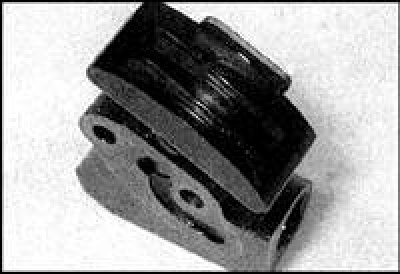
4. Check for signs of wear or damage on the chain tensioners and dampers. If defects are found, replace these parts (in the photo - a chain tensioner with signs of wear).
5. Check the upper chain tensioner shoe shoe, make sure the tensioner plunger moves freely inside the shoe. Check the condition of the tensioner spring, comparing it with a new one. If damage or wear of the shoe shoe is found, or if the condition of the spring is questionable, the tensioner should be replaced.
Installation
Top chain, distinctive links and alignment marks
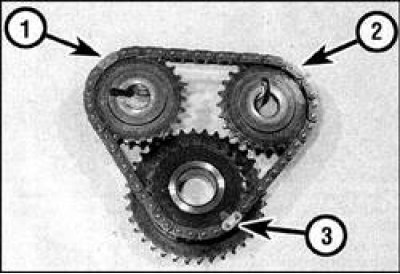
1. Mark on the intake camshaft sprocket and the corresponding chain link
2. Mark on the exhaust camshaft sprocket and the corresponding chain link
3. Mark on the intermediate sprocket and the corresponding chain link
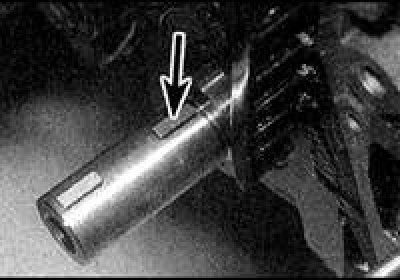
1. Make sure that the piston of the 1st cylinder is at TDC of the compression stroke (the keyway on the crankshaft nose should be facing vertically upwards when viewed from the right side of the engine). Insert the key into the groove on the nose of the crankshaft (by the arrow).
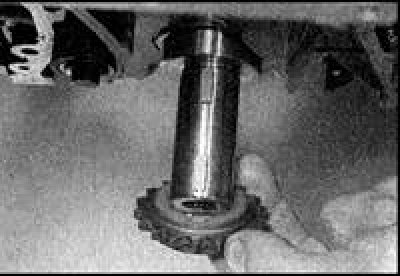
2. Orient the drive sprocket so that the timing mark is facing away from the crankshaft, align the groove in the sprocket with the key and place the sprocket on the nose of the crankshaft.
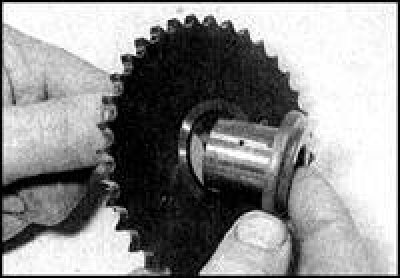
3. Lightly lubricate the intermediate sprocket shaft with fresh engine oil and place the sprocket on the shaft with the shaft flange facing the cylinder block. Engage the intermediate sprocket with the lower chain, aligning the outer timing mark with one of the silver-colored chain links.
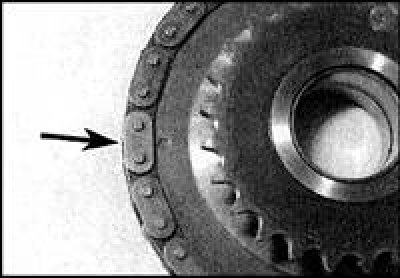
4. Install the chain together with the intermediate sprocket in place so that the second link with the distinctive coloring coincides with the installation mark on the crankshaft drive sprocket. The installation mark looks like a small groove on the hub of the drive sprocket (indicated by the arrow).
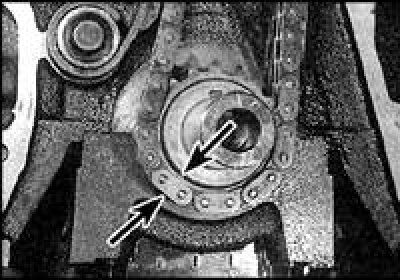
5. Make sure the labels (indicated by arrows) on the intermediate and leading sprockets are combined with silver-colored chain links.
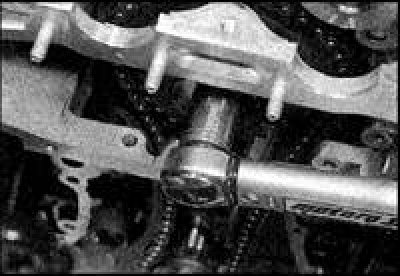
6. Install the intermediate sprocket bolt and washer and tighten to the specified torque.
7. The top drive chain has three differently colored links, each of which corresponds to a timing mark on each of the sprockets the chain spans. The differently colored links are spaced at different intervals. On early engines, all three links are silver colored. The first colored link (which should match the mark on the intake camshaft sprocket) is separated from the second painted link (which coincides with the mark on the exhaust camshaft sprocket) on 16 rollers, and the third painted link is 22 rollers away from the first (see Fig. Top chain, distinctive links and alignment marks).
8. On late production engines, the intervals between the painted links of the upper chain are the same, and the link corresponding to the timing mark of the intermediate sprocket is gold in color (the remaining links are silver in color and must align with the marks on the driven camshaft sprockets).
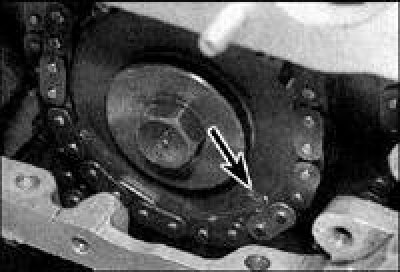
9. Taking into account point 7, install the upper chain in place so that the painted links are facing outward. Put the chain on the intermediate sprocket, aligning the corresponding link with the mark (indicated by the arrow) on the star.
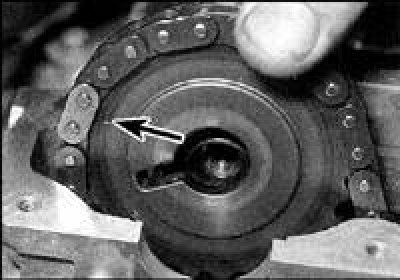
10. Install the camshaft sprockets with the timing marks facing outward (both driven sprockets are the same). Put the chain on so that the silver links are aligned with the timing marks. Make sure that all the different colored links of the top chain are precisely centered with the corresponding marks on the sprockets (arrow).
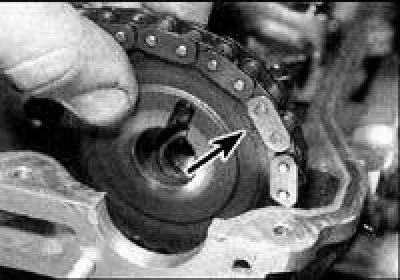
11. Orient the sprockets on the camshafts by aligning the grooves with the mounting pins. Once again, make sure that all painted links of the upper chain are aligned with the corresponding marks on the sprockets (arrow). If the alignment is broken, then disengage the sprockets from the chain and achieve alignment.
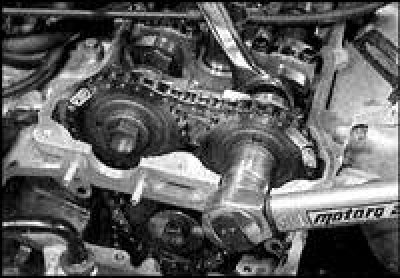
12. Tighten the sprocket bolts to the specified torque.
13. Install the lower chain tensioner shoe and tighten the shoe axle bolt to the specified torque.
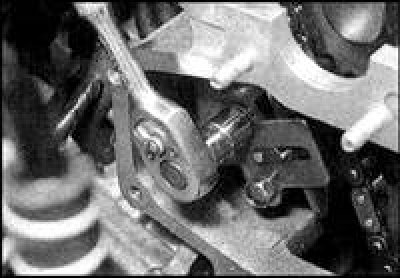
14. On early engines, install the upper chain limiter bar on the cylinder head and tighten the bar bolts to the specified torque. Install the upper chain tensioner on the cylinder head, having previously pressed it down and fixed it in this position with a hook. Tighten the tensioner bolts to the specified torque, then remove the hook. Make sure that the shoe of the tensioner rests firmly against the chain.
15. On late-model engines, push the tensioner shoe aside and hold it in place with a rod. Install the tensioner on the cylinder head and tighten the mounting bolts to the specified torque. Remove the rod and make sure the tensioner shoe shoe is firmly pressed against the chain.
16. Install the cylinder head cover.
17. Install the camshaft chain cover.