


Table of contents: Measuring the axial clearance of the…↓ Removal the crankshaft ↓ Crankshaft seals ↓ Checking crankshaft parts ↓ Measuring the clearance of main and…↓ Installing the crankshaft ↓
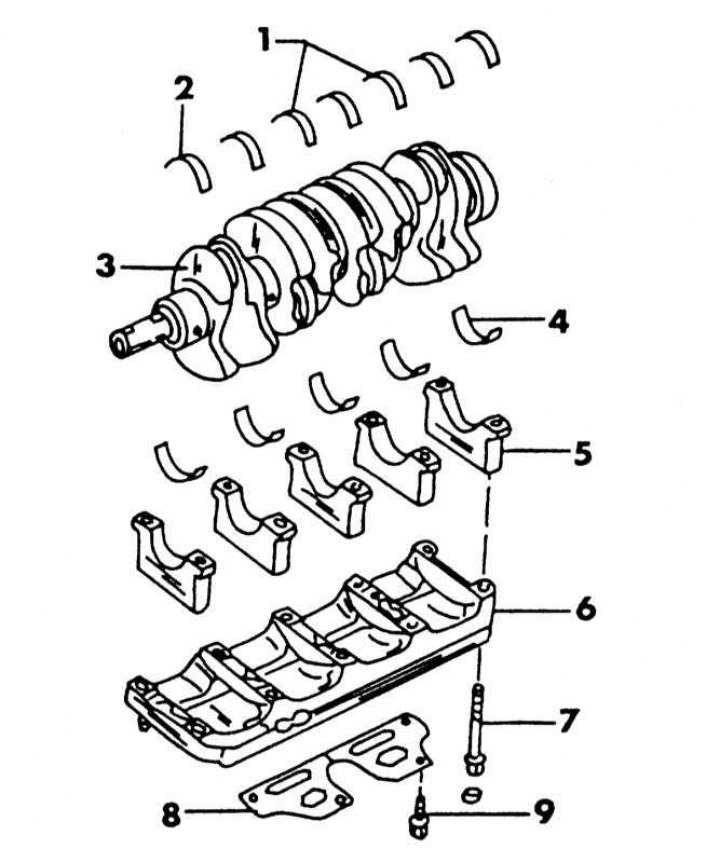
Crankshaft bearings for injection engines
1 - adjusting half rings; 2 - upper main bearing shells; 3 - crankshaft; 4 - lower main bearing shells; 5 - main bearing caps; 6 - main bearing cap frame; 7 - cover bolts; 8 - oil-conducting plate; 9 - bolt, 6.5-7.5 Nm
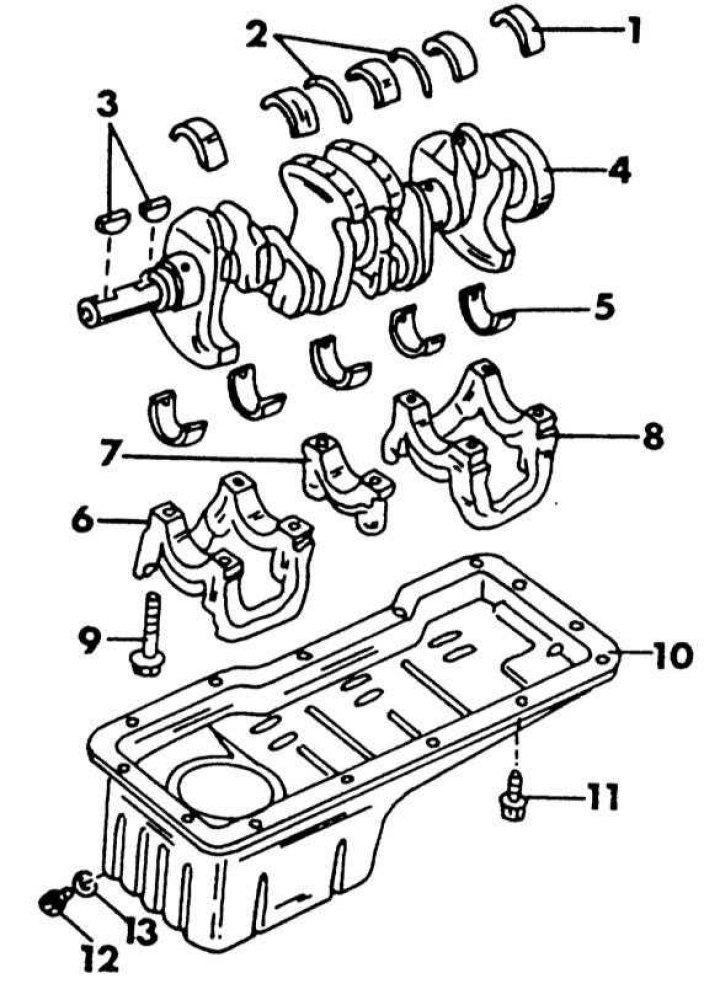
Carburetor engine crankshaft bearings
1 - upper main bearing shells; 2 - adjusting half rings; 3 - segment keys; 4 - crankshaft; 5 - lower main bearing shells; 6 - Front main bearing cap; 7 - middle main bearing cap; 8 - rear main bearing cover; 9 - cover bolt, 47-53 Nm; 10 - oil pan; 11 - bolt, 6.5-8.5 Nm; 12 - oil drain plug, 30-40 Nm; 13 - gasket
The crankshaft bearings of injection and carburetor engines are different. The carburetor engine has a crankshaft with five bearings. Double bearing caps are used at both ends. The injection engine uses five main bearing caps, but a frame of caps is installed on the caps to maintain their position. The illustrations above show both versions of the crankshaft bearings.
Measuring the axial clearance of the crankshaft
Before removing the crankshaft from the installed engine, measure the axial clearance to determine whether the adjusting half rings on the middle support need to be replaced during assembly. Proceed as follows:
1. Set the dial indicator in front of the flywheel end as shown in the illustration and check whether the axial play is less than 0.3 mm. This is the maximum allowable play. The dial indicator should be set to "0" first.
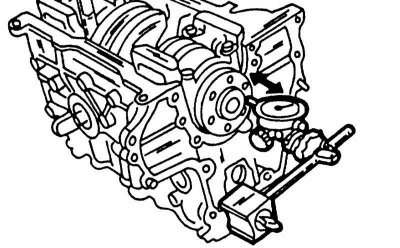
Measuring the crankshaft axial play. The measurements are carried out in the same way on both engines
2. Using a lever, press against the crank arm (better with a wooden handle of the tool) press the shaft to the side as shown by the arrow in the illustration.
Removal the crankshaft
To remove the crankshaft, the engine must be removed. In Section Disassembling the engine most of the preparatory work is described, which is described in detail in the following chapters:
1. Remove the cylinder head (Section Cylinder head and timing drive).
2. Remove the oil pan (Chapter Cooling and heating systems).
3. Remove the camshaft drive (Section Cylinder head and timing drive).
4. Remove the flywheel, engine intermediate plate and oil seal flange from the back side.
5. Remove the pistons and connecting rods.
6. On an injection engine, guided by illustration, loosen the main bearing cap bolts from the edge to the middle (first loosen both bolts on the flywheel side) and remove the bed of the main bearing caps caps and the inserted liners. Mark each cap and insert (colored stripe), so that they can be installed in their original position. Raise the crankshaft and remove the upper halves of the main bearing shells from the cylinder block. Stack the shells with the other shells and the corresponding covers. Mark both adjusting half rings and remove from the middle support.
7. On a carburetor engine, following illustration loosen the three bearing caps in the sequence shown in the illustration below in several passes and remove the caps in order. Remove the crankshaft as described for the injection engine.
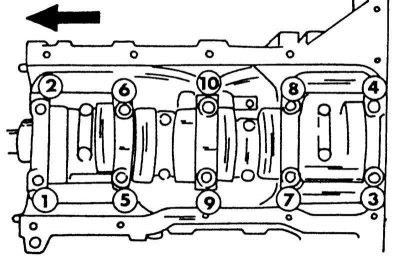
Sequence of loosening the crankshaft main bearing cap bolts on a carburetor engine.
Crankshaft seals
The front seal is located in the camshaft drive cover, the rear seal is located in a flange bolted to the cylinder block. Both seals can be replaced on an installed engine. Depending on the version, the front cover may either remain installed or must be removed.
Replacing the front crankshaft oil seal
1. On the injection engine, unscrew the lower panel, the cover in the right wheel arch and the side engine cover and remove the crankshaft belt pulley. Carefully press out the oil seal with a screwdriver.
2. On a carbureted engine, remove the drive belts and all components mounted on the end face of the engine as described in Section Cylinder head and timing drive, so that you can unscrew the camshaft drive cover. Remove the oil seal from the front side using a screwdriver. Do not damage the cover.
To hold the crankshaft belt pulley, engage the gear.
3. Hammer the new seal with a suitable rod (in both cases outside). Lubricate the working edge with a small amount of grease. Depending on the engine, install either the cover or the removed parts. Depending on the installed units, adjust the drive belts after assembly.
Replacing the rear crankshaft oil seal
1. Remove the gearbox, flywheel and clutch (or in the version with automatic transmission drive disk).
2. Loosen the sealing flange bolts and remove the cover. Carefully clean the sealing surfaces from sealant residues using a scraper. With a little skill, the seal can be removed from the installed cover.
3. Knock out the seal from the inside outwards without damaging the housing. Use a reliable sharp mandrel to do this.
Installation is carried out as follows:
4. Carefully tap the new seal with a hammer until it is centered. Be careful not to damage the seal lip. The outer surface of the seal should be flush with the housing.
5. Coat the seal housing with sealant and reinstall the cover.
6. Perform all other work in the reverse order of removal.
Checking crankshaft parts
1. Carefully inspect the crankshaft for damage and accurately measure the main and connecting rod bearings. The main and connecting rod bearing journals can be ground to allow the shaft to be installed with oversize bearing shells.
2. Clamp the crankshaft between lathe centers or place the outer journals in prisms (see illustration below) and check the runout on the middle journal using a dial indicator. The runout should not exceed 0.04 mm. It should be remembered that the runout reflected on the indicator during one crankshaft revolution should be divided by 2 to obtain the actual bend. If the runout is greater, the shaft should be replaced.

Carefully use a screwdriver to remove the oil seal from the camshaft drive cover.
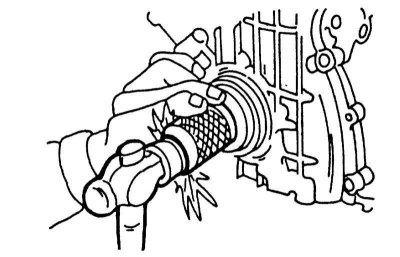
When driving the front seal, the rod must be installed on the entire outer surface.
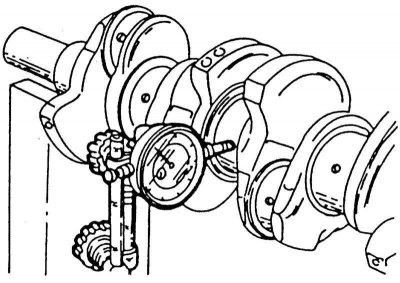
Checking the crankshaft runout. Install a dial indicator on the middle journal of the main bearing and slowly rotate the crankshaft installed in the prisms.
Measuring the clearance of main and connecting rod bearings
Typically, bearing clearance is measured using a polymer hair "Plastigage", however, on these engines, accurate measurement of the bearing journal diameter and the bearing shell bore diameter is recommended. When determining bearing clearance, proceed as follows, provided that both an outside and inside micrometer are available:
1. Clean the bearing shells thoroughly and insert into the bearing holes of the cylinder block (in accordance with bearing designations). Insert the lower shells into the main bearing caps and install the caps on the crankcase. On an injection engine, screw on the frame of the caps.
2. Tighten all main bearing cap bolts, starting from the inside out, to the appropriate torque Specifications tightening torque (see illustration for carburetor, illustration for injection).
3. Using an internal indicator, measure the inside diameter of the individual bearings as shown in the illustration. First set the feeler gauges as shown in the illustration, then at right angles to this. Record the values obtained for each bearing and each direction of measurement. The difference between measurements "A" and "B" gives the ovality of the holes.
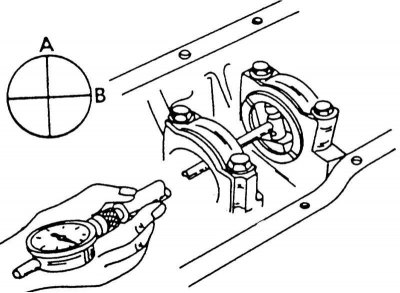
Measuring the inner diameter of bearing shells with covers installed. Measure in directions "A" and "B". Also on both outer edges of the bearing.
4. Using the illustration below as a guide, measure the diameter of each bearing journal. Measure in directions "A" and "B" and at locations "1" and "2". The difference between measurements "A" and "B" reflects the ovality of the journal; the difference between measurements "1" and "2" reflects the narrowing of the cervix. Record the measurements for each cervix and each measurement location.
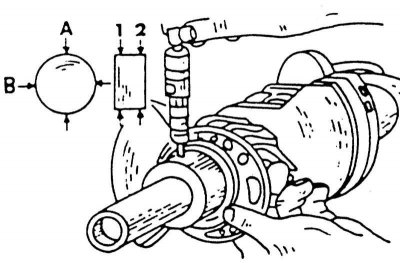
Measuring the crankshaft bearing journals. Measure the diameter at locations "1" and "2", as well as in directions "A" and "B".
5. Calculate the difference between the "A-B" and "1-2" values. If the out-of-roundness or narrowing is outside the permissible limits, the journals must be ground. If the values are as required, subtract the main bearing journal outside diameter from the inside diameter of the same bearing. The result will give the clearance value specified in Specifications.
6. Calculate all clearances as described above. If any bearing clearances have reached the limit value, the crankshaft should be ground to install oversize bearing shells.
7. Make the same measurements on the connecting rod bearing journals and bearings. Tighten the connecting rod bearing nuts to the appropriate Specifications tightening torque (to do this, clamp the connecting rod in a vice and measure the bearing journals), as well as the inner diameter of the liners according to the two illustrations below.
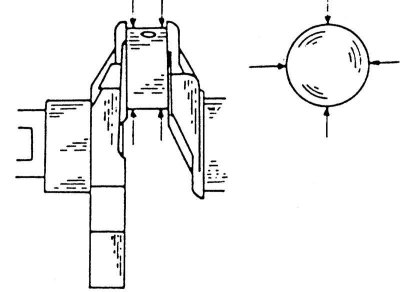
Measuring the journals of connecting rod bearings. Measure at the locations indicated by arrows.
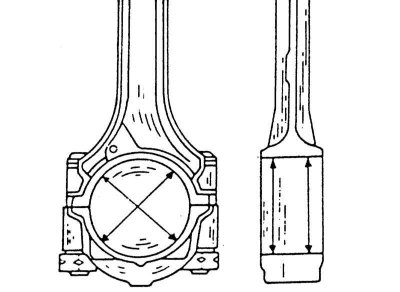
Measuring the inner diameter of the connecting rod bearings. Take measurements at the locations indicated by arrows.
8. Calculate the bearing clearances as described above and, based on the results, determine the condition of the journals. If the journal clearance has exceeded the limit value, the crankshaft should be ground. The correct selection of bearing shells is quite a difficult job and it is recommended that you use the following instructions when contacting your parts supplier to correctly select the main and connecting rod bearing shells.
9. In the cylinder block, at the place indicated in the illustration, numbers are stamped that indicate the class of the crankshaft bearings. The same numbers are stamped on the crankshaft counterweight. If you look at the crankshaft from the front, the size class of the first bearing is given on the left, if we are talking about an injection engine. The numbers from 0 to 4 are used.
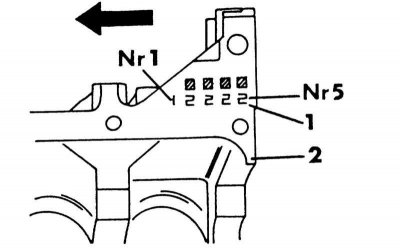
The cylinder block has the designations of the main bearing journal sizes in the indicated location
1 - class number
2 — cylinder block
10. In a carburetor engine, it is the other way around, i.e. looking from the front, the number stamped on the left refers to bearing #5. This engine only uses numbers from 0 to 2. To correctly order the liners, which have color markings, you should copy the numbers in the cylinder block and the numbers on the crankshaft and provide them to your supplier. Thanks to this, the seller can select the parts you need. If the shaft has been ground, you automatically receive the required liners.
11. A similar division by size occurs for connecting rod bearing liners, which are identified on the basis of four digits.
Installing the crankshaft
Based on various installation diagrams:
1. Install the engine so that the crankcase side of the crankshaft is on top. Insert the upper halves of the crankshaft bearing shells into the holes. The shells with oil holes are installed in the block. Install both adjusting half rings to the left and right of bearing No.3. If new bearing shells are installed, they must be installed in the corresponding holes according to the color designation. The guide projections of the shells must enter the corresponding holes. Lubricate the bearing surfaces well.
2. Carefully lower the crankshaft into the supports.
3. Lubricate and install the bearing shells onto the journals thoroughly, following the instructions above.
4. Install the bearing caps.
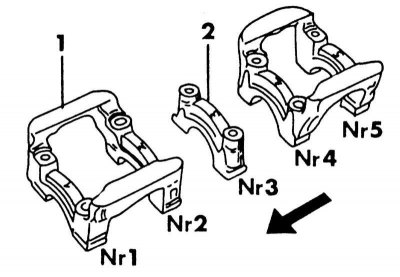
Carburetor engine crankshaft bearing caps. The lower numbers indicate where the caps are installed. The large arrow faces forward
1 - bearing cover
2 - knocked out arrow
Please note the following:
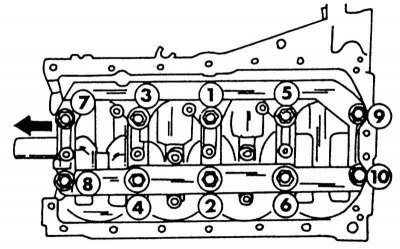
Tightening sequence of main bearing caps of injection engine. Arrow points forward.
- For a carburetor engine, follow the illustration and install the caps accordingly. All caps have an arrow that should face forward after installation. Insert the cap bolts and, as shown in illustrations, tighten to 47 - 53 N·m in two or three passes. Move the crankshaft from side to side several times before tightening the bolts to seat the shaft in the bearings.
- On an injection engine, install the bearing caps as marked and place the bearing cap frame on top. Tighten the bolts in the sequence shown in the illustration in two or three passes to 33 - 39 N·m. Then tighten them in the same sequence to a final torque of 75 - 85 N·m.
5. Check the axial play using a dial indicator as described in subsection Measuring the axial clearance of the crankshaft. If the axial clearance does not correspond to the required value, it means that the measurements were not taken accurately enough during repair.
6. Screw the gland housing on from the back side. Cover the sealing surface with sealant.
7. Install the pistons (Section Pistons and connecting rods).
8. Screw the rear engine intermediate plate.
(The material is based on data from the portal: NISSANBOOK.ru)
9. Install the flywheel or torque converter drive plate and tighten the bolts to the appropriate torque Specifications force. The flywheel or disc must be held from turning, which is best done by inserting a wooden block between the crankshaft and the flywheel. Use only bolts with good threads, lightly lubricate the threads with oil.
10. Further assembly is carried out in the sequence already described, i.e. the cylinder head, timing drive, oil pan, etc. are installed according to the instructions in individual sections. Installation of the oil pan is discussed in Chapter Engine assembly.