


Table of contents: Injector engine ↓ Carburetor engine ↓
1. If the valves, cylinder head, lever guides and/or valve seats have been replaced, the thickness of the new compensation washers under the lever should be determined. This work requires a special tool to measure the height of the installed valve. If there is any doubt about the correct choice of washers, it is recommended to take the cylinder head to a Nissan workshop, where they can select the necessary washers.
2. Thoroughly clean the valves, valve seat chamfers, bores and sealing surfaces. Clean the inside of the valve guides by pulling a rag soaked in gasoline through them. This is especially necessary if the valves have been lapped, so that the remains of the grinding paste cannot get into the holes. When assembling, proceed as follows.
Injector engine
1. Install the valve stem seals on the valves. The end of the valve with the cracker grooves should be wrapped in foil (from a pack of cigarettes). The oil-deflecting caps are put on using a piece of pipe, after the valve spring cup has been installed. The caps must not be damaged.
2. Insert the valves into the appropriate holes. The valves on the original engines were not marked. New valves may have the marking "53J" in the middle (intake valves) or "5J" (sR20DE engine exhaust valves) or "64Y" (sE20Di engine exhaust valves). Valves marked in this way can be installed instead of old ones.
3. Install the valve springs with the closed coils facing the cylinder head. In addition, the lower part of the valve springs has a color designation. This side faces the cylinder head.
4. Place the upper spring cup on and compress the spring with a spring compressor or press so that the valve cotters can be inserted into the grooves illustrations shows how to install the valve spring compressor.
5. Release the compressor and hit the valve spring with a hammer to ensure that the crackers are firmly seated.
6. If the cylinder head studs were replaced, they must be securely screwed into the head; to do this, lock the two nuts together and place a wrench on the top nut.
7. Install the valve levers, compensation washers, lever guides and hydraulic compensators according to illustrations. Now the compensating elements should be checked. If the lever can be pressed down 1 mm when the lever on the opposite side is pressed down, there is air in the corresponding element. The air must be removed because it will not come out on its own.
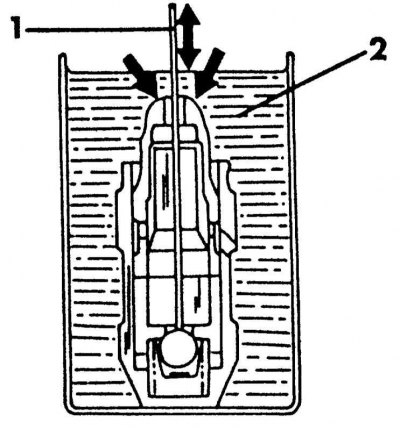
Checking the hydraulic compensating element. Press the piston in the direction of the two arrows downwards, while the metal rod in the direction of the arrow will press on the ball
1 - metal rod
2 - motor oil
8. Although the work is somewhat difficult, the air must be removed from the element, otherwise it will knock when the engine is running. To remove the air, remove the element again, insert it into a container filled with engine oil, so that the lower side rests on the bottom. Press the piston with your finger and insert a small rod into the valve hole. Move the rod up and down. In this case, the rod presses on the check valve and displaces the air. The air is removed when the piston no longer moves. The illustration above shows the elements of this work. The rest of the assembly of the cylinder head is identical to its installation and has already been described.
The source of the article is on the website: Nissanbook.ru
Carburetor engine
To assemble the cylinder head of a carburetor engine, it is only necessary to install the valves and the removed parts. It should be remembered that it is necessary to adjust the valve clearance, as described in the subsection Valve guides. The valves are installed in accordance with the instructions above. Further assembly of the cylinder head is adequate for its installation and is described in Section Checking and adjusting valve clearances Chapters Routine care and maintenance.