


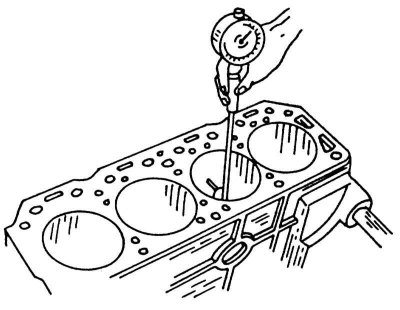
Measuring a cylinder with an internal micrometer.
If there is no indicator, the following work cannot be performed. Measurements of the cylinders should be made in the longitudinal and transverse directions (illustration below). It is also necessary to take into account the differences between an injection and a carburetor engine.
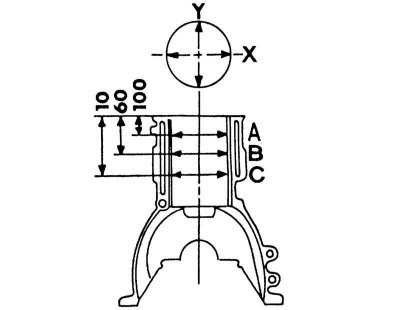
Cylinder block measurement diagram. Measure at levels A, B and C and in the directions "XX" and "YY".
1. On an injection engine, the measurement should be taken as shown in the illustration above, i.e. 10 mm, 60 mm and 100 mm from the top edge. Take measurements in the "X" and "Y" directions.
2. On a carburetor engine, the first measurement is taken 20 mm from the top edge of the cylinder, the rest are as in the previous point.
3. A total of 6 measurements are required for each cylinder. Record all the values and compare them with the values in Specifications at the beginning of the Chapter. Precise measurements are used to determine ovality (the difference between dimensions "A" and "B") and taper (difference between the values of the upper and lower dimensions). It should be remembered that all cylinders must be bored, even if only one cylinder is outside the permissible limits. A deviation from the required dimensions of 0.04 mm is permissible. Repair dimensions of pistons are available in Specifications at the beginning of the Chapter. The final cylinder diameter is determined by measuring the piston as shown in the illustration below, i.e. the micrometer grips are set to 9.5 mm (carburetor engine) or 11.0 mm (injection engine) from the lower edge of the piston at an angle of 90° to the piston pin. To this dimension add the clearance value of 0.010 - 0.030 mm (injection engine) or 0.015 - 0.035 mm (carburetor engine). Also allow for an extra 0.02mm for final cylinder grinding. To check piston clearance, measure the piston and cylinder as described and calculate the difference between the dimensions for each cylinder.
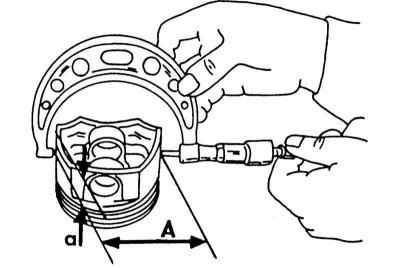
Measuring the piston diameter. The "a" dimension is not the same for an injection and carburetor engine.
4. If you have no experience in measuring, the block should be taken to a special workshop and measured there.
The article is located on the website: www.nissanbook.ru
For clarity, you can draw a sketch and record the measurement results there. The difference between the upper and lower measurements reflects the taper. The difference between the transverse and longitudinal measurements reflects the ovality. Nowhere should the diameter differ from the required value by more than 0.04 mm.
5. The upper surface of the cylinder block is stamped with numbers indicating the piston size class. When replacing the cylinder block, pistons of the corresponding size class must be installed. Check the surface of the cylinder block for deformation, as shown in the illustration below.
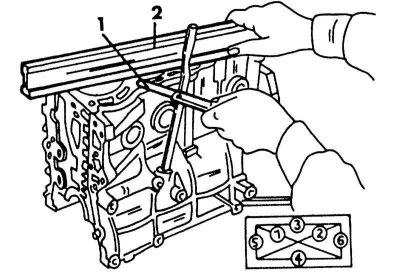
Measurement of cylinder block surface deformation
1 - feeler gauge
2 - steel ruler
6. To do this, place a steel ruler (2) on the block surface and measure the gap using a feeler gauge (1). Measure the block in the longitudinal, transverse and diagonal directions, as shown in the small diagram. The maximum permissible size is 0.10 mm. It should be remembered that the head and cylinder block can be ground by a total of no more than 0.2 mm. If the head does not need to be ground, you should check the height of the cylinder head, the size is indicated in Specifications at the beginning of the Chapter. If the cylinder block after grinding has a height less than the permissible one, it must be replaced.