


Table of contents: Disassembly ↓ Assembly ↓
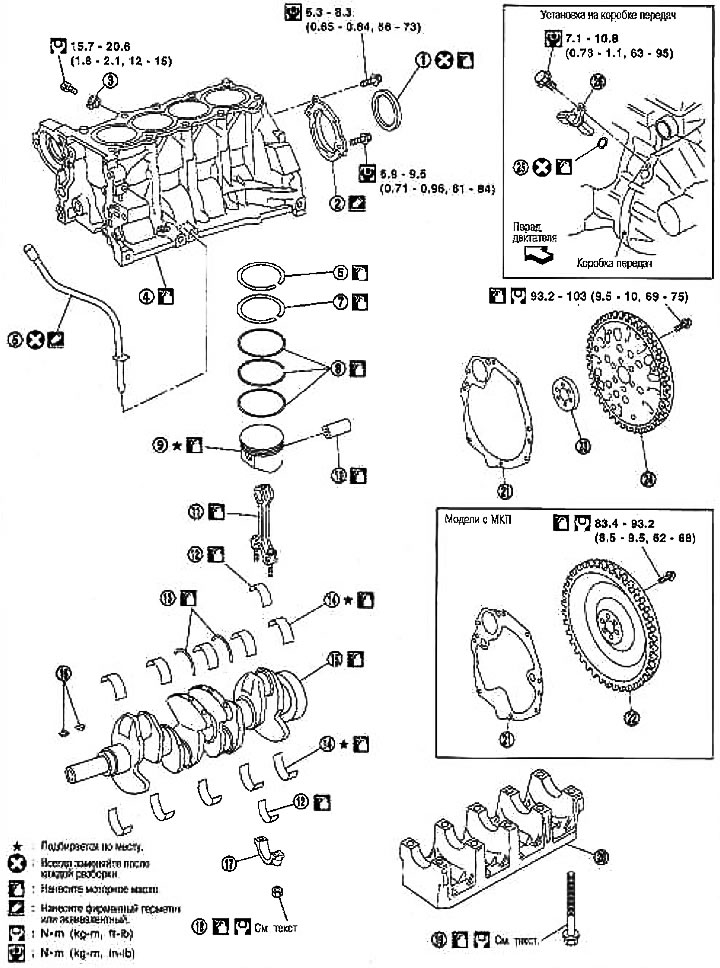
1. Rear oil seal; 2. Rear oil seal holder; 3. Knock sensor; 4. Cylinder block; 5. Oil dipstick guide; 6. Upper compression ring; 7. Second compression ring; 8. Oil scraper ring; 9. Piston; 10. Piston pin; 11. Connecting rod; 12. Connecting rod bearing; 13. Thrust bearing; 14. Main bearing; 15. Crankshaft; 16. Key; 17. Connecting rod bearing cap; 18. Connecting rod nut; 19. Main bearing cap bolt; 20. Main bearing cap; 21. Back plate; 22. Flywheel (models with manual transmission); 23. Reinforcement disk (models with automatic transmission); 24. Leading disk (models with automatic transmission); 25. O-ring seal; 26. Crankshaft angle sensor (POS)
Disassembly
1. Remove the engine and transmission assembly from the vehicle and separate the transmission from the engine. See the section above "Removal and installation".
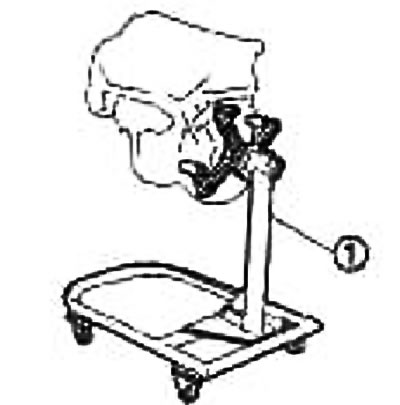
2. Install the engine on the stand (special tool) as follows:
Note: We will use an engine stand as an example (suitable special tool) with rear cylinder block mounting (from the gearbox side).
- a. Remove the clutch housing and driven disc. See chapter Clutch.
- b. Remove the flywheel.
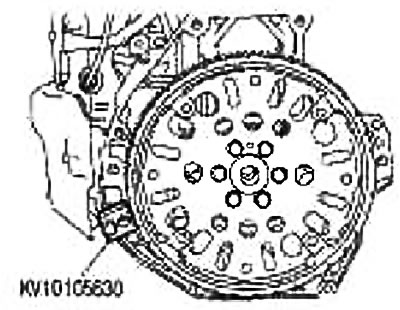
Secure the crankshaft with a ring gear holder (special tool), loosen the mounting bolts crosswise and remove.
Caution: Make sure that the signal disc (1) is not damaged or deformed.
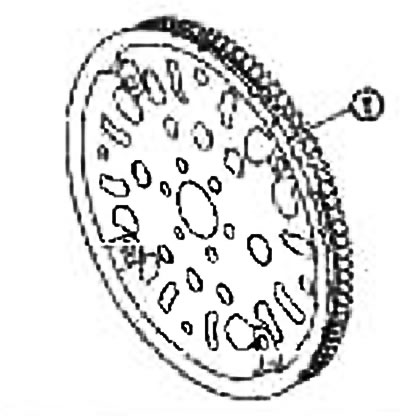
Note: The illustration shows the drive disc.
- c. Remove the back plate
- d. Lift the engine with a winch and place it on a stand.
For information on installing lifting eyes on the engine, see the section above "Removal and installation".
3. Drain the engine oil and coolant from the engine.
4. Remove the following components and related parts:
- air cleaner housing assembly; see section "Air purifier and air duct";
- upper part of the intake manifold; see section "Upper part of the intake manifold";
- fuel injectors and fuel pipe assembly; see section "Fuel injectors and fuel line";
- ignition coils; see section "Ignition coil";
- valve cover; see section "Valve cover";
- oil pan and coarse oil filter; see section "Oil pan and coarse oil filter";
- front cover and timing chain; see section "Timing chain";
- camshaft; see section "Camshaft";
- cylinder head assembly; see section "Cylinder head";
- oil filter; see chapter Lubrication system and engine cooling system;
- low oil pressure warning light switch; see chapter Lubrication system and engine cooling system.
5 Remove the knock sensor.
Caution: Handle the sensor with care and avoid impact.
6. If necessary, remove the dipstick guide.
Caution: Once removed, the guide cannot be reinstalled. Remove it only if absolutely necessary.
7 Remove the rear oil seal holder.
Remove by inserting a screwdriver between the main bearing cap and the rear oil seal retainer.
8 Remove the rear oil seal from the holder. Remove the oil seal using a screwdriver.
Caution: Do not damage the rear oil seal holder.
9. Remove the connecting rods and pistons as an assembly as follows:
Before removing the connecting rods, check the connecting rod side clearance. See section "Connecting rod side clearance".
- a. Bring the crankpin of the connecting rod being removed to BDC
- b. Remove the connecting rod big end cap.
- c. Push the connecting rod and piston assembly towards the cylinder head with the handle of a hammer
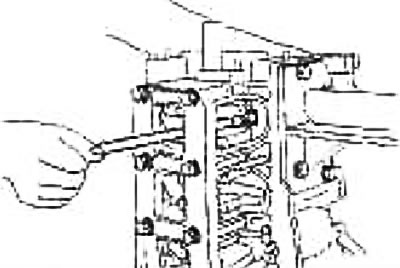
10. Remove the bearings from the connecting rod and connecting rod bearing cap.
Note: When removing, mark their installation positions and put them in order without mixing them up.
11. Remove the piston rings from the pistons.
Use a piston ring expander (1).
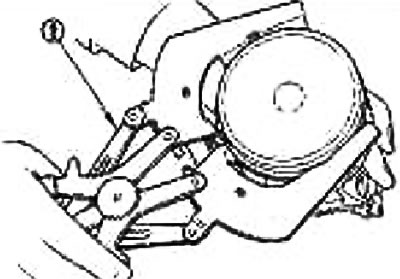
Caution: When removing piston rings, be careful not to damage the piston. Do not spread the piston rings too wide - they may break.
Before removing the piston rings, check the piston ring side clearance. See the section below "Piston ring side clearance".
12. Remove the piston from the connecting rod.
Press out the piston pin using a stand and press.
Note: The piston pin is press fit into the connecting rod.
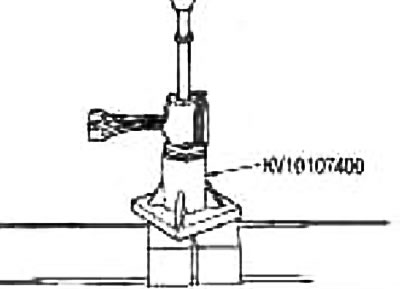
Caution: Do not damage the piston and connecting rod.
13. Remove the main bearing caps.
- a. Loosen and remove the bolts in several passes in the reverse order to that shown in the figure.
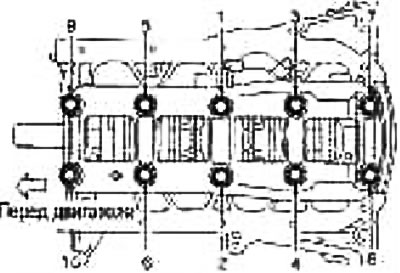
Before loosening the main bearing cap bolts, measure the crankshaft end play. See section "Crankshaft axial play".
- b. Remove the main bearing caps by tapping them lightly with a plastic hammer.
14. Remove the crankshaft.
15. Remove the main and thrust bearings from the cylinder block and remove the main bearing caps.
Note: When removing, mark their installation positions and put them in order without mixing them up.
Assembly
1. Blow out the coolant passages, oil passages, cylinders and crankcase with compressed air and remove foreign particles from them.
2. If the plug (1) shown in the figure was unscrewed, apply sealant to the threads of the plug.
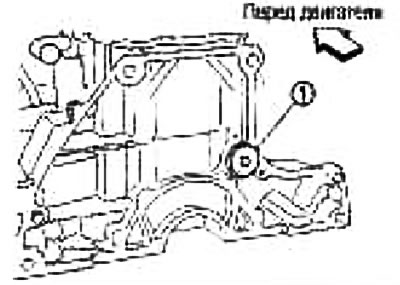
Use branded sealant or equivalent
Do not reuse the washer. Replace it with a new one.
Tighten to the specified torque: 58.8-68.6 N·m (6.0-6.9 kg·m)
3. Install the main and thrust bearings as follows:
- a. Remove foreign particles, dust, dirt and oil from the bearing mating surfaces in the cylinder block and from the main bearing caps.
- b. Install thrust bearings (1) on both sides of journal No.3 (2) in the cylinder block.
Place the thrust bearings with the oil groove (3) towards the crank arm (outward)
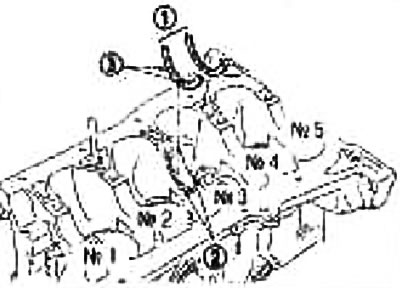
- c. Install the main bearings (1), observing the installation direction.
Install main bearings with lubrication groove and hole (2) in the cylinder block, and bearings without them - in the main bearing caps (5).
Before installing the main bearings, apply fresh motor oil to the bearing surfaces (from the inside). Do not apply oil to the back side, but wipe it thoroughly.
When installing, align the protrusion of the main bearing stopper (3) with the recess (4).
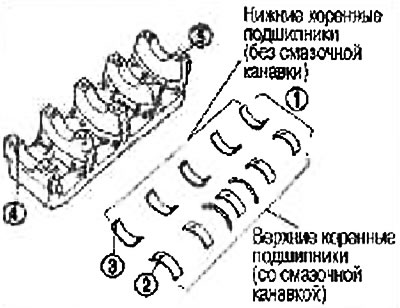
Make sure the oil holes in the cylinder block are aligned with the holes in the corresponding bearing.
4. Install the crankshaft into the cylinder block.
[The article was obtained from the portal: www.nissanbook.ru]
Turn the crankshaft by hand and make sure it rotates freely.
5. Install the main bearing caps.
Place them with the front mark (1) facing the front of the engine.
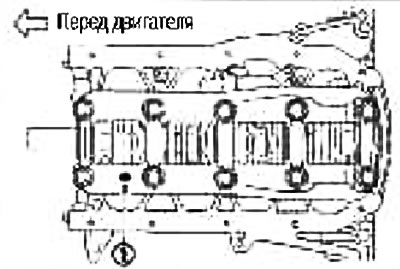
Note: The cylinder block and main bearing caps are manufactured as one piece. They can only be replaced as a set.
6. Tighten the main bearing cap bolts in several passes in the order shown by the numbers in the illustration.
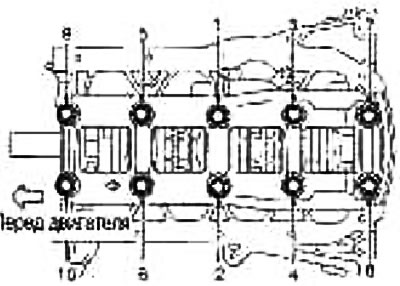
- a. Apply fresh engine oil to the threads and seating surface of the main bearing cap bolts.
- b. Tighten the bolts to 24.5-30.3 N·m (2.5-3.0 kg·m)
- c. Turn 90-100° clockwise (standard: 95°) (tightening at an angle).
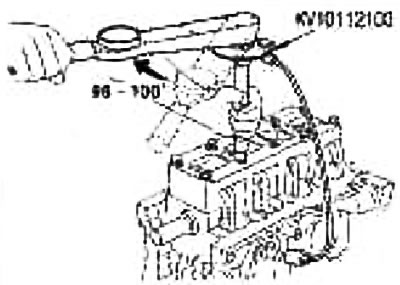
Note: Check the tightening angle with a protractor wrench (special tool). Avoid eyeballing without using tools.
After tightening the main bearing cap bolts, turn the crankshaft by hand and make sure it rotates freely.
Check the crankshaft end play. See section "Crankshaft axial play".
7. Install the connecting rods into the pistons as follows:
- a. Assemble the piston and connecting rod so that the front mark (1) on the piston crown and the cylinder number (2) on the connecting rod are positioned as shown in the figure.
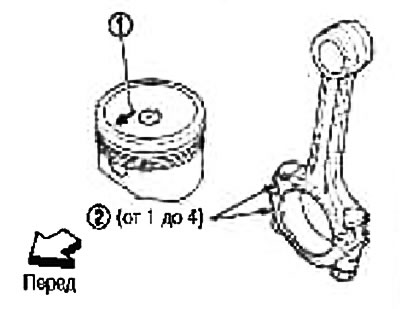
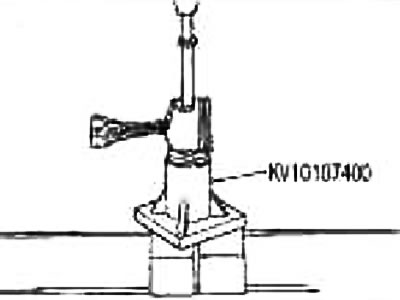
- b. Press in the piston pin using a stand (special tool).
Note: The piston pin is a press fit in the connecting rod. After installation, make sure the piston moves freely.
8. Install the piston rings using the expander as shown in the figure.
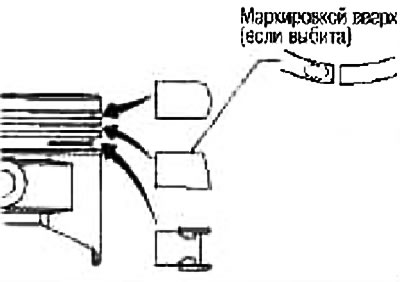
Caution: When installing piston rings, do not damage the piston. Do not spread the piston rings too wide - they may break.
Position the piston ring locks relative to the piston front mark (1) as shown in the figure.
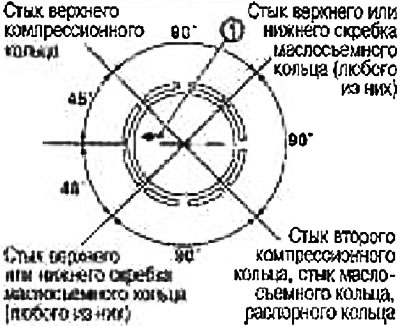
Place the top and second compression rings with the marking facing up.
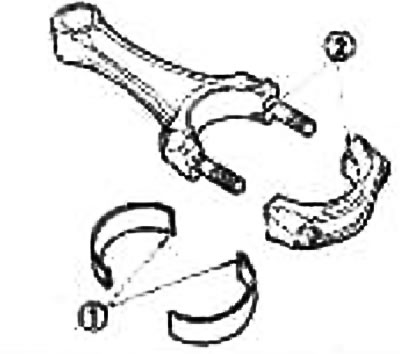
9. Install the bearings into the connecting rods and caps.
When installing connecting rod bearings, apply fresh engine oil to the bearing surfaces (internal). Do not apply oil to the back side, but wipe it thoroughly.
When installing, align the stopper protrusion (1) on the connecting rod bearing with the recess (2) on the connecting rod.
10. Install the connecting rods and pistons as an assembly onto the crankshaft.
Bring the crankpin of the connecting rod being installed to BDC.
Apply a sufficient amount of engine oil to the cylinder walls, piston and connecting rod journal.
Check the cylinder number that the connecting rod corresponds to.
Using a piston ring compressor (special tool) (1) Insert the piston with the grade marking on the piston bottom towards the front of the engine.
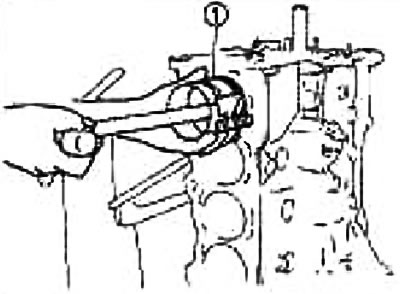
Caution: When inserting the large connecting rod head, do not damage the cylinder walls and connecting rod journal.
11. Install the connecting rod bearing cap.
Before installation, check that the cylinder number marking (1) stamped on the connecting rod matches the marking on the cover.
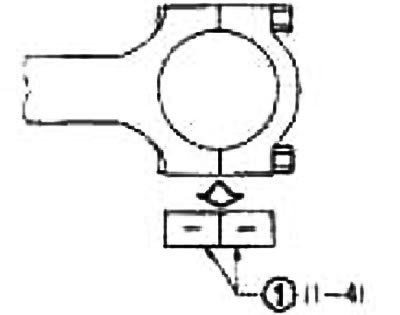
12. Tighten the connecting rod nuts as follows:
- a. Apply fresh engine oil to the threads and seating surfaces of the connecting rod nuts and bolts.
- b. Tighten to 13.7-15.7 N·m (1.4-1.6 kg·m)
- c. Turn 45-50° clockwise (normal: 45°) (tightening at an angle)
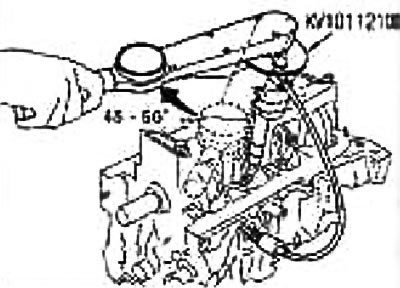
Caution: Use a protractor key (special tool). Avoid eyeballing without using tools.
After tightening the nuts, make sure the crankshaft rotates freely.
Check the connecting rod side clearance. See section "Connecting rod side clearance".
13. Press in the rear oil seal.
Make sure the area around the rear oil seal is not damaged and press the oil seal in using a punch.
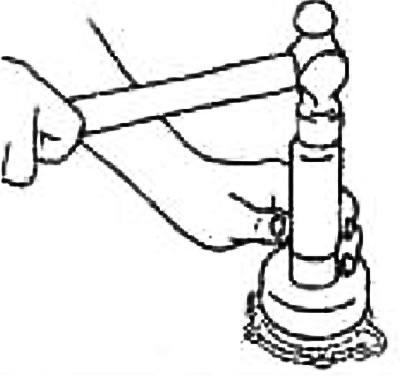
Press until the end of the rear seal is flush with the edge of the retainer.
14. Install the rear oil seal holder.
Apply sealant evenly to the areas shown in the figure.
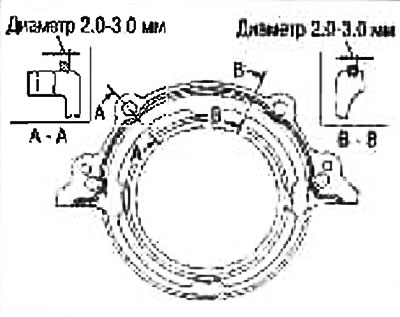
Use brand name sealant or equivalent.
Install so that it aligns with the dowel pin on the cylinder block side.
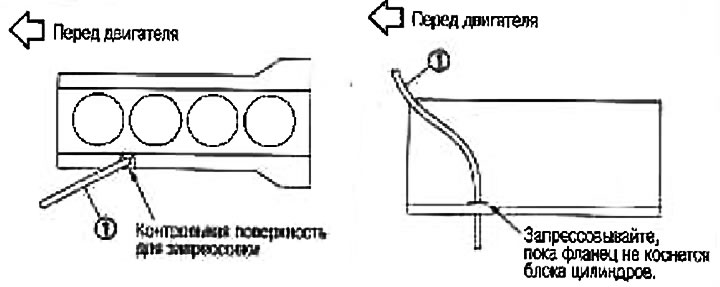
15. Install the oil dipstick guide (1).
Press the oil dipstick guide (1) into the cylinder block with the control surface as shown in the figure.
Apply sealant to the pressed areas.
Caution: Replace the dipstick with a new one.
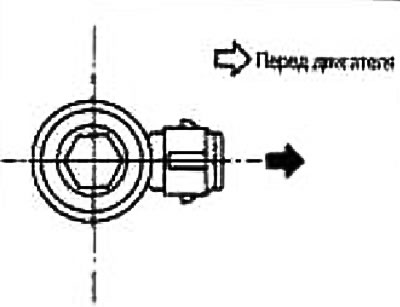
16. Install the knock sensor.
Install the sensor with the connector facing the front of the engine.
Attention:
- Handle the sensor with care. If you hit or drop the knock sensor, replace it with a new one.
- Make sure there are no foreign particles on the contact surface of the cylinder block and the rear surface of the knock sensor.
- Use recommended bolts.
- Do not tighten the bolts by holding the connector.
- Make sure the knock sensor does not interfere with other parts.
17. After this operation, the assembly of the components removed in step 4 is performed in the reverse order of disassembly.
18. Lift the engine using a winch, unscrew the bolts and separate it from the stand.
19. Install the back plate.
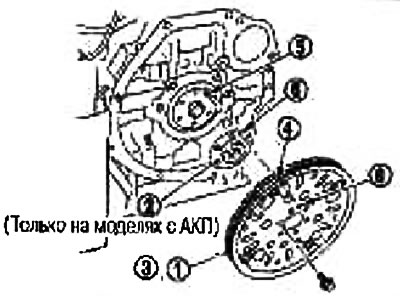
20. Install the flywheel (1).
Install with the signal disc (4) towards the rear of the engine.
Install by aligning the hole (6) for the locating pin with the locating pin (5) on the back of the crankshaft.
Caution: Make sure that the signal disc (4) is not damaged or deformed.
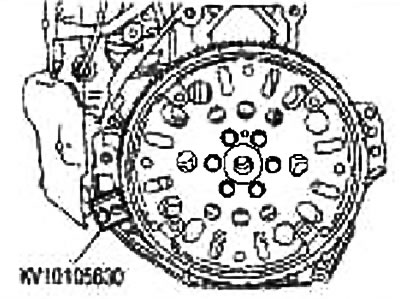
Secure the crankshaft with a ring gear holder (special tool) and tighten the bolts crosswise.
21. Install the remaining components in the reverse order of removal.