


Caution: Use goggles to protect your eyes.
2. Install the plug (1) into the coolant drain hole as shown in the figure. Use only branded silicone sealant or equivalent.
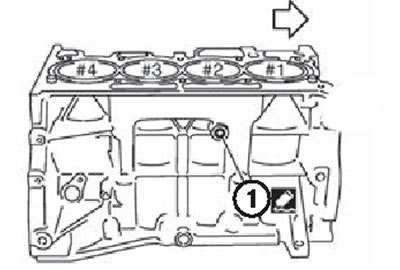
Note: Arrow points to the front of the engine.
3. Install the main bearing shells and thrust rings as follows:
Remove dust, dirt and engine oil from the cylinder block mounting seats.
Install thrust rings on both sides of main bearing No.3 (B) of the cylinder block so that the sides with oil grooves (A) are directed towards the crankshaft (outward).
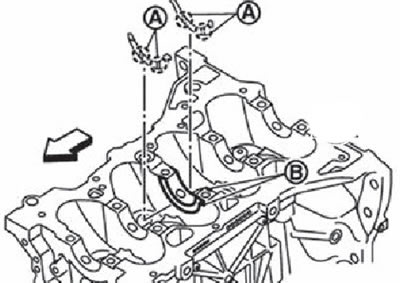
Note: Arrow points to the front of the engine.
Install the main bearing shells (1), paying attention to the fact that the shells with oil grooves (A) are installed in the cylinder block, and the shells without grooves - in the main bearing caps. Before installing the shells, apply fresh engine oil to the inner (working) surface of the bearing. Do not apply oil to the outer surface of the shells - it must be clean.
Make sure that the oil holes in the cylinder block align with the holes in the bearing shells.
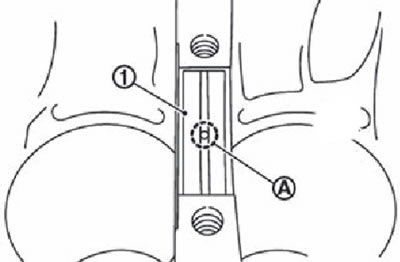
Install the main bearing shells as shown in the figure.
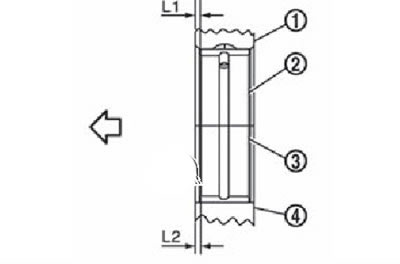
1. Cylinder block.
2. Upper insert.
3. Lower insert.
4. Main bearing cover.
Note: Arrow points to the front of the engine.
Note: Install the main bearing shell to the center position, observing the following dimensions. The center position can be determined visually during servicing.

Note: The dimension L1 of support #3 is the distance from the edge of the body (block) (not from the thrust ring installation surface).
4. Install the signal disk on the crankshaft if it was removed:
Install the signal disk (1) with the surface with the protrusions towards the balancer (front of the engine) on the rear of the crankshaft.
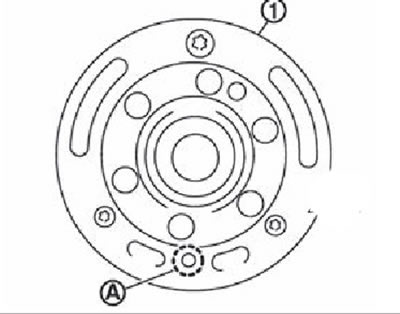
Align the locating pin with the hole (A) of the disc and tighten the bolt.
Note: The crankshaft timing pin and signal disk are a precision pair.
Remove the dowel pin.
Caution: Make sure the locating pin is removed.
5. Install the crankshaft into the cylinder block. Make sure that the crankshaft turns smoothly by hand.
Caution: Do not remove the rear crankshaft oil seal at this stage.
6. Install the crankshaft main bearing caps, paying attention to the front part marks (B) and the bearing number stamp (A).
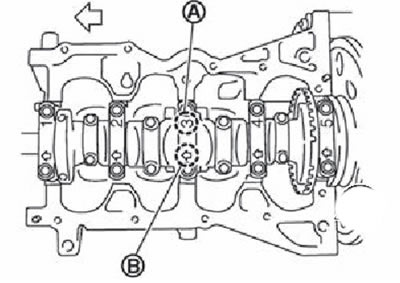
Note: The main bearing caps cannot be replaced individually as they are machined together with the cylinder block.
7. Tighten the main bearing cap bolts in the order shown in the figure as follows:
- Apply fresh engine oil to the threads and bolt seating surfaces.
- Tighten the main bearing cap bolts to a torque of 32.4 Nm.
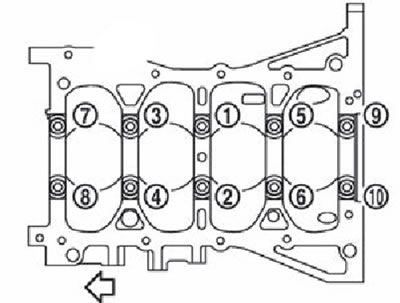
Note: Arrow points to the front of the engine.
Tighten the main bearing cap bolts 60° clockwise (with a corner wrench) in the order shown in the figure.
Note: Check and confirm the tightening angle using the angle wrench (KV10112100) (A) or a protractor. It is not recommended to finish the job "by eye".
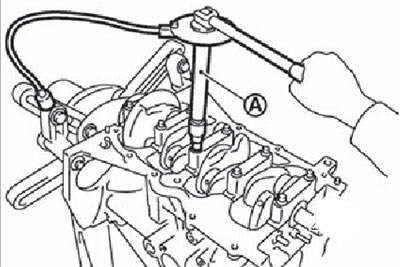
After installing the mounting bolts, make sure that the crankshaft turns freely by hand.
Check the crankshaft axial clearance.
8. Install the piston on the connecting rod as follows:
For more information, see the website NissanBook
Install the piston and connecting rod so that the front mark (A) on the piston crown and the cylinder number (C) are on the same side, as shown in the figure.
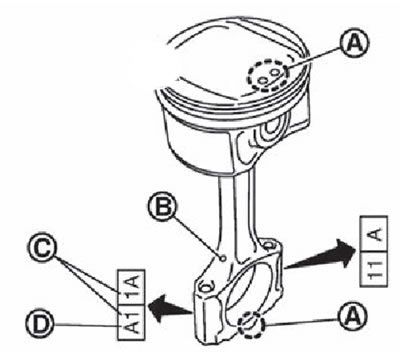
A. Front marks.
B. Oil groove.
C. Cylinder number.
D. Marking of the lower connecting rod head.
Note: Symbols without description are not used in the maintenance process.
Press in the piston pin using a press.
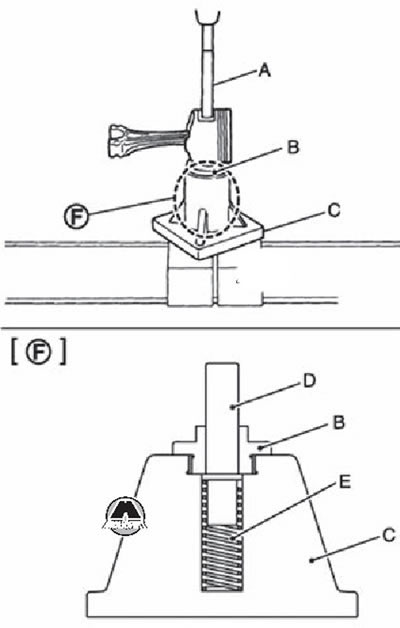
A. Opravka (KV10109730).
B. Centering cup (KV10110310).
C. Press base (ST13030020).
D. Central rod (KV10114120).
E. Spring (ST13030030).
F. Assembly of parts.
Caution: Be careful not to damage the piston pin during the pressing process.
Note: The piston pin is pressed into the upper connecting rod head.
Press in the piston pin (2) to a depth of 2.35 mm from the piston surface (A).
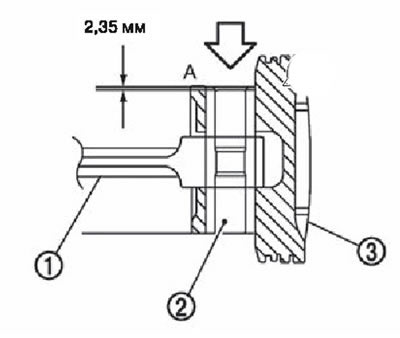
1. Connecting rod.
2. Piston pin.
3. Piston.
A. Piston surface.
After finishing work, make sure that the piston (3) rotates freely.
9. Using a ring expander, install the piston rings:
Attention.
- When installing the rings, be careful not to damage the piston.
- Do not spread the rings too wide to avoid breaking them.
Install the piston rings so that their locks are in position, while focusing on the front marks (B) of the piston.
Install the second compression ring so that the "R" stamp on it faces upward.
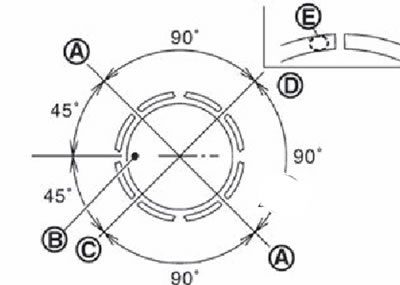
A. Upper or lower oil scraper ring disc lock (any of them).
B. Front piston marks.
C. Lock of the second compression ring and the oil scraper ring expander.
D. Upper compression ring lock.
10. Install the connecting rod bearings into the connecting rods and connecting rod caps:
When installing connecting rod bearings, apply fresh engine oil to the inner (working) surface of the bearings. Do not apply oil to the outer surface of the bearings - it must be clean.
Set the liners to the central position.
Note: The inserts do not have a locking lug.
Make sure that the oil holes in the bearing and connecting rod are aligned.
Install the connecting rod according to the dimensions shown in the figure.
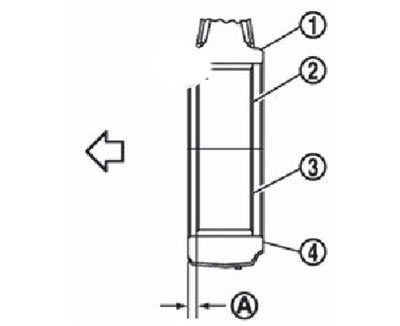
1. Connecting rod.
2. Upper connecting rod bearing.
3. Lower connecting rod bearing.
4. Connecting rod cover.
A. 1.7-2.1 mm.
Note: Arrow points to the front of the engine.
Note: Set the connecting rod bearing to the central position, observing the dimension "A". During service, the central position can be determined visually.
11. Install the piston with connecting rod assembly on the crankshaft:
- Place the crankshaft journal in the position corresponding to the bottom dead center of the piston.
- Apply fresh engine oil to the cylinder bore, piston and crankshaft journal.
- Place the pistons with connecting rods opposite the corresponding cylinder holes, using the numbers on the connecting rods as a guide.
- Using piston ring crimping (EM03470000) (A) Insert the piston into the cylinder so that the mark on the front of the piston faces the front of the engine.
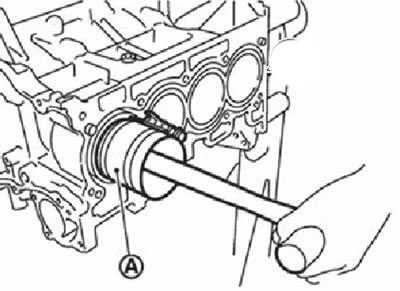
Attention.
- Be careful not to damage the connecting rod cap mating surfaces.
- Be careful not to damage the cylinder bore and crankshaft journal with the striking lower end of the connecting rod.
12. Install the connecting rod lower head cover. Align the cylinder number on the connecting rod (C) with the cylinder number on the connecting rod cover.
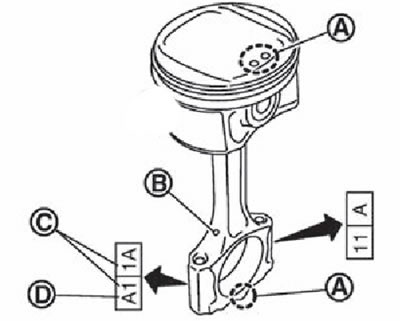
A. Front mark.
B. Oil groove.
C. Cylinder number.
D. Marking of the lower cylinder head.
13. Check the outside diameter of the connecting rod bolts.
14. Tighten the connecting rod bolts as follows:
- Apply fresh engine oil to the threads and seating surfaces of the connecting rod bolts.
- Tighten the connecting rod bolts in several passes to a tightening torque of 27.5 Nm.
- Loosen the connecting rod bolts completely.
- Tighten the connecting rod bolts in several passes to a tightening torque of 19.6 Nm.
- Tighten all bolts 60 degrees clockwise (with a corner wrench).
Note: Check and confirm the tightening angle using an angle wrench (KV10112100) (A) or conveyor. It is not recommended to tighten it "by eye".
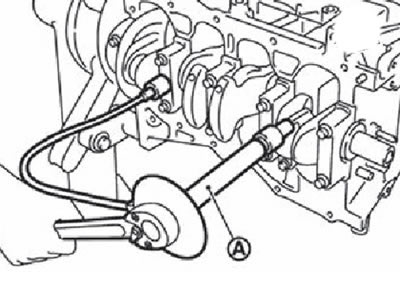
After tightening the connecting rod bolts, make sure that the crankshaft rotates freely.
Check the side clearance of the connecting rods.
15. Install the upper part of the oil pan.
Note: Press in the rear crankshaft oil seal after installing the upper oil pan.
16. Press in the rear oil seal.
17. Install the flywheel and tighten the mounting bolts in a cross pattern in several passes.
18. Install the knock sensor (1) so that its connector faces the rear of the engine.
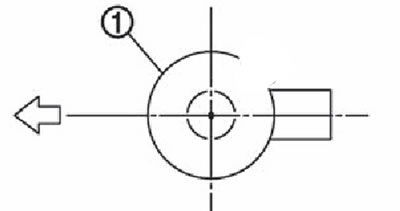
Note: Arrow points to the front of the engine.
Attention.
- Do not tighten the mounting bolts by holding the sensor by the connector.
- If the sensor has been dropped or impacted, replace it with a new one.
Note.
- Make sure there is no foreign material on the contact surface of the cylinder block and the back surface of the knock sensor.
- Make sure the knock sensor does not contact other parts of the engine.
19. Install the crankshaft position sensor (POS) with the cover and tighten the mounting bolts.
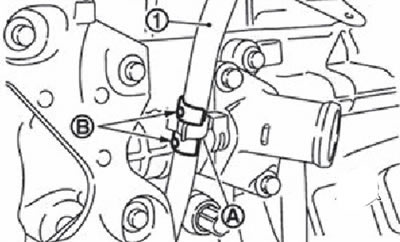
20. Insert the dipstick adjustment tube (1) into the cylinder block and secure it with the holders (B) near the holder (A) of the cooling system inlet pipe, as shown in the figure.
21. Further assembly is carried out in the reverse order of disassembly.