


Note: Nominal and maximum allowable values are given in the Service Data and Specification section of this chapter.
1. Crankshaft axial clearance:
Using a dial indicator (A), measure the clearance between the thrust ring and the crankshaft by moving it in the longitudinal direction.
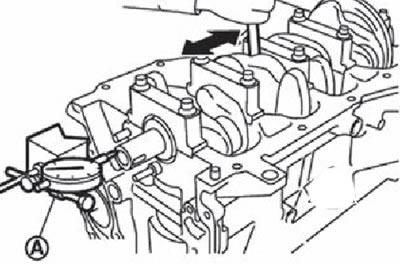
If the measurement results exceed the maximum permissible value, replace the thrust rings with new ones and perform the measurements again. If the obtained values still exceed the norm, replace the crankshaft.
2. Connecting rod side clearance:
Measure the side clearance between the connecting rod and the crankshaft using a set of flat feeler gauges (A).
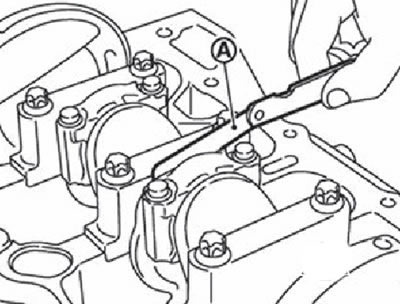
If the measurement results exceed the maximum permissible value, replace the connecting rod with a new one and perform the measurements again. If the obtained values still exceed the norm, replace the crankshaft.
3. Clearance between piston pin and piston:
Using a bore gauge (A), measure the inner diameter of the hole in the piston.
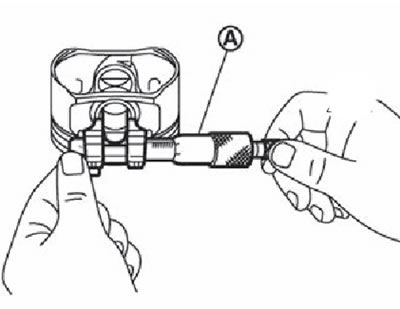
Using a micrometer (A), measure the outside diameter of the piston pin.
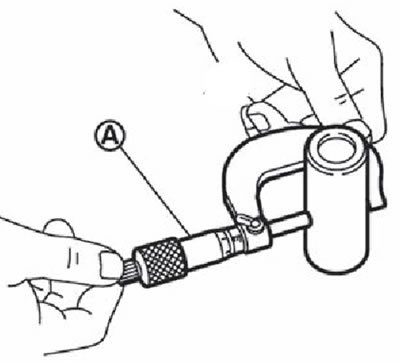
Calculate the clearance between the piston pin and the piston as the difference between the outer and inner diameters.
If the clearance value exceeds the maximum permissible value, replace the piston with the piston pin assembly.
4. Lateral clearance of piston rings:
Measure the side clearance between the piston ring and the groove in the piston using a set of flat feeler gauges.
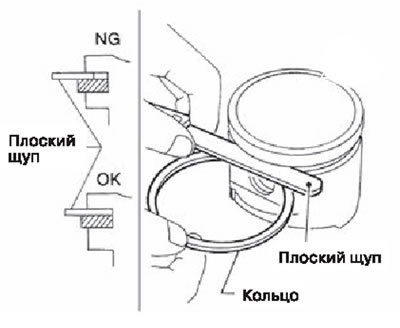
If the measurement results exceed the maximum permissible value, replace the piston ring and repeat the measurement. If the obtained values still exceed the norm, replace the piston.
5. Piston ring gap:
Make sure that the cylinder bore diameter is within the standard.
Apply fresh engine oil to the piston (1) and piston ring (2), then push (A) the piston ring with the piston to the middle of the cylinder (B) and measure the gap in the piston ring joint using a set of flat feeler gauges (C).
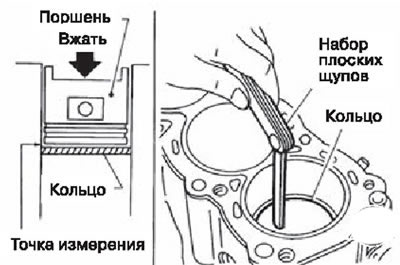
If the measurement results exceed the maximum permissible value, replace the piston ring with a new one.
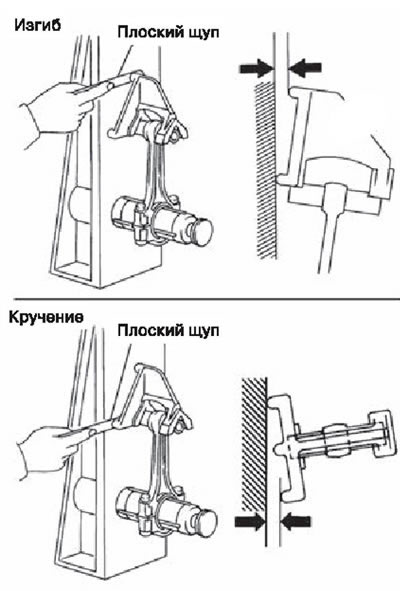
6. Bending and twisting of the connecting rod:
The connecting rod should be checked using a special stand.
If the maximum values are exceeded, replace the connecting rod with a new one.
7. Connecting rod lower head diameter:
Put the cover on the connecting rod (without inserting inserts) and tighten the connecting rod bolts to the specified torque.
Measure the diameter of the connecting rod bearing bed using a bore gauge.
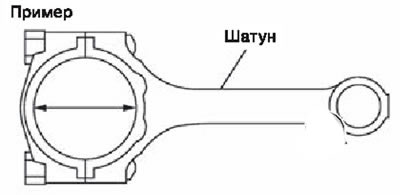
If the size is exceeded, replace the connecting rod with a new one.
8. Clearance in the upper connecting rod head:
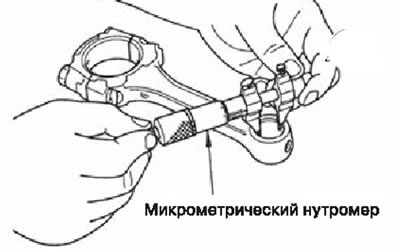
Measure the inner diameter of the bushing using a bore micrometer.
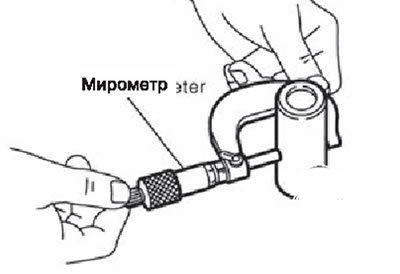
Measure the outside diameter of the piston pin using a micrometer.
Calculate the oil clearance in the upper connecting rod head as the difference between the inner and outer diameters.
If the oil clearance is greater than the maximum permissible, replace the connecting rod and/or piston and piston pin. When replacing the piston with the pin, follow the information on selecting the piston and connecting rod bearings.
9. Non-flatness of the cylinder block:
Using a scraper, remove the remains of the gasket from the upper surface of the cylinder block and also clean the surfaces from oil, carbon deposits and other contaminants.
Caution: Be careful not to allow gasket residue to enter the oil passages and coolant passages in the cylinder block.
Using a straightedge and a flat feeler gauge, measure the warpage of the cylinder block at several points in six directions (1-6).
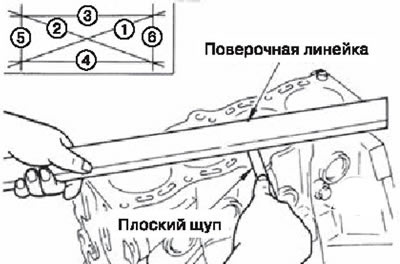
If the measured value does not meet the specifications, replace the cylinder head.
10. Main bearing bed diameter:
- Without installing the main bearings, install the main caps, and then tighten the main bolts to the specified torque.
- Measure the diameter of the crankshaft bed five millimetres from the edge in two directions using a bore gauge.
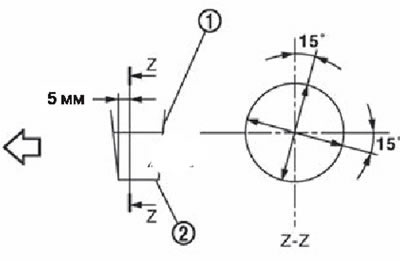
1. Cylinder block.
2. Main bearing cover
Note: Arrow points to the front of the engine.
If the measured value does not correspond to the specifications, replace the cylinder block with main caps as an assembly.
Note: The main bearing caps cannot be replaced separately as they are machined together with the cylinder block.
11. Clearance between piston and cylinder:
Using a bore gauge, measure the wear, ovality and taper of each cylinder at six points. (In the planes "X" and "Y" in sections "A", "B" and "C"), the plane ("Y" coincides with the longitudinal axis of the engine).
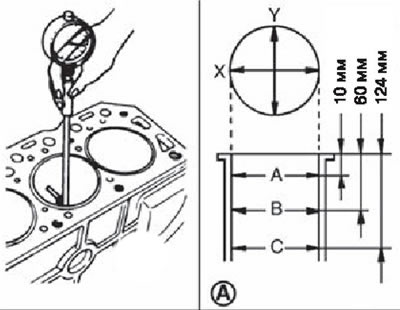
Note: To determine the cylinder size group, measure the diameter in section "B".
If the dimensional values exceed the maximum permissible values or there are scratches and burrs on the surface, replace the cylinder block with a new one.
Note: There are no repair dimensions for pistons and cylinder block.
Using a micrometer (A), measure the diameter of the piston skirt.
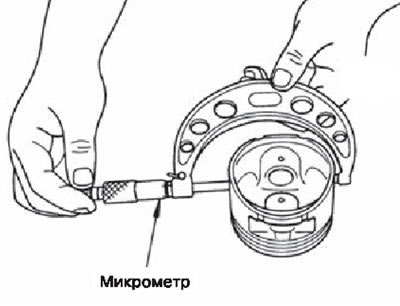
The clearance between the piston and the cylinder is calculated as the difference between the outer diameter of the piston skirt and the inner diameter of the cylinder bore (plane "X" section "B").
If the obtained value does not correspond to technical standards, replace the piston with the piston pin assembly and/or the cylinder block.
12. Diameter of crankshaft main journals:
Measure the outside diameter of the crankshaft journal using a micrometer (A).
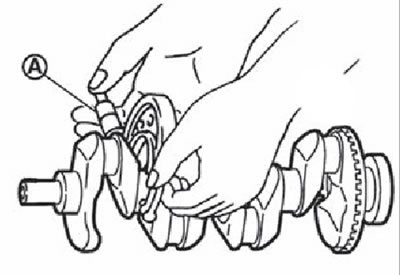
If the measured value is not within the norm, measure the clearance in the main bearing and, if necessary, use reduced main bearing shells.
13. Diameter of connecting rod journals:
- Measure the outside diameter of the crankshaft journal using a micrometer.
- If the measured value is not within the standard, measure the clearance in the connecting rod bearing and, if necessary, use reduced connecting rod bearing shells.
14. Ovality and taper of crankshaft journals:
Measure the diameter of each main and connecting rod journal at four points as shown in the figure.
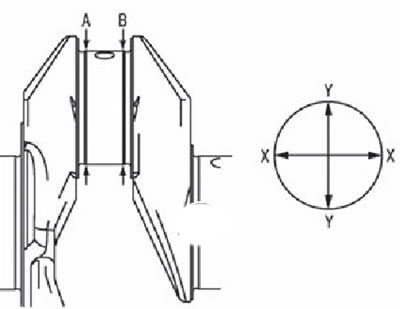
Ovality is determined by the difference in dimensions "X" and "Y" at points "A" and "B".
Taper is determined by the difference in dimensions "A" and "B" about points "X" and "Y".
If the measured values do not correspond to the technical conditions, then regrind or replace the crankshaft.
After regrinding, check the oil clearance on the machined journals. Then select the main and/or connecting rod bearings.
15. Crankshaft runout:
Place the V-shaped prisms on the marking plate and place the crankshaft on the prisms.
Place a dial indicator (A) opposite the middle main journal (No. 3).
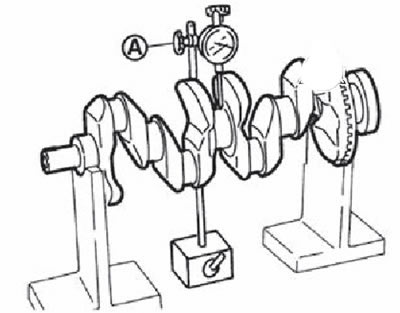
Rotate the crankshaft and measure the crankshaft runout at the middle main journal (arrow amplitude).
If the measured value does not meet the specifications, replace the crankshaft.
16. Clearance on the connecting rod journal:
A) Calculated determination of the gap:
Install the connecting rod bearings into the connecting rod and into the connecting rod cap, tighten the connecting rod bolts to the specified torque.
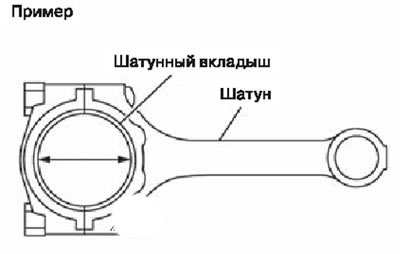
Measure the diameter of the crankpin bed using a bore micrometer.
Calculate the clearance as the difference between the diameters of the opening of the lower head of the connecting rod and the connecting rod journal.
If the obtained value does not correspond to the technical conditions, select connecting rod bearings based on the diameter of the connecting rod bearing bed, the diameter of the connecting rod journal and the required oil clearance.
B) Measuring the gap with a deformable gauge:
Thoroughly wipe the crankpin and connecting rod bearings.
Measure and cut a plastic gauge to a length slightly shorter than the bearing width and install it axially on the crankpin, but not on the oil hole.
Install the connecting rod bearings into the connecting rod and connecting rod cap, tighten the connecting rod bolts to the specified torque.
Caution: Do not turn the crankshaft.
Remove the connecting rod cover with the bearing shell and use the gauge scale to determine the radial oil clearance.
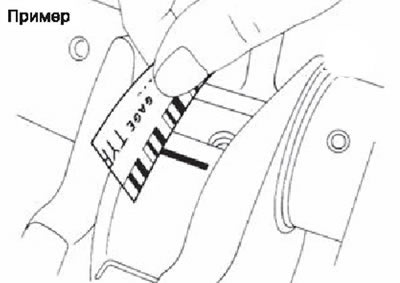
Note: If the gap is greater than the maximum, the measures taken are the same as in the case of the calculation method.
17. Main journal clearance:
A) Calculation of the gap:
Install the main bearings into the cylinder block and the main caps, install the main caps of the crankshaft bed and tighten the main bolts to the specified torque.
Measure the diameter of the crankshaft bed using a bore gauge.
Calculate the clearance as the difference between the diameters of the main bearing hole and the main journal.
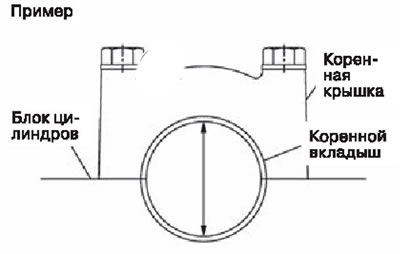
If the obtained value does not correspond to the technical conditions, select the main bearings based on the diameter of the main bearing bed, the diameter of the main journal and the required oil clearance.
B) Measuring gaps with a deformable gauge:
Thoroughly wipe the main journal and main bearings.
Measure and cut a plastic gauge to a length slightly shorter than the bearing width and install it axially on the main journal, but not on the oil hole.
Install the main bearing shells into the cylinder block and into the main bearing cover, tighten the main bolts to the specified torque.
Caution: Do not turn the crankshaft.
Remove the main bearing cover with the liner and use the scale to determine the radial oil clearance.
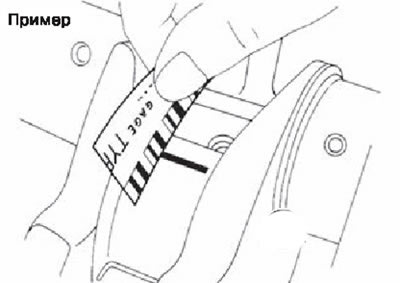
Note: If the gap is greater than the maximum, the measures taken are the same as in the case of the calculation method.
18. Protrusion of the main bearing:
After removing the main cover with the liner, which was tightened to the specified torque, the end of the liner should protrude above the bed connector.
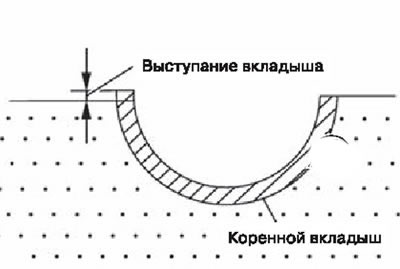
If there is no protrusion, replace the liners.
19. Connecting rod bearing protrusion:
After removing the connecting rod cap with the bearing shell, which was tightened to the specified torque, the end of the bearing shell should protrude above the bed connector.
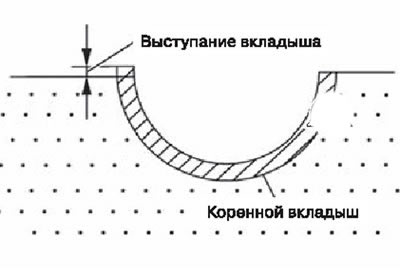
If there is no protrusion, replace the liners.
20. Main bolt outer diameter:
Measure the diameters "d1", "d2") as shown in the figure.
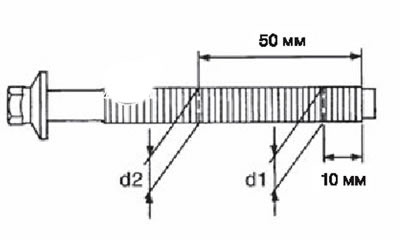
If the bolt thinning occurs outside the section "d2", take this value as the diameter "d2". The maximum permissible difference ("d1" - "d2"): 0.2 mm.
If the difference is greater than the maximum permissible value, replace the main bolt with a new one.
21. Connecting rod bolt outer diameter:
Measure the diameter "d" of the connecting rod bolt as shown in the figure.
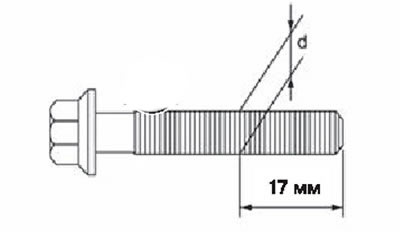
If the bolt thinning occurs outside the section "d", consider this diameter as "d". The maximum permissible value is 7.75 mm.
If the bolt is thinner than the maximum permissible value "d", replace it with a new one.
22. Flywheel runout:
Using a dial indicator (A), measure the runout of the flywheel working surface as shown in the figure.
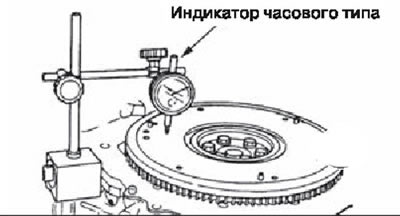
If the measured value exceeds 0.25 mm, replace the flywheel with a new one.