


Table of contents: Crankshaft axial play ↓ Connecting rod side clearance ↓ Oil clearance between piston and…↓ Piston ring side clearance ↓ Piston ring gap. ↓ Bending and twisting of the…↓ Big end diameter of connecting rod ↓ Connecting rod small end bushing oil…↓ Cylinder block warping ↓ Inner diameter of main bearing…↓ Clearance between piston and…↓ Crankshaft journal diameter ↓ Crankshaft journal diameter ↓ Ovality and taper of crankshaft…↓ Crankshaft runout ↓ Connecting rod bearing oil clearance ↓ Main bearing oil clearance ↓ Protrusion of the main bearing above…↓ Protrusion of the connecting rod…↓ Main bearing cap bolt outer diameter ↓ Connecting rod bolt outer diameter ↓ Flywheel deformation ↓
Crankshaft axial play
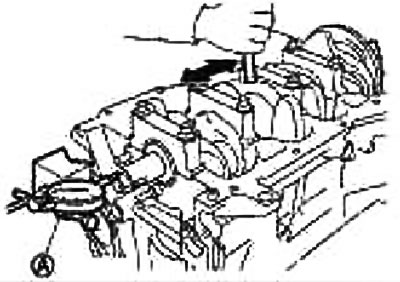
Using a dial indicator (A), measure the clearance between the thrust bearings and the crank arm by moving the crankshaft back and forth.
Standard: 0.098-0.260mm
Limit: 0.35 mm
If the measured value exceeds the limit, replace the thrust bearings and measure again. If the clearance still exceeds the limit, replace the crankshaft as well.
Connecting rod side clearance
Using a feeler gauge (A), measure the side clearance between the connecting rod and the crank arm.
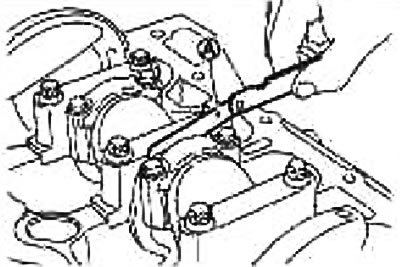
Standard: 0.200-0.352 mm
If the measured value exceeds the limit, replace the connecting rod bearings and measure again. If the clearance still exceeds the limit, replace the crankshaft as well.
Oil clearance between piston and piston pin
Inner diameter of piston pin hole
Using a bore gauge, measure the inside diameter of the piston pin hole.
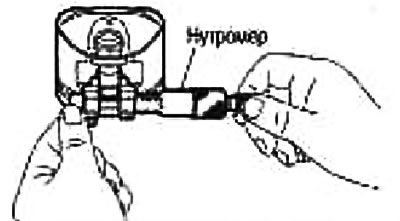
Standard: 19.006-19.012 mm
Piston pin outer diameter
Using a micrometer, measure the outside diameter of the piston pin.
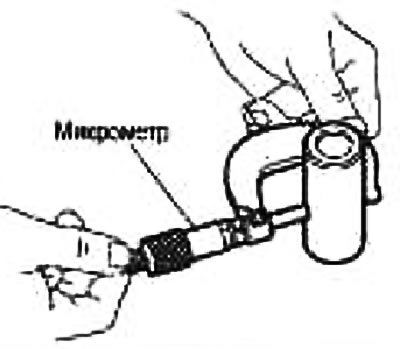
Standard: 18.996-19.002 mm
Oil clearance between piston and piston pin
(Piston pin oil clearance) = (piston pin bore diameter) - (piston pin outer diameter)
Standard: 0.008-0.012 mm
If the resulting clearance is different from the norm, replace the piston and piston pin assembly.
Piston ring side clearance
Using a feeler gauge, measure the gap between the piston ring and the piston ring groove (see fig.)
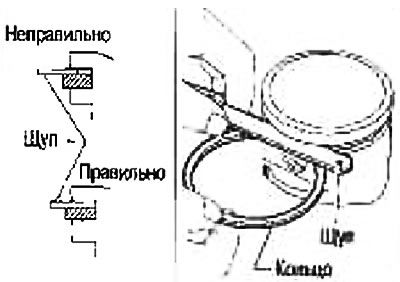
| Standard | Upper compression | 0.040-0.080 mm |
| Second compression | 0.030-0.070 mm | |
| Oil scraper | 0.030-0.140 mm | |
| Limit | Upper compression | 0.11 mm |
| Second compression | 0.10 mm |
If the measured value exceeds the limit, replace the piston ring and measure again. If the clearance still exceeds the limit, replace the piston as well.
Piston ring gap.
Make sure the cylinder bore is within specifications. See "Piston to Cylinder Wall Clearance" below.
Lubricate the piston and piston ring with fresh engine oil and push the piston ring with the piston to the middle of the cylinder and use a feeler gauge to measure the gap in the lock.
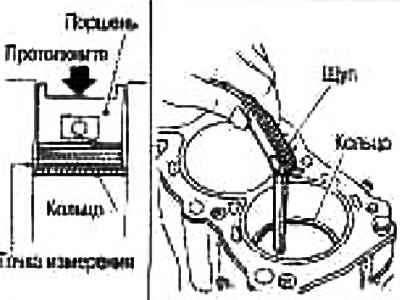
| Standard | Upper compression | 0.20-0.30 mm |
| Second compression | 0.35-0.50 mm | |
| Oil scraper (ring with scraper) | 0.20-0.60 mm | |
| Limit | Upper compression | 0.50 mm |
| Second compression | 0.66 mm | |
| Oil scraper (ring with scraper) | 0.92 mm |
If the measured value exceeds the limit, replace the piston ring.
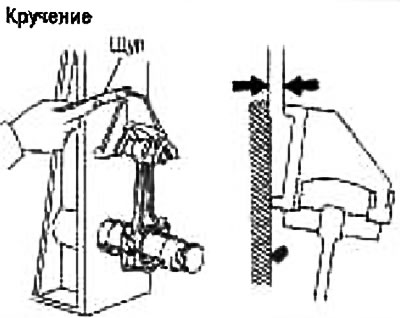
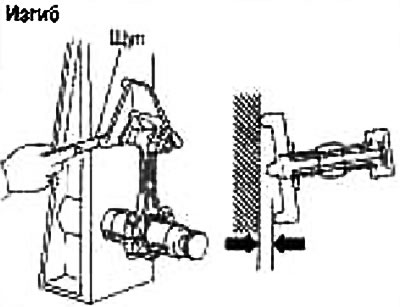
Bending and twisting of the connecting rod
Perform a check using a connecting rod end alignment tester.
Limit bending: 0.15 mm per 100 mm of length
Torsion limit: 0.30 mm per 100 mm of length
If twist or bend exceeds the limit, replace the connecting rod assembly.
 |
 |
Big end diameter of connecting rod
Install the connecting rod cap without the bearing and tighten the connecting rod bolts to the specified torque. For tightening procedure, see the section "Assembly".
Measure the inside diameter of the big end of the connecting rod using a bore gauge.
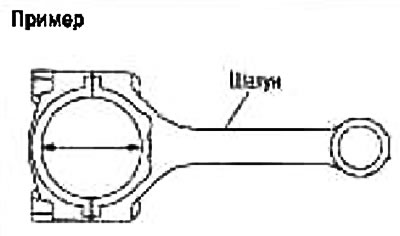
Standard: 43,000-43,013 mm
If the inner diameter is different from the standard, replace the connecting rod assembly.
Connecting rod small end bushing oil clearance
Inner diameter of connecting rod small end bushing
Measure the inside diameter of the connecting rod small end bushing using a bore gauge.
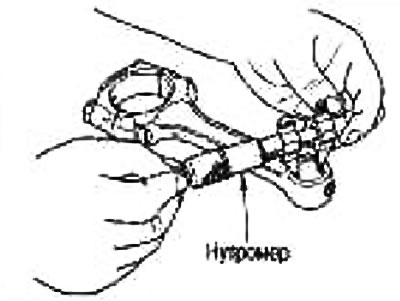
Standard: 10.958-18.970 mm
Piston pin outer diameter
Measure the outside diameter of the piston pin using a micrometer.
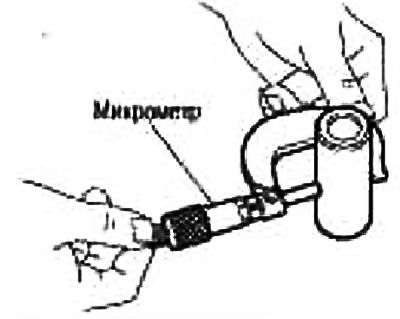
Standard: 18.996-19.002 mm
Connecting rod small end bushing oil clearance
(Connecting rod small end bushing oil clearance) = (small end inner diameter of connecting rod) - (piston pin outer diameter)
Standard: -0.018 to -0.044 mm
If the obtained value differs from the standard, replace the connecting rod assembly and/or the piston and piston pin assembly.
When replacing the connecting rod assembly, select the connecting rod bearing using the section below "Connecting Rod Big End Bearing Oil Clearance".
Cylinder block warping
Using a scraper, remove traces of the gasket from the surface of the cylinder block, and also remove oil, scale, carbon deposits and other contaminants.
Caution: Do not allow gasket residue to enter oil or coolant passages.
Check the top surface of the cylinder block for warpage by measuring in 6 different directions using a ruler and feeler gauge.
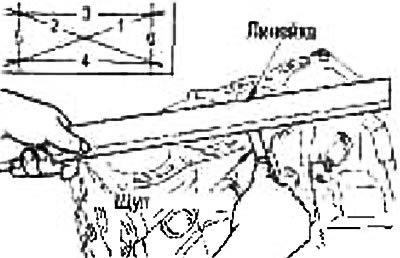
Limit: 0.1 mm
If warpage exceeds the limit, replace the cylinder block.
Inner diameter of main bearing housing
Install the covers without bearings and tighten the mounting bolts to the specified torque. For tightening procedure, see section "Assembly".
Using a bore gauge, measure the inside diameter of the main bearing housing.
Take the measurement at the location shown in the figure (5 mm back from the front end of the main bearing housing), in 2 directions. The smaller value will be the measurement result.
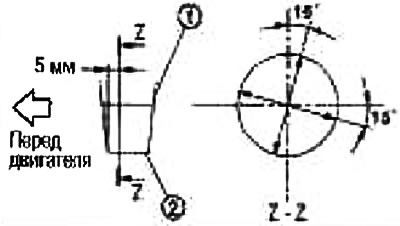
1. Cylinder block
2. Main bearing cap
Standard: 51.997-52.017 mm
If the diameter is different from the standard, replace the cylinder block and main bearing caps as an assembly.
Note: The cylinder block and main bearing caps are manufactured as one piece. They can only be replaced as a set.
Clearance between piston and cylinder wall
Inner diameter of the cylinder
Using a bore gauge, check each cylinder for wear, out-of-roundness and taper in 6 different positions: along the X and Y axes at points A, B and C. (Y is the longitudinal axis of the engine).
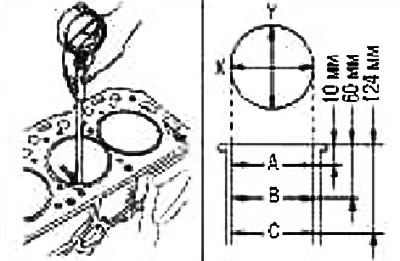
Note: When determining the cylinder diameter class, measure in position "B".
Standard inner diameter: 78.000-78.015 mm
Wear limit: 0.2 mm
Ovality (difference between "X" and "Y"): 0.015 mm
Taper (difference between "A" and "C"): 0.010 mm
If the measured value exceeds the limit or if there are scratches and/or scoring on the inner cylinder walls, replace the cylinder block.
Note: Oversized pistons are not available.
Piston skirt diameter
Measure the outside diameter of the piston skirt using a micrometer.
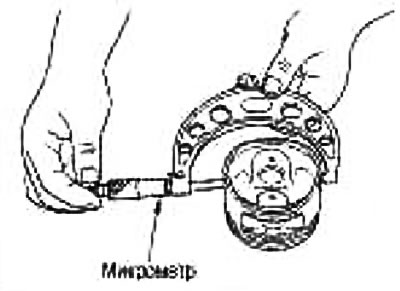
Measurement point (distance from the bottom): 37.1 mm
Standard: 77.955-77.980 mm
Clearance between piston and cylinder wall
Perform calculations based on the values of the piston skirt outside diameter and the cylinder inside diameter (axis "X", point "B")
(Gap) = (inner diameter of the cylinder) - (piston skirt outside diameter)
Standard: 0.020-0.050 mm
Limit: 0.09 mm
If the clearance exceeds the limit, replace the piston and piston pin assembly and/or the cylinder block.
Crankshaft journal diameter
Measure the outside diameter of the crankshaft journals using a micrometer (A).
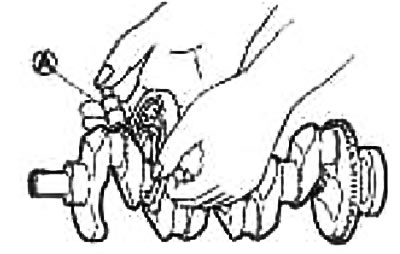
Standard: 47.959-47.979 mm
If the diameter is different from the standard, measure the oil clearance in the main bearings. Then use bearings of reduced repair size. See "Main Bearing Oil Clearance" below.
Crankshaft journal diameter
Measure the outside diameter of the crankpins using a micrometer.
Standard: 39.953-39.971 mm
If the diameter is different from the standard, measure the oil clearance in the connecting rod bearings. Then use bearings of reduced repair size. See "Connecting rod bearing oil clearance" below.
Ovality and taper of crankshaft journals
Using a micrometer, measure all main and rod journals at 4 different points shown in the illustration.
Ovality is determined by the difference in size between the X and Y axes at points A and B.
Taper is determined by the difference in size between points "A" and "B" along the axes "X" and "Y".
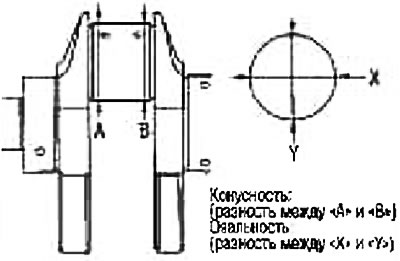
Ovality limit (difference between "X" and "Y"): 0.003 mm
Taper limit (difference between "A" and "B"): 0.004 mm
If the measured value exceeds the limit, regrind or replace the crankshaft.
In case of regrinding, measure the oil clearance of the regrinded main and/or connecting rod journals. Then select the main bearing and/or connecting rod bearing. See "Main Bearing Oil Clearance" and "Connecting Rod Bearing Oil Clearance" below.
Crankshaft runout
Place the prisms on a flat surface and install the crankshaft on them with the outer journals.
Place the indicator (A) vertically on main journal No.3.
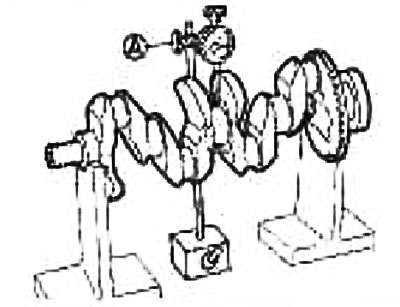
While turning the crankshaft, read the indicator readings (maximum indicator reading).
Limit: 0.10 mm
If the runout exceeds the limit, replace the crankshaft.
Connecting rod bearing oil clearance
Method of calculation
Install the bearings into the connecting rod and cap and tighten the connecting rod bolts to the specified torque. For tightening procedure, see the "Assembly".
Using a bore gauge, measure the inside diameter of the connecting rod bearing.
(Oil clearance) = (connecting rod bearing inner diameter) - (outside diameter of crank pin)
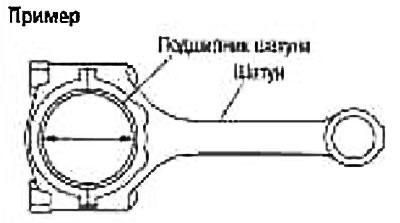
Standard: 0.037-0.047 mm
Limit: 0.010 mm
If the clearance exceeds the limit value, select the required connecting rod bearing according to the diameter of the big end of the connecting rod and the diameter of the crankshaft connecting rod journal and achieve the specified oil clearance in the bearing. See section "The procedure for selecting connecting rod bearings".
(Source is available on the resource Nissanbook.ru)
Method using calibrated plastic wire PLASTIGAGE
Completely remove oil and dust from the crankpins and bearing surfaces.
Cut the wire into pieces slightly shorter than the width of the bearings, place them in the direction of the crankshaft axis, but not on the lubrication holes.
Install the connecting rod bearings into the connecting rods and caps and tighten the bolts to the specified torque. For tightening procedure, see the "Assembly".
Caution: Do not turn the crankshaft.
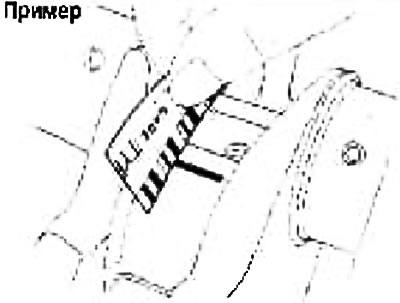
Remove the caps and connecting rod bearings and measure the width of the wire pieces using the scale on the wire package (see fig.).
Note: If the measured value exceeds the limit, take the same measures as specified in the "Calculation Method" section below.
Main bearing oil clearance
Method of calculation
Install the main bearings into the cylinder block and covers and tighten the bolts to the specified torque. Refer to the Assembly section for tightening procedure.
Measure the inside diameter of the main bearings using a bore gauge.
(Oil clearance) = (main bearing inner diameter) - (crankshaft journal diameter).
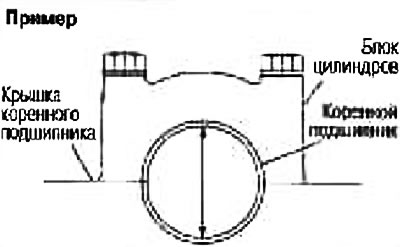
Standard: 0.024-0.034 mm
If the obtained value exceeds the limit, select the required main bearing according to the inner diameter of the main bearing and the outer diameter of the crankshaft main journal and achieve the specified oil clearance in the bearing. See section "The procedure for selecting main bearings".
Method using calibrated plastic wire PLASTIGAGE
Completely remove oil and dust from main journals and bearing surfaces.
Cut the wire into pieces slightly shorter than the width of the bearings, place them in the direction of the crankshaft axis, but not on the lubrication holes.
Install the main bearings into the cylinder block and covers and tighten the bolts to the specified torque. For tightening procedure, see the section "Assembly".
Caution: Do not turn the crankshaft.
Remove the main bearing caps and bearings and measure the width of the wire segments using the scale on the wire package.
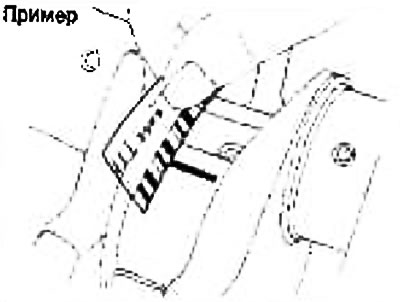
Note: If the measured value exceeds the limit, take the same measures as specified in the "Calculation Method" section.
Protrusion of the main bearing above the parting plane
When removing the main bearing caps after tightening to the specified torque with the main bearings installed, the edge of the bearing should protrude above the parting plane. For tightening procedure, see section "Assembly".
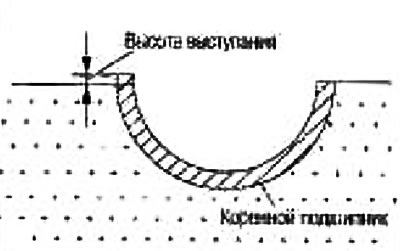
Standard: There must be a protrusion.
If the main bearings are not within specification, replace them.
Protrusion of the connecting rod bearing above the parting plane
When removing the connecting rod bearing caps after tightening to the specified torque with the connecting rod bearings installed, the edge of the bearing should protrude above the parting plane. For tightening procedure, see section "Assembly".
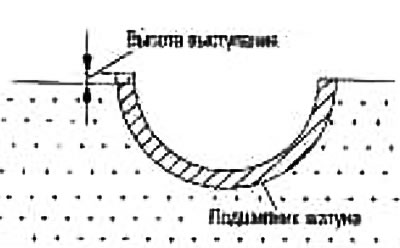
Standard: there must be a protrusion
If the connecting rod bearings are not within specification, replace them.
Main bearing cap bolt outer diameter
Measure the outside diameters ("d1", "d2") in two places shown in the figure.
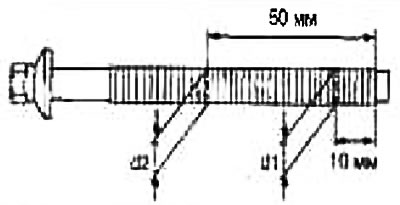
If the narrowing is observed in a section other than "d2", mark it as "d2"
Limit ("d1" - "d2") = 0.2 mm
If the constriction exceeds the limit (big difference in size), replace the main bearing cap bolt with a new one.
Connecting rod bolt outer diameter
Measure the outside diameter "d" at the location shown in the figure.
If the narrowing is observed at a location other than "d", label it as "d".
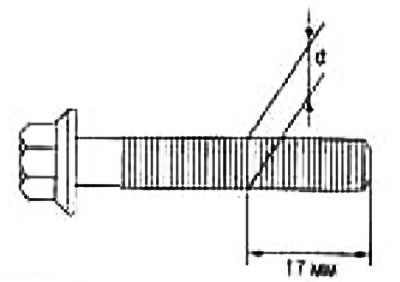
Limit: 7.75 mm
When the size "d" exceeds the limit (becomes thinner), replace the connecting rod bolt with a new one.
Flywheel deformation
Measure the deformation of the flywheel-clutch contact surface using a dial indicator.
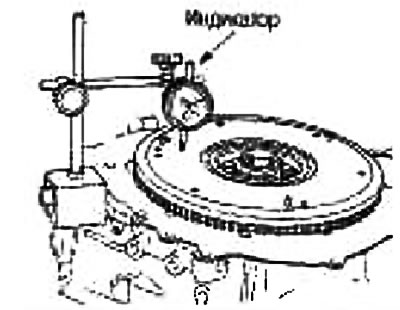
Standard: 0.25mm
If the deformation is different from the norm, replace the flywheel.