


Place chocks under the rear wheels at the front and rear.
If the engine is not equipped with lifting eyes, select them and bolts from the SPARE PARTS CATALOG.
Attention:
- Always carry out work in safe conditions, avoid performing unintended operations.
- Do not begin work until the exhaust system and engine coolant have cooled sufficiently.
- If the required components or operations are not covered in the Engine Mechanical chapter, see. relevant chapters.
- Always lift the engine using the indicated points.
- Use either a 2-post lift or other independent lift available to you. If, for reasons beyond your control, you have to use a side stand, before starting work, in order to avoid shifting the center of gravity in the rear
- in this direction, support the vehicle at the support point on the rear axle with a telescopic stand or similar device.
- For the support points for the lift and jack on the rear axle, see chapter "Garage jack, safety stands and 2-post lift".
Removal
Description of works
Remove the engine and transmission from the vehicle and separate the engine and transmission.
Preparatory work
1. If the engine can be lifted with a winch, remove the hood. See Chapter Body.
2. If the engine can be supported by a winch, remove the hood grille cover and hood grille extension assembly. See Chapter Body.
3. Relieve the fuel pressure. See chapter Engine management system.
4. Drain the engine coolant from the radiator. See chapter Lubrication system and engine cooling system.
Caution: Perform this operation when the engine is cold.
5. Remove the following components:
- engine protection from the bottom;
- headlights; see chapter Electrical equipment;
- hood grille; see chapter Body;
- protective strip from the front right and left fenders; see chapter Body;
- front wheels;
- battery, battery shelf;
- drive belts; see section "Drive belts";
- air duct and air cleaner housing assembly; see section "Air purifier and air duct";
- upper and lower radiator hoses, automatic transmission fluid radiator and cooling fan assembly; see chapter Lubrication system and engine cooling system;
- front exhaust pipe; see chapter Accelerator, fuel system and exhaust system.
In the engine compartment on the left
1. Disconnect all engine wiring connectors near the left engine mount insulator and temporarily secure the wiring to the engine.
Caution: To prevent foreign particles from getting into the connectors during work, cover them with plastic bags.
2. Disconnect the fuel hose from the engine side. See section "Fuel injectors and fuel line".
3. Disconnect the heater hoses. Plug the hoses to prevent engine coolant from leaking. See chapter Lubrication system and engine cooling system.
4. Disconnect the control linkage from the gearbox. See chapter Manual transmission.
5. Disconnect the ground wire from the transmission side.
In the engine compartment on the right
1. Disconnect the ground wire between the front cover and the vehicle.
2. Remove the generator and generator bracket. See chapter Electrical equipment.
3. Remove the air conditioning compressor from the engine (on models with air conditioning) with the tubes connected and temporarily secure it to the vehicle with a rope to prevent the tubes from stretching. See chapter Automatic air conditioner.
Under the bottom of the car
1. Remove the front ABS sensors (left and right) from the steering knuckle. See chapter Brake system.
Information copied from the website [NissanBook.ru]
2. Remove the brake caliper assembly with the pipes connected from the steering knuckle. Temporarily secure it to the side of the car with a rope to prevent stretching the brake hose. See Chapter Brake system.
3. Remove the drive shafts (left and right) from the steering knuckle. See chapter Front axle and suspension.
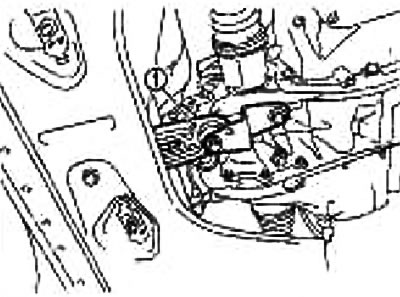
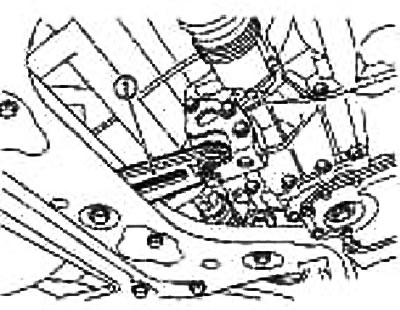
4. Remove the rear torque rod (1).
 |
 |
5. In preparation for separating the transmission, remove the transmission mounting bolts that pass through the lower rear of the oil pan (upper). See Chapters Manual transmission and Automatic transmission.
Removal operations
1. If the engine can be supported by a winch, remove the top of the intake manifold to keep it clear of the hanging chain. See Section "Upper part of the intake manifold".
2. If the engine can be supported by a winch, attach the engine lifting eyes to the front left (A) and rear right (B) of the cylinder head and support the engine by the winch.
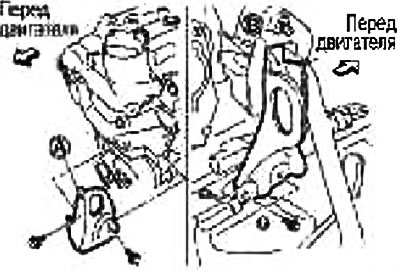
Lifting eye bolts: 25.5 Nm (2.6 kg·m)
3. Lift the engine with a winch and hang it in the required position.
4. Securely support the bottom of the engine and transmission using a jack stand (suitable special tool) or equivalent rigid device, eg telescopic stand and at the same time adjust the winch tension.
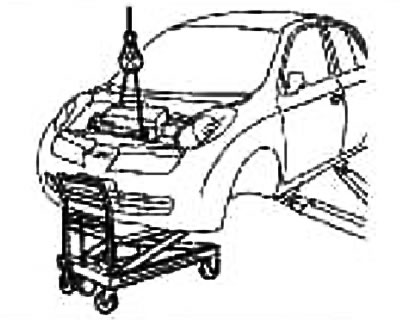
Note: Place a piece of board or similar as a support surface to provide stability.
5. Remove the right engine mount bracket (1), right engine mount insulator (2) and right engine mount bracket (3).
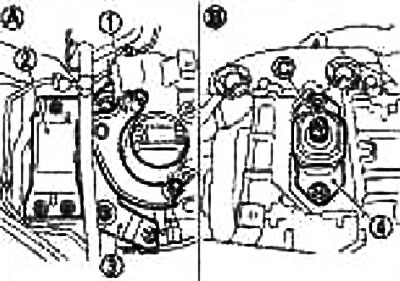
4. Left engine mount insulator
A. From the front of the engine
B. From the gearbox side.
6. Unscrew the nut (C) securing the through bolt of the engine mount.
7. Remove the engine and gearbox assembly from the vehicle from underneath using careful lifting equipment.
Attention:
- When carrying out work, make sure that no part of the engine touches the body.
- Before and during lifting, check that all electrical wiring is disconnected.
- During removal, do not allow the vehicle to fall off the lifting device due to a shift in the center of gravity.
- If necessary, support the vehicle using a jack or equivalent device from behind.
Separation operations
Caution: During this operation, support the engine securely by placing a block of wood under the engine oil pan and transmission oil pan and lift it by the lifting eyes using a winch.
1. If the engine is not lifted with a winch at the same time, secure the engine lifting eyes at the front left and rear right of the cylinder head. See "Removal" above.
2. Remove the generator. See chapter Electrical equipment.
3. Lift with a winch and place over the engine.
4. Separate the engine and gearbox. See chapters Manual transmission and Automatic transmission.
Installation
Installation is carried out in the reverse order of removal, taking into account the following:
Avoid damaging the engine mount insulator or allowing oil to come into contact with it.
If installation direction is specified, refer to the component drawing above and install according to the direction marks.
Make sure all support insulators are seated correctly and tighten the mounting nuts and bolts.
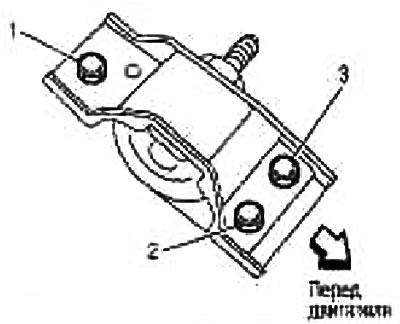
Tighten the right engine mount insulator bolts in the order shown by the numbers in the illustration.
Post-installation check
Checking for leaks
Below are procedures for checking for fluid, engine oil and exhaust leaks.
Before starting the engine, check the oil/fluid levels, including engine coolant and engine oil. If the level is low, top up to the required level. See chapter General information and maintenance.
Check for fuel leaks as follows:
- Turn the ignition key to the "ON" position (without starting the engine). After creating pressure in the fuel lines, check for fuel leaks at the joints.
- Start the engine. Increase the engine speed and check again for fuel leaks at the fuel line joints.
Let the engine run and check for any unusual noise or vibration.
Warm up the engine thoroughly and check for any fuel, exhaust or oil/fluid leaks, including engine coolant and engine oil.
Bleed air from the pipes and hoses of the relevant systems, such as the cooling system.
After the engine has cooled down, check the oil/fluid levels again, including engine coolant and engine oil. Top up as necessary to the proper level.
Check table
| Component | Before starting the engine | With the engine running | After the engine has stopped |
| Engine coolant | Level | Leakage | Level |
| Motor oil | Level | Leakage | Level |
| Other oils and liquids** | Level | Leakage | Level |
| Fuel | Leakage | Leakage | Leakage |
| Exhaust gases | - | Leakage | - |
*: Fluid for manual transmission, automatic transmission, brake fluid, etc