


Table of contents: Draining engine coolant ↓ Filling the engine with coolant ↓ Engine coolant filling capacity: ↓ Flushing the cooling system ↓
Attention:
- To avoid getting burned, do not change the coolant when the engine is hot.
- Wrap the lid with a thick cloth and carefully remove the lid. First, unscrew the lid a quarter turn and release the pressure. Then unscrew the lid all the way.
Draining engine coolant
All models except models with manual transmission and air conditioning
1. Disconnect the lower hose from the radiator and remove the radiator cap.
Caution: Drain the coolant when it is cold.
2. Remove the reservoir and drain the coolant as follows:
- a. Move the relay box in front of the battery.
- b. Separate the reservoir from the fan housing. Apply force towards the left side of the vehicle and lift the reservoir upward.
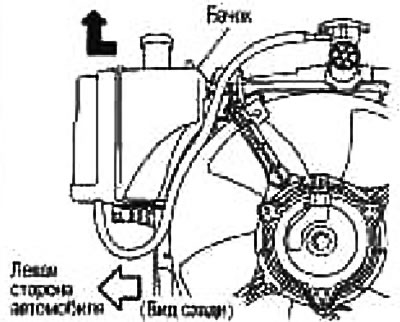
3. Check the drained coolant for contaminants such as rust, corrosion and color change.
If there are traces of contamination, flush the engine cooling system.
Models with manual transmission and air conditioning
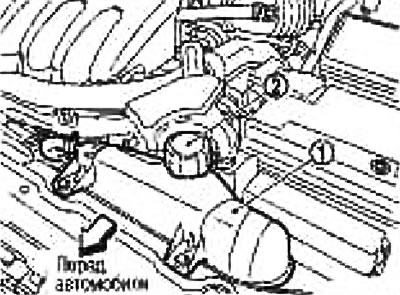
1. Disconnect the lower hose from the radiator and remove the cap from the tank.
Caution: Drain the coolant when it is cold.
2. Remove the reservoir and drain the coolant.
3. Check the drained coolant for contaminants such as rust, corrosion and color change.
If there are traces of contamination, flush the engine cooling system.
Filling the engine with coolant
1. Install the tank.
2. Connect the lower hose to the radiator.
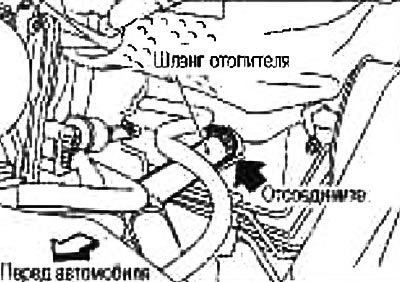
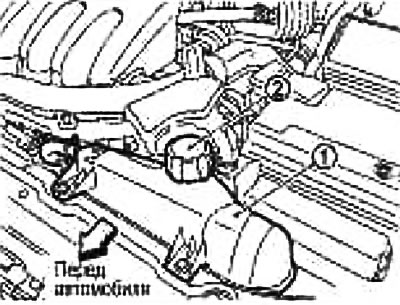
3. Disconnect the heater hose (from the side of the heater hose outlet: from the top side), as shown in the figure. Keep the end of the hose at the same height as before removal.
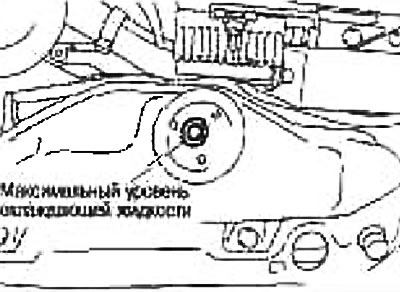
4. Fill the radiator and reservoir to the required level.
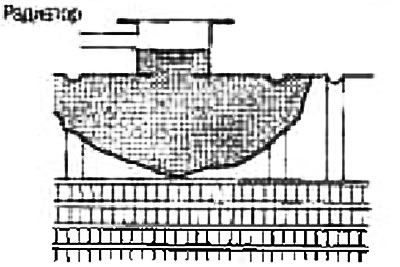
Pour the coolant slowly at a rate of less than 2 liters per minute to allow air to escape from the system.
When coolant begins to flow out of the heater hose, reconnect the heater hose and continue filling.
Use NISSAN GENUINE COOLANT L250 or equivalent mixed with water (distilled or desalted). See chapter General information and technical services.
Engine coolant filling capacity:
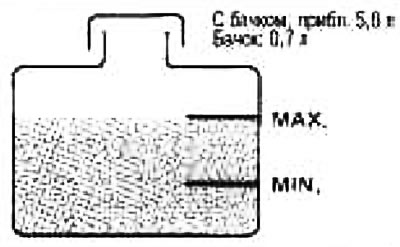
All models except models with manual transmission and air conditioning
Models with manual transmission and air conditioning
With reservoir: approx. 6.0 l
Tank: 1.2 l
 |
 |
5. Start the engine and warm it up to normal operating temperature, tightening the radiator cap.
6. Warm up until the thermostat opens. Maintain the engine speed at approximately 3000 rpm for 10 minutes.
To determine if the thermostat is opening, touch the upper radiator hose with your hand and make sure that hot fluid flows through it.
Caution: Watch the coolant temperature gauge to avoid overheating the engine.
7. Turn off the engine.
8. When the engine has cooled down (to about 50°C or below), remove the radiator cap and check the coolant level. If the level is low, add coolant to the radiator up to the filler neck and repeat from step 5.
9. When the coolant level has stabilized, fill the tank to the "MAX" mark.
10. Check for leaks in the cooling system with the engine running.
11. Allow the engine to cool down (to approximately 50°C or below).
12. Start the engine Perform the following operation three times. Maintain the engine speed at 1000 rpm for about 30 seconds. Then gradually increase the speed to 3000 rpm.
13. When performing step 12, make sure that no sound of fluid leaking from the radiator core can be heard.
Sound may be heard from the heater.
14. If the sound is heard, repeat operations from step 4 to step 13.
Wipe off excess coolant from the engine.
Flushing the cooling system
1. Fill the radiator and reservoir with water and tighten the cap on the radiator.
2. Start the engine and warm it up to normal operating temperature.
3. Press the accelerator pedal two or three times without load.
4. Turn off the engine and wait until it cools down.
5. Drain the water.
6. Repeat steps 1-5 until clean water starts flowing out of the radiator.