


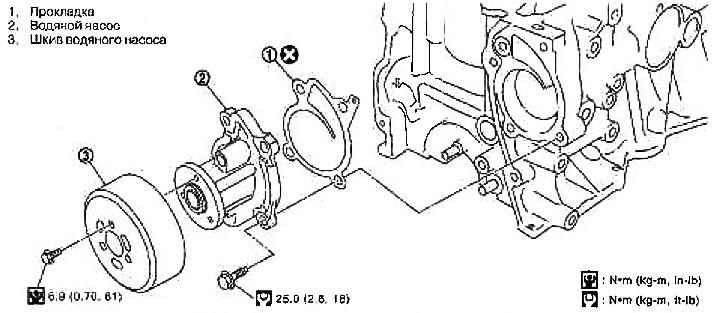
Removal
1. Drain the coolant.
Caution: Do not remove the radiator cap when the engine is hot. High-pressure coolant squirting out of the radiator can cause severe burns.
Drain the coolant when it is cold.
2. Turn the front wheels to the right.
3. Remove the front fender (right) protective cover. See chapter Body.
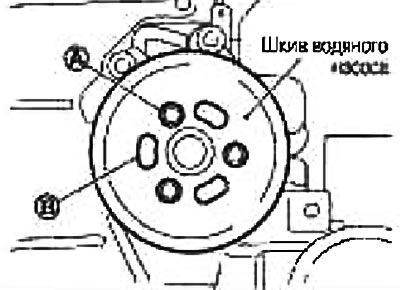
4. Before releasing the drive belt tension, loosen the water pump pulley mounting bolts.
5. Remove the drive belt. See chapter Mechanical part of the engine.
6. Remove the water pump pulley.
7. Remove the water pump.
Loosen the mounting bolts in the reverse order to that shown in the illustration.
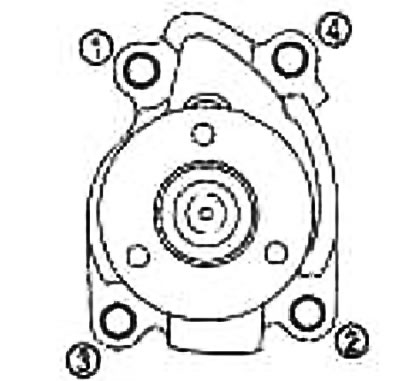
When removing, the coolant remaining in the engine will spill out. Collect it in a container.
Attention:
- Do not allow water pump blades to come into contact with other components.
- The water pump cannot be disassembled and must be replaced as an assembly.
Check after removal
Make sure there is no significant dirt or rust on the water pump body or blades.
Check for play on the blade shaft. Check if the shaft rotates freely by hand.
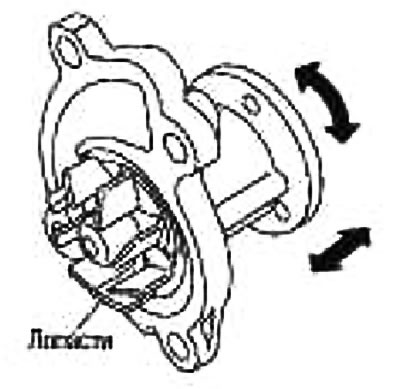
If any abnormalities are found, replace the water pump.
Installation
Installation is carried out in the reverse order of removal, taking into account the following:
Installing a water pump
Tighten the mounting bolts in the order shown by the numbers in the illustration.
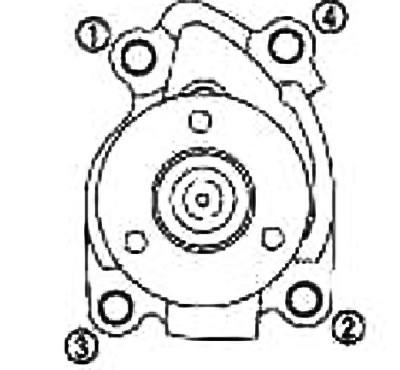
Water pump pulley
Caution: Do not insert the mounting bolts (A) into the oval holes (B).
Post-installation check
Check for engine coolant leaks using a radiator cap adapter (special tool: EG17650301) and the pump (suitable tool) (models without air conditioning.) or using a pump and an adapter for the tank lid (models with air conditioning.).
Start the engine and warm it up to normal operating temperature. Conduct a visual inspection to ensure there are no coolant leaks.