


Table of contents: Checking the level ↓ Checking for leaks ↓
Checking the level
All models except models with manual transmission and air conditioning
Make sure that the coolant level in the reservoir is between the "MIN" and "MAX" marks when the engine is cold.
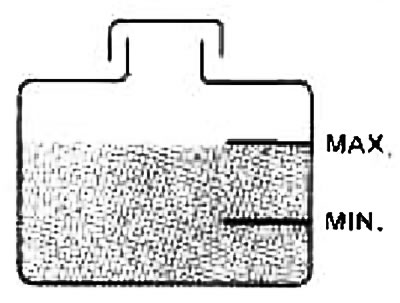
If necessary, top up the coolant level to normal.
Models with manual transmission and air conditioning
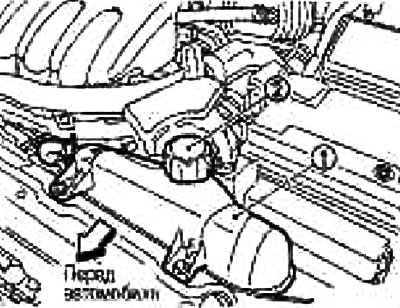
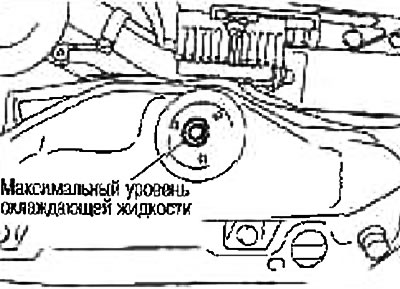
Make sure the coolant level in the reservoir is between the "MIN" and "MAX" marks when the engine is cold.
If the coolant level is too high or too low, top up to the correct level.
 |
 |
Checking for leaks
All models except models with manual transmission and air conditioning
To check for leaks, pressurize the cooling system using a pump (suitable tool) and an adapter (special tool).
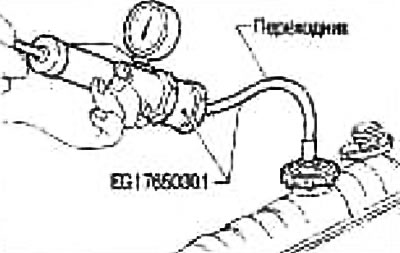
Test pressure: 157 kPa (1.6 kg/cm²)
Caution: Do not remove the radiator cap when the engine is hot. High-pressure coolant squirting out of the radiator can cause severe burns.
Caution: Pressures higher than specified may cause damage to the radiator.
Note: If the coolant level drops, add coolant to the radiator.
If any deviations are found, correct the defects or replace damaged components.
Models with manual transmission and air conditioning
To check for leaks, attach the adapter to the tank, then connect it to the pump.
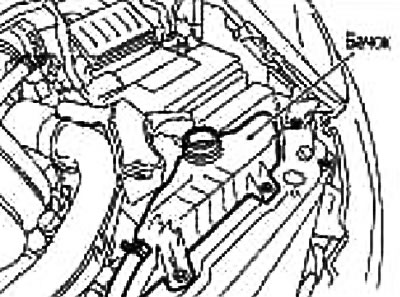
Warm up the engine and turn it off.
Build up pressure in the cooling system and stop pumping.
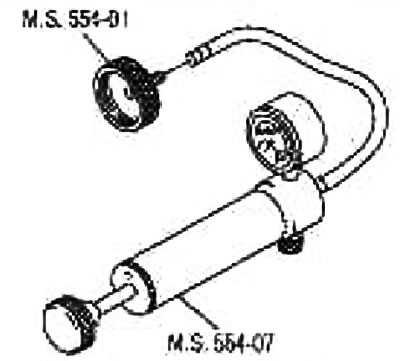
Test pressure: 90 kPa (0.92 kg/cm²)
If the pressure drops, check for leaks.
Slowly unscrew the adapter from the tank, release the pressure in the cooling system and replace the cap.
Caution: Do not remove the radiator cap when the engine is hot. HIGH-PRESSURIZED COOLANT escaping from the radiator can cause serious burns.
Caution: Pressures higher than specified may cause damage to the radiator.