


Table of contents: Removal a carburetor engine ↓ Installation of the unit ↓ Disconnecting and connecting the…↓ Engine mounts ↓
1. The engine is removed together with the gearbox downwards, i.e. the car must be raised accordingly to allow enough space. To facilitate the work, you will need either a crane or a strong assistant to lower the unit using a cable and a steel rod.
2. Due to the differences in removing injection and carburetor engines, the procedures are described separately, first for injection engines.
3. Remove the battery ground cable. The battery can be removed to provide more space. This also prevents short circuits during operation (for example, if a tool falls on the terminals).
4. Unbolt the hood. Locate the hood panel hinges and unbolt the bolts. Have an assistant hold the hood so it cannot tip over. Place the hood in a safe place to avoid damage.
5. Remove all plates under the front of the car.
6. Remove the air filter as described in the relevant section.
7. Drain the coolant as described in Chapter Cooling and heating systems. The coolant contains antifreeze concentrate and must be collected in a clean container for reuse. To drain, remove the lower hose on the radiator (having previously opened the lid).
8. Remove the radiator together with the fan as described in Chapter Cooling and heating systems. In the case of an automatic transmission, also disconnect the oil cooler hoses from the radiator. Collect the transmission oil in a container provided.
9. Remove the power steering pump without disconnecting the hoses. Remove the alternator and, if equipped, the air conditioning compressor. Do not disconnect the compressor hoses from the fittings.
10. Unscrew the exhaust pipe from the exhaust manifold and release the exhaust pipe mount from the suspension. In Chapter Suspension and steering further instructions on this work are given.
11. Referring to the illustration, disconnect the shift rod (1) and the thrust bar (2) with the manual transmission installed.
In Chapter Manual transmission, differential and final drive further details of this work are given.
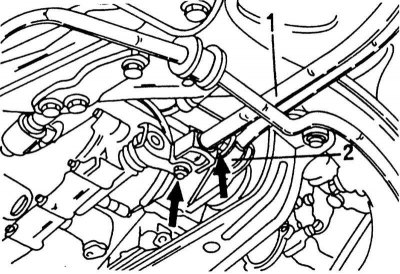
Disconnecting the shift rod with a manual transmission installed
1 - shift rod
2 - stop bar
12. With the automatic transmission installed, disconnect the shift cable on the transmission side and the throttle cable on the engine side.
13. Loosen the nut located inside the fork head (see illustration below) and disconnect the clutch cable from the release lever when it is long enough to do so.
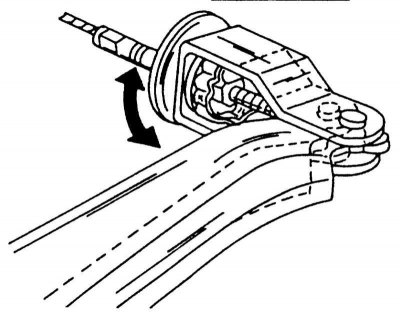
The clutch cable is held on the inside of the fork head.
14. Following the curve of the speedometer cable, remove the mounting plate bolt. Remove the entire clutch cable from the gearbox. The drive gear remains on the cable. Plug the hole in the gearbox with a rag (see illustration below).
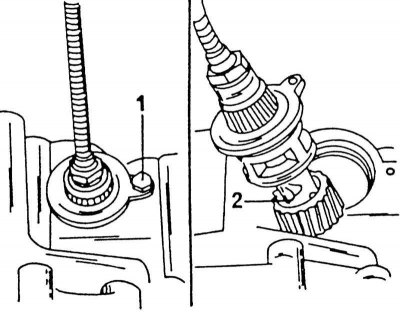
Fastening the speedometer cable (1) in the left picture and removing the cable with the gear (2) in the right picture.
15. Disconnect the throttle cable from the throttle body.
16. Disconnect all vacuum and air hoses between the engine and the body. Depending on the country of destination and the applicable emission control laws, the routing of the vacuum hoses varies. Chapter Fuel and exhaust systems contains details on adjusting the gas composition.
17. Disconnect all electrical wires between current consumers on the engine and the body. These include the generator, oil pressure sensor, remote thermometer thermal sensor, ignition distributor, starter, etc.
18. Before disconnecting the fuel system pipes, the pressure in the system should be reduced. To do this, open the fuse box cover and remove the fuse shown in the illustration. Start the engine. After a while, it will stall because no fuel will be supplied. Turn the crankshaft two or three more times with the starter to relieve all the pressure. Immediately put the fuse back in place. Now you can disconnect all the fuel hoses between the engine and the body.
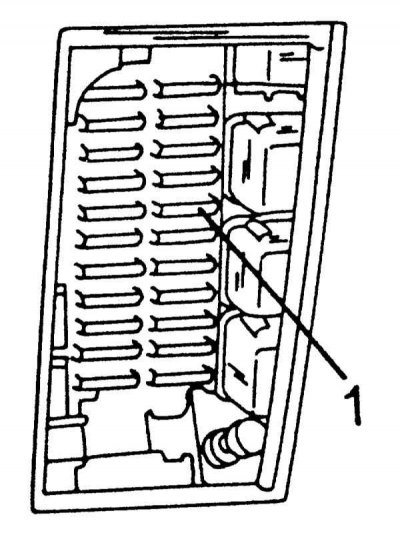
Position of the fuel pump fuse (1) in the fuse box.
19. Place the front of the vehicle on supports and remove the front wheels.
20. Remove the brake calipers on both sides. Do not unscrew the brake hoses from the calipers and pipes. After loosening the two bolts, hang the caliper on a wire from the front suspension so that the caliper does not hang on the hose.
21. On each side of the vehicle, remove the ball joint nut from the steering knuckle and use a puller to disconnect the ball joint from the steering knuckle. Press the wishbone down until the ball joint pins are free. In the illustration, the lower arrow indicates where the ball joint is connected. In Section Front suspension the removal of the front suspension ball joint is described in detail.
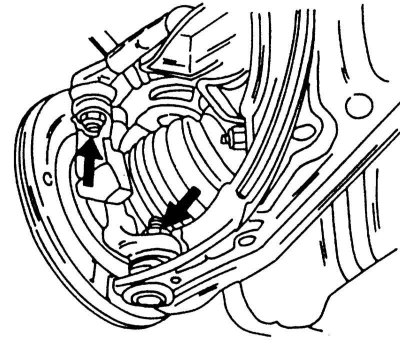
The arrows indicate the connections that need to be disassembled to remove the drive shafts.
22. Disconnect the tie rod ends in the same manner, but this time from the steering arm. This connection is indicated in the illustration above by the left arrow. In Sections Steering without power steering and Power steering (servo control) the use of the puller is described in more detail.
23. Drain the transmission oil.
24. Disconnect the drive shafts from the gearbox as described in Chapter Clutch and drive shafts and remove the steering knuckle, press the shafts outward from the gearbox. In this case, a screwdriver is installed behind the hinge. With a short jerk of the screwdriver, remove the retaining ring from the differential gear and the shaft will pop out. Depending on the design of the shaft, removal may differ, which is described in more detail in Chapter Clutch and drive shafts. Be careful not to damage the seal in the gearbox. If the seal is damaged, it should be replaced before installing the drive shaft.
25. Attach a suitable rope or chain to both engine lifting eyes and tie the rope or chain to a crane. If there are no lifting eyes, prepare two strong steel angles and screw one at the back and one at the front of the cylinder head. Raise the unit slightly from the engine compartment so that the rope is taut. Hold the engine and gearbox in this position.
26. Place a mobile lift under the gearbox (placing a wooden spacer between them) and raise the transmission. You may need to tighten the engine jack.
27. From the bottom of the gearbox, unscrew and remove the middle beam. It is secured on both sides with two bolts and is also connected to the unit at the front and rear by suspension supports.
28. Unscrew the one shown in illustrations front engine mount and shown in illustrations rear engine mount. Also unscrew the gearbox mount. Always ensure that the weight of the unit is off the supports. If necessary, lower or raise the crane. When unscrewing the engine mount, follow these instructions:
- When loosening the suspension on the end side, remove only the bolt and nut inserted in the middle.
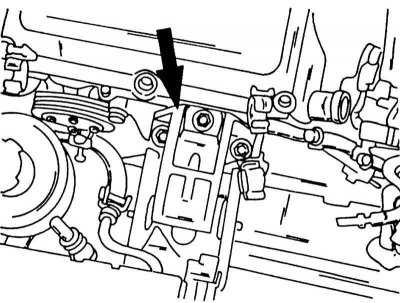
Front suspension of injection engine.
- When loosening the rear engine mount, only unscrew the engine bracket from the cylinder block.
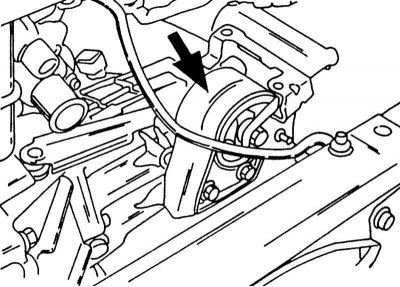
Rear engine mount. Injector and carburetor engine.
- The engine mounts remain on the engine and can be removed if necessary after the unit has been removed.
29. Check that all connections between the unit and the body are loosened and lower the engine slowly down. At the same time, operate the lift and crane accordingly. An assistant is required to guide the unit. When lowering, be careful not to damage engine parts, i.e. hoses, cables, pipes, etc. Be careful not to damage the brake pipes and the master cylinder.
Removal a carburetor engine
1. Disconnect the ground cable from the battery. The battery should be removed to allow more space. In addition, it prevents short circuits (for example, if a tool falls on the terminals).
2. Unscrew the hood. Trace the hinges with a pencil and loosen the bolts. Have an assistant hold the hood so it doesn't tip over. Put the hood in a safe place to avoid damage.
3. Remove all panels bolted under the front of the body.
4. Remove the air filter as described in the relevant chapter.
5. Drain the coolant as described in Chapter Cooling and heating systems. The coolant contains antifreeze concentrate, so for reuse it should be collected in a clean container. To drain, disconnect the lower hose from the radiator (having previously opened the radiator cap).
6. Remove the radiator together with the fan.
7. Unscrew the intake manifold supports to gain access to the battery cable connected to the starter.
8. Loosen the power steering pump belt and remove the pump without disconnecting the hoses.
9. Unscrew the exhaust pipe from the exhaust manifold and release the exhaust pipe mount from the suspension.
In Chapter Suspension and steering detailed instructions for this work are given.
10. Guided by illustration disconnect the shift rod (1) and the stop bar (2). In Chapter Manual transmission, differential and final drive this work is described in more detail.
11. Loosen the nut inside the fork head (see illustration) and disconnect the clutch cable from the release lever when it is long enough by loosening the nut.
12. Following the curve of the speedometer cable, remove the mounting plate bolt. Remove the entire clutch cable from the gearbox. The drive pinion remains on the cable. Plug the hole in the gearbox with a rag (see illustration).
13. Disconnect the throttle cable from the lever on the carburetor.
14. Disconnect all hoses and lines between the engine and the body.
15. Disconnect all electrical wires between power consumers on the engine and the body. These include the generator, oil pressure sensor, remote thermometer heat sensor, ignition distributor, starter, etc.
16. Disconnect the fuel lines between the fuel pump and the fuel line from the tank.
17. Place the front of the vehicle on supports and remove the front wheels.
18. Remove the brake calipers on both sides. Do not unscrew the brake hoses from the calipers and pipes. After loosening the two bolts, hang the caliper on a wire from the front suspension so that the caliper does not hang on the hose.
19. On each side of the vehicle, remove the ball joint nut from the steering knuckle and use a puller to disconnect the ball joint from the steering knuckle. Press the wishbone down until the ball joint pins are free. On illustrations the lower arrow indicates the location of the ball joint connection. In Section Front suspension the removal of the front suspension ball joint is described in detail.
20. Disconnect the tie rod ends in the same manner, but this time from the steering arm. This connection is marked on illustrations Steering without power steering and Power steering (servo control) the use of the puller is described in more detail.
21. Drain the transmission oil.
22. Disconnect the drive shafts from the gearbox as described in Chapter Clutch and drive shafts and removing the steering knuckle, press the shafts outward from the gearbox. In this case, a screwdriver is installed behind the hinge. With a short jerk of the screwdriver, remove the retaining ring from the differential gear and the shaft will pop out. Depending on the design of the shaft, removal may differ, which is described in more detail in Chapter Clutch and drive shafts. Be careful not to damage the seal in the gearbox. If the seal is damaged, it should be replaced before installing the drive shaft.
23. Attach a suitable rope or chain to both engine lifting eyes and tie the rope or chain to a crane. If there are no lifting eyes, prepare two strong steel angles and screw one at the back and one at the front of the cylinder head. Raise the unit slightly from the engine compartment so that it is slightly taut. Hold the engine and gearbox in this position.
24. Place a mobile lift under the gearbox (placing a wooden spacer between them) and lift the transmission. You may need to tighten the engine jack.
25. From the bottom of the gearbox, unscrew and remove the middle beam. It is secured on both sides with two bolts and is also connected to the unit at the front and rear by suspension supports.
26. Unscrew the front engine mount shown in the illustration.
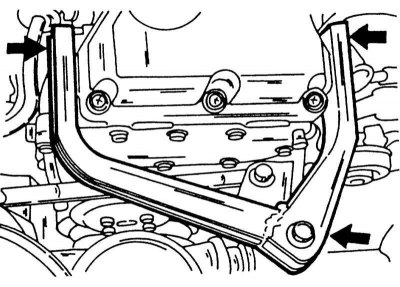
Engine mount on the end face of a carbureted engine. Arrows indicate where the bolts are located.
27. To do this, unscrew only the three bolts indicated by the arrows.
28. Unscrew the one shown in illustrations rear engine mount. Also unbolt the gearbox mount. Always ensure that the weight of the unit is off the supports. Lower or raise the lift if necessary.
29. Check that all connections between the unit and the body are loosened and slowly lower the engine down. At the same time, operate the lift and crane accordingly. In order to guide the unit, the help of an assistant is required. When lowering, be careful not to damage engine parts, i.e. hoses, cables, pipes, etc. Be careful not to damage the brake pipes and the master cylinder.
Installation of the unit
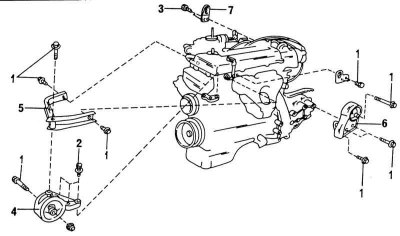
Elements installed on a carburetor engine
1 - 45-55 Nm; 2 - 50-60 Nm; 3 - 22-29 Nm; 4 - front engine support; 5 - Front engine mounting bracket; 6 - rear engine support; 7 - lifting eyes
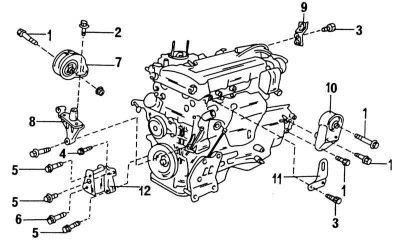
Elements installed on an injection engine
1 - 45-55 Nm; 2 - 50-60 Nm; 3 - 22-29 Nm; 4 - 74-83 Nm; 5 - 64-74 Nm; 6 - 62-78 Nm; 7 - front engine mount; 8 - suspension carrier; 9 - rear lifting eye; 10 - rear engine support; 11 - Front lifting eye
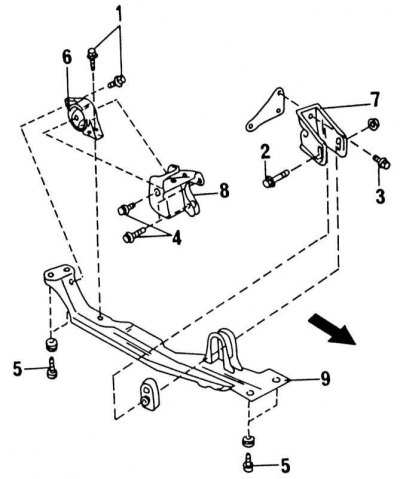
Engine mount components mounted on the crossmember. Arrow points to the front of the vehicle
1 - 50-60 Nm; 2 - 62-78 Nm; 3 - 45-55 Nm; 4 - 65-75 Nm; 5 - 77-98 Nm; 6 - rear engine support; 7 - suspension console; 8 - suspension console; 9 - cross beam
1. Place the engine and gearbox under the vehicle and secure the cable to the lugs. Lift the unit by cable into the engine compartment until it is approximately in the desired position. Check that there are no disconnected components in the way. When lifting, be careful not to crush any components. Be careful not to damage the brake pipes and the master cylinder.
2. Align the engine in the mounts and set the cable tension so that the engine mounts can be secured. Follow these instructions when bolting the engine mounts:
- Tighten the nuts and bolts of the front engine mount, i.e. those shown in the illustrations Rear engine mount. Injector and carburetor engine or Engine mount on the end face of a carburetor engine, with a force of 45-55 N·m. If the engine mount was unscrewed from the console (injection engine) or from the engine (carburetor engine), it should be screwed with a force of 50-60 Nm.
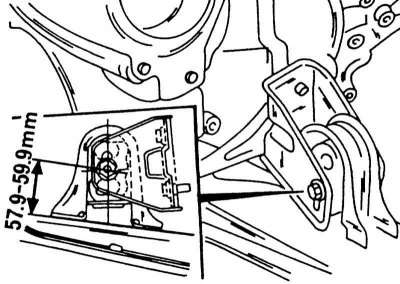
The engine mount height on the cross beam must match the specified size. Only then tighten the horizontally inserted bolt with nut.
3. Tighten the horizontally inserted bolts to 45 - 55 N·m.
- Tighten the bolts and the rear suspension bolts of the unit to 45 - 55 N·m. Tighten the large through bolt to the same torque.
- With a manual gearbox installed, the engine mount shown in the illustration above must be adjusted for height. The suspension console has longitudinal holes and the inserted bolt must be tightened with a nut with a force of 62 - 78 N·m, when the shown in the figure is maintained illustrations size.
- Tighten the cross member on the lower side at both ends to 77 - 98 N·m. If the rear support was removed, tighten it to 50 - 60 N·m. If the bracket on the other side of the engine was unscrewed, tighten it to 45 - 55 N·m.
- All other engine mount tightening torques are shown in the illustrations Elements installed on an injection engine and Engine mount components mounted on the crossmember. Arrow points to the front of the vehicle Since tightening torques vary greatly, great care must be taken not to strip the bolt.
4. Disconnect the cable from the power unit and remove the lift.
5. Insert the drive shafts into the gearbox as described in Chapter Clutch and drive shafts.
6. Connect all electrical wires between electrical consumers on the engine and the body. These include the generator, oil pressure sensor, remote thermometer thermal sensor, ignition distributor, starter, fuel system components, etc. Connect the fuel lines in place.
7. Connect all vacuum and air hoses between the engine and the body. Depending on the country of destination and the applicable emission control laws, the vacuum hose routing varies. In Chapter Fuel and exhaust systems details are given on the regulation of the exhaust gas composition.
8. Reconnect the throttle cable and check that the throttle valve opens fully when the gas pedal is depressed.
9. Insert the speedometer cable and install the mounting plate shown in illustrations. Tighten the mounting plate bolts.
10. Attach the clutch cable to the clutch lever and tighten the adjusting nut. Adjust the clutch pedal as described in Chapter Clutch and drive shafts and tighten the lock nut.
11. With the automatic transmission installed, connect the shift cable and throttle cable to the transmission.
12. Guided by illustration, attach the shift rod (1) and the thrust bar (2) if a manual transmission is installed. In Chapter Manual transmission, differential and final drive a detailed description of this work is given.
13. Screw the exhaust pipe to the exhaust manifold and secure the pipe to the suspension. This work is described in detail in Chapter Suspension and steering.
14. Install the power steering pump, if equipped.
15. Install the radiator as described in Chapter Cooling and heating systems. If an automatic transmission is installed, connect an oil cooler to the radiator. Check the transmission oil level, top up if necessary.
16. Fill with coolant as described in Chapter Cooling and heating systems.
17. Install the air filter and connect the suction hoses.
18. Screw the hood on. The hinge marks must match. Use an assistant to position the hood so that it cannot tip over.
19. Start and warm up the engine. Check the ignition timing and engine idle speed, adjust if necessary.
Disconnecting and connecting the gearbox
1. Unscrew the starter from the clutch housing.
2. Loosen the bolts between the engine and gearbox.
3. Disconnect the gearbox from the engine. Make sure that the weight of the gearbox does not affect the clutch shaft. Attach the gearbox in the reverse order.
Engine mounts
As mentioned in the previous chapter, the suspension of injection engines differs from that of carburetor engines. To avoid mistakes when tightening the bolts, follow the illustrations. The mounting bracket, marked (7) on illustrations, is screwed to the engine. The console has longitudinal holes, which are used to adjust the engine suspension in height. The rear support (6) is screwed to the crossbar and is held inside the carrier (8).