


Table of contents: Valve drive mechanism (injection…↓ Valve seats ↓ Valves ↓ Valve guides ↓ Valve springs ↓
Valve drive mechanism (injection engine)
1. Check the levers for wear.
2. Measure the diameter of the hydraulic elements and replace if it is outside the range of 16.690 - 16.994. Using an internal micrometer, measure the bore of the elements (17.000 - 17.020). The difference between the obtained dimensions gives the value of the backlash, which should be within the range of 0.07 - 0.040 mm.
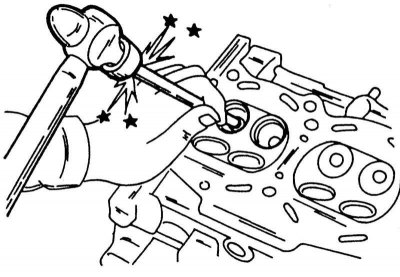
Knocking out the valve guide. Knock it out from the indicated side.
Valve seats
1. For all measurements mentioned, the corresponding size is indicated in Specifications. The dimensions for individual engine models differ, there is a difference even between the two injection engines. The seats in the cylinder head should be machined to the required angle using a milling cutter or grinding stone. The exact angles of the valve seat chamfers are specified in Specifications at the beginning of the Chapter. The width of the valve seat chamfer is different for carburetor and injection engines. Make sure the size is correct.
2. To reduce the width of the chamfer of the saddle, there are cutters with different angles, which are also given in Specifications at the beginning of the Chapter.
Valves should be lapped in the normal manner, using a good but non-installable valve for lapping.
3. If the valve seat chamfers are badly worn, new seats can be installed, but the cylinder head must be reamed to the appropriate size. This work must be done at a Nissan workshop, as the valve seats must be installed concentrically with the valve guides.
Valves
1. Check the valve stems for wear, nicks or cracks. Apply a steel ruler to a well-cleaned valve stem and check that the stem is straight. It should not be bent, as this will cause the valve to stick in the guide. Check the valve plates for carbon deposits or craters. There should be a certain distance between the top surface of the valve and the top edge of the valve chamfer. This dimension is designated as the valve edge width and should be within certain limits. Do not underestimate the minimum dimension under any circumstances. Valve plates can be ground with a special machine, provided that the required edge thickness is maintained.
2. If the ends of the valve stems are no longer smooth (they can no longer be properly actuated by rocker arms or pushrods) they can be sanded, provided that they are ground down no more than 0.2 mm.
Valve guides
The valve guides are pressed into the cylinder head. If the clearance between the stem and the valve guide is too large (more than 0.10 mm), the guides can be replaced. First check the clearance. To do this, insert the valve into the head as shown in the illustration below and pull it out by 15 mm. Install a dial indicator as shown and move the valve from side to side. If the clearance is more than 0.2 mm, the guide must be replaced. In this case, new valves should be installed.
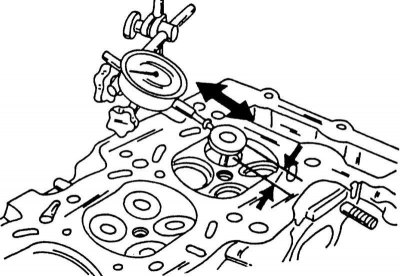
Checking the valve stem for wear in the bore.
1. For repairs, there are guides of repair size (different diameters for injection engines) and the holes in the head should be reamed accordingly to accommodate the new guides.
2. Be sure to maintain the specified dimension to ensure an accurate fit. The holes must be reamed to the specified size before pressing in the new guides.
3. Heat the cylinder head again to 110 - 130° and drive the new guides from the top side into the head until the protruding part (dimension "L" in the illustration below) has a length of 14.0 -14.2 mm for an injection engine or 11.5 - 11.7 mm for a carburetor engine. This work should be done very slowly and carefully so as not to drive the guide too deep. After all the guides have been driven, cool the head and ream the guide holes with a reamer of the appropriate size. Work with special oil, always from the combustion chamber side.
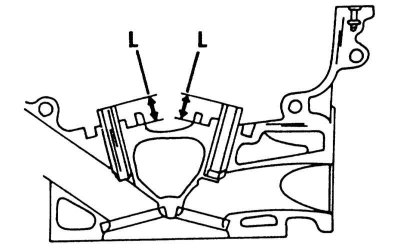
Dimension "L" is the size of the guide protrusion.
4. The exact valve stem play can be calculated by measuring the outer diameter of the stem and the inner diameter of the guide.
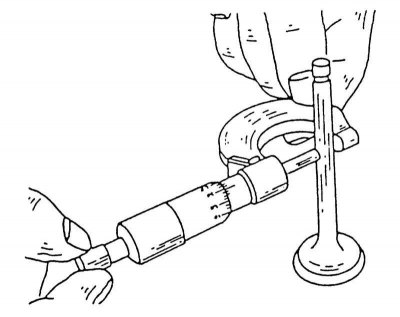
Measuring the diameter of the valve stems. Measure in three places along the entire length.
5. To measure the holes, you need an internal micrometer, as shown in the illustration below. To get the backlash value, you need to subtract one dimension from the other.
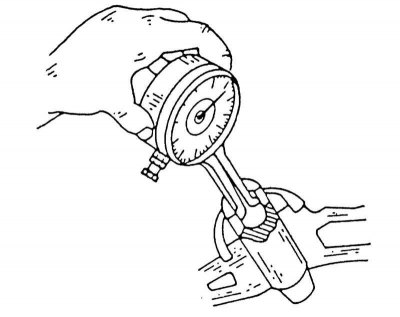
Measuring the valve guide bore with a dial indicator.
[Read more on the website: Nissanbook.ru]
6. After boring the guides, always chamfer the valve seats to maintain the alignment of the guides and seats. Otherwise, the valves will not close tightly.
Valve springs
It is always recommended to replace the valve springs if the engine has a high mileage. The spring can be checked by putting the old and new springs on the bolt, abutting each other, and tightening the nut with the corresponding washer. Tighten the nut until the springs are compressed and measure the length of the springs. If the old spring is shorter than the new one by 10%, the entire set should be replaced. A special testing device is required for an accurate check of the springs. If such a device is available, you can check the installation load and the associated spring length. Install the springs one by one on a flat surface (glass) so that the closed coil is at the bottom. Attach a steel square to the spring (see illustration below). Measure the gap between the square and the top, which should not exceed the specified value. Otherwise, the spring is bent and must be replaced.
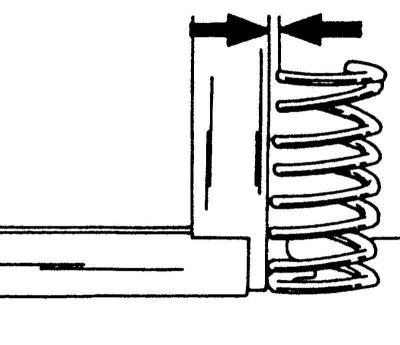
Checking the valve spring for bending. Install the spring as shown and check the upper side deflection.
Valve springs should be installed with the closed end at the bottom. If you look at the spring, you will see that the coils on one side are further apart than on the other side.