


Table of contents: Removal and installation - GA and SR…↓ Disassembly - GA engines ↓ Disassembly - SR Engine ↓ Removal - CD Engines ↓ Disassembly - CD engines ↓ Checking and repair ↓ Assembly - SA engines ↓ Assembly - SR engine ↓ Assembly - CD engines ↓ Installation - CD Motors ↓
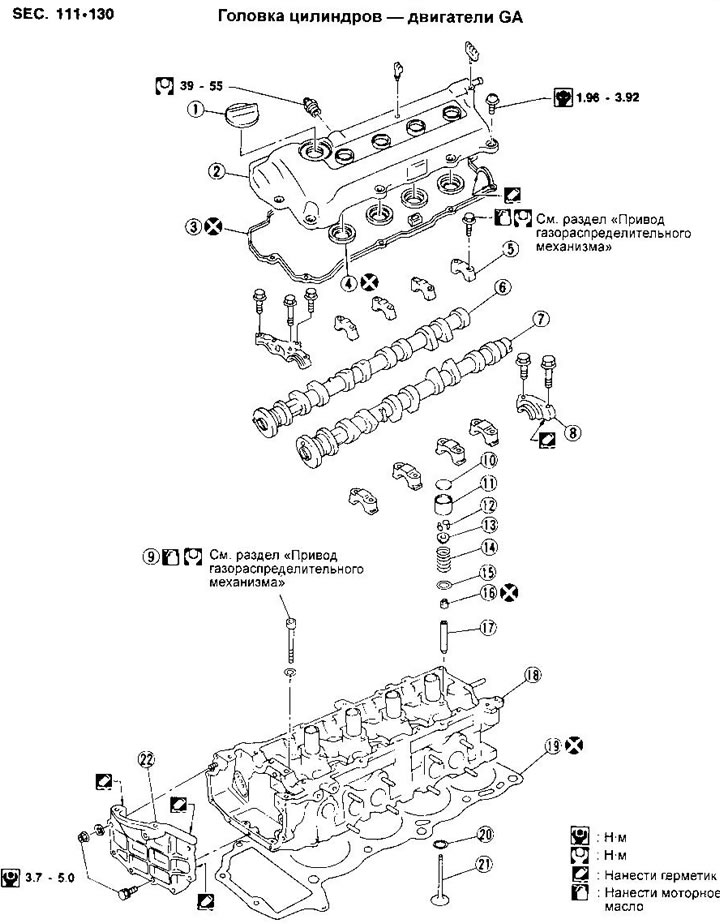
1. Filler cap
2. Cylinder head cover
3. Cylinder head cover gasket
4. Seal
5. Camshaft bearing cap
6. Intake valve camshaft
7. Exhaust camshaft
8. Ignition distributor bracket
9. Cylinder head mounting bolt
10. Adjusting washer
11. Valve tappet
12. Rusk
13. Spring plate
14. Valve spring
15. Valve spring seat
16. Oil deflector cap
17. Valve guide bushing
18. Cylinder head
19. Cylinder head gasket
20. Valve seat
21. Valve
22. Front cylinder head cover
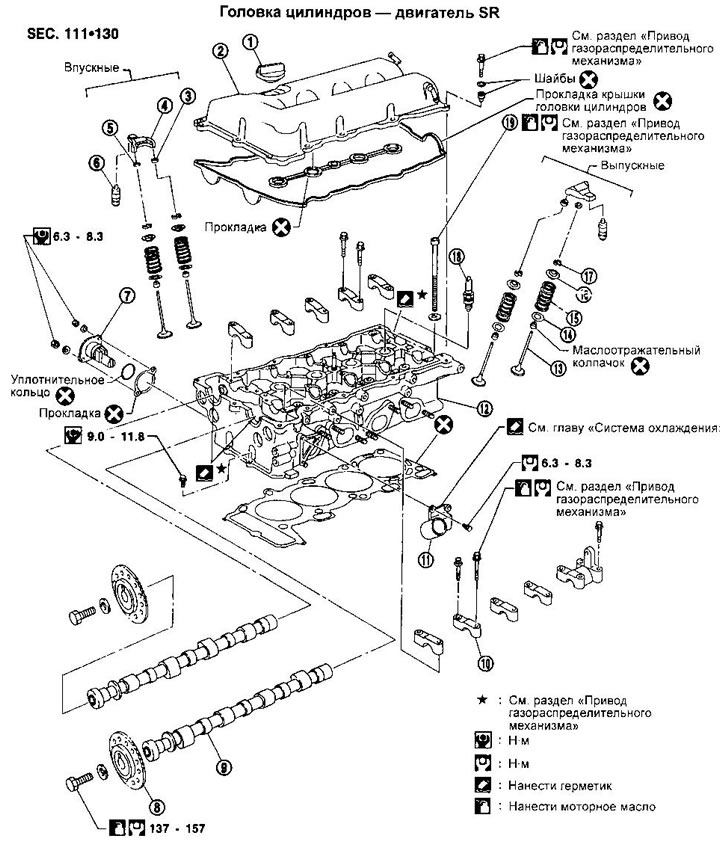
1. Filler cap
2. Cylinder head cover
3. Lever guide
4. Valve drive lever
5. Adjusting washer
6. Hydraulic clearance compensator
7. Timing chain tensioner
8. Camshaft drive sprocket
9. Camshaft
10. Camshaft bearing cap
11. Water pipe
12. Cylinder head
13. Valve
14. Valve spring seat
15. Valve spring
16. Valve spring plate
17. Rusk
18. Spark plug
19. Cylinder head mounting bolt
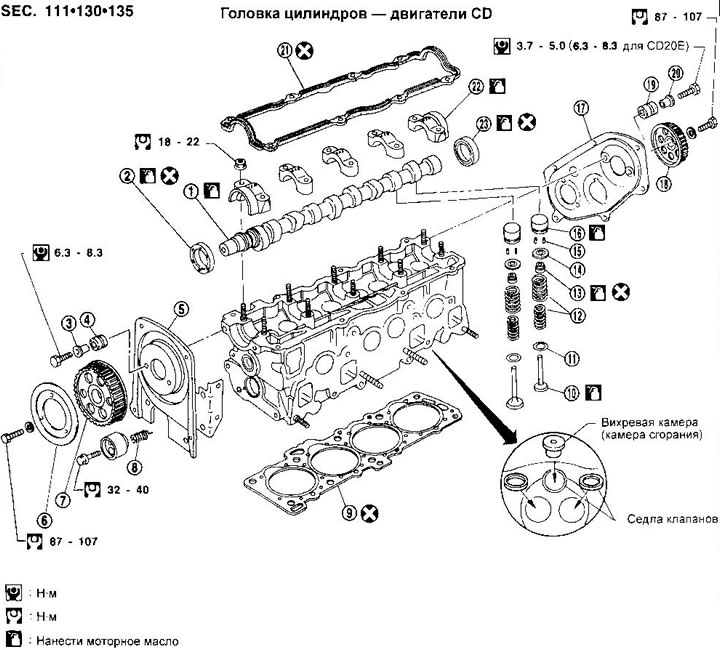
1. Camshaft
2. Front camshaft oil seal
3. Spacer sleeve
4. Rubber bushing
5. Front cover
6. Timing belt guide
7. Front timing pulley
8. Tension roller spring
9. Cylinder head gasket
10. Valve
11. Valve spring seat
12. Valve spring
13. Oil deflector cap
14. Spring plate (inlet valve) or valve rotator (exhaust valve)
15. Rusk
16. Hydraulic pusher
17. Back cover
18. Rear toothed pulley of the camshaft
19. Rubber bushing
20. Spacer sleeve
21. Cylinder head cover gasket
22. Camshaft bearing cap
23. Rear camshaft oil seal
NOTE: On the CD20E engine the rear cover has a different shape due to the installation of the vacuum pump.
Removal and installation - GA and SR engines
Removal and installation of the cylinder head are described in the section "Timing drive".
Disassembly - GA engines
1. Remove the valves using a special tool to compress the springs.
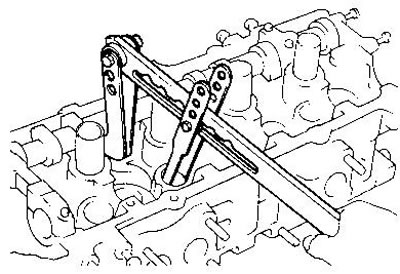
2. Remove the oil deflector caps (see section "Replacing the valve stem seals").
Disassembly - SR Engine
WARNINGS:
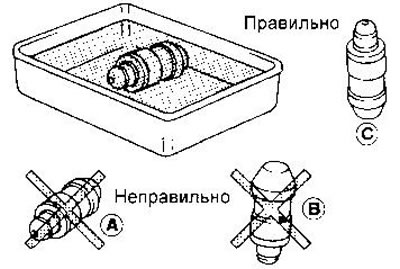
- If the hydraulic lifters are positioned horizontally, air may get in. After removal, keep the hydraulic lifters in a vertical position or immerse them in a bath of new engine oil.
- Do not disassemble hydraulic lifters.
- Mark the hydraulic lifters so that they can be installed in their original locations during assembly.
1. Remove the valve drive levers, adjusting washers, lever guides and hydraulic clearance compensators.
When assembling, all parts must be installed in their original places.
2. Remove the crankcase ventilation oil separator.
3. Remove the exhaust manifold cover.
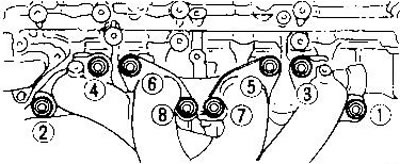
4. Remove the exhaust manifold, following the sequence of loosening the nuts shown in the figure.
5. Remove the water pipe.
6. Remove the intake manifold brackets.
7. Remove the fuel rail with injectors (see chapter "Engine management system").
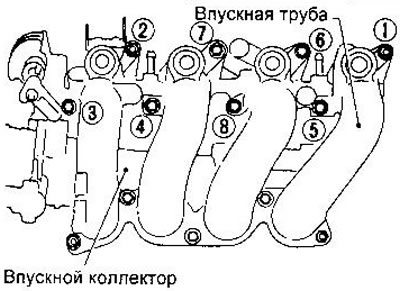
8. Remove the intake manifold, following the sequence of unscrewing the nuts shown in the figure.
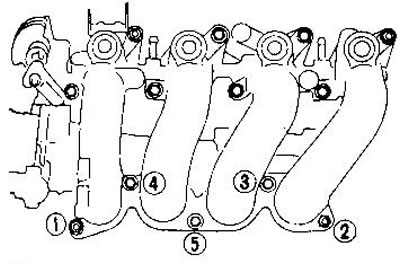
9. Disconnect the intake pipes from the manifold by loosening the nuts in the sequence shown in the figure.
10. Remove the thermostat housing together with the water hoses.
11. Remove the valves using a special device or its equivalent to compress the springs.
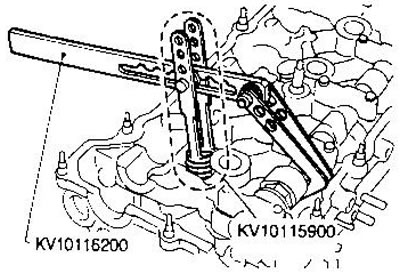
12. Remove the oil seals using pliers.
Removal - CD Engines
1. Drain the coolant and disconnect the intake pipe from the exhaust manifold.
2. Disconnect the water hoses, air line and remove the intake manifold.
3. Remove the heat shield and exhaust manifold.
4. Remove the cylinder head cover and injectors.
5. Remove both timing belts.
After removing the belts, do not turn the crankshaft and camshaft separately to avoid damaging the pistons and valves.
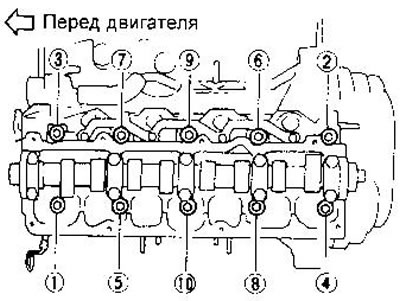
6. Remove the cylinder head, following the sequence of loosening the bolts shown in the figure.
Disassembly - CD engines
1. Remove the timing belt guide from the front camshaft pulley, then remove the front and rear pulleys using the special key and the rear cover.
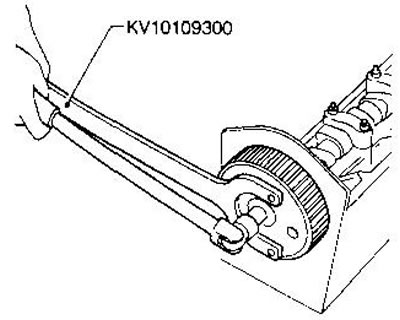
2. Remove the camshaft bearing caps, starting with the inner ones. Loosen the nuts in two or three steps.
3. Remove the camshaft and seals.
4. Remove the valve lifters.
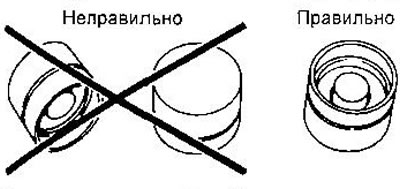
- Do not hold the hydraulic lifters as shown in the figure to avoid air getting into them.
- Do not disassemble hydraulic lifters.
- After removal, mark the tappets so that they can be reinstalled in their original locations.
- After removal, the tappets should be placed in engine oil.
5. Remove the valves using a special device or its equivalent to compress the springs.
When assembling, all valve parts must be installed in their original places.
6. Remove the oil seals using special tool KV10107902.
Checking and repair
Cylinder head deformation. Clean the cylinder head mating surface. Use a metal ruler and feeler gauge to check whether the flatness is within acceptable limits.
The check should be performed in 6 directions as shown in the figure.
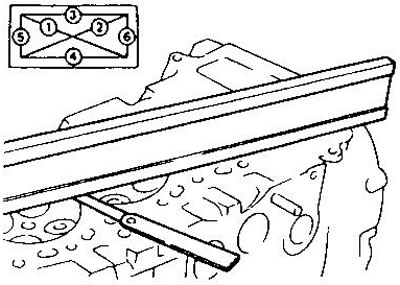
Deviation from flatness:
- Nominal - no more than 0.03 mm
- Maximum permissible - 0.1 mm
If the flatness in at least one direction exceeds the permissible limit, replace or regrind the cylinder head.
The maximum reduction in the height of the cylinder head is determined from the condition A + B = 0.2 mm (0.1mm for CD engines), where A is the reduction in the height of the cylinder head, B is the reduction in the height of the cylinder block after processing.
After resurfacing the cylinder head, the camshaft should rotate freely by hand. If resistance is felt, the cylinder head must be replaced.
Nominal cylinder head height:
- GA engines - 117.8-118.0 mm
- SR Engine - 136.9-137.1 mm
- CD engines - 137.9-138.1 mm
General condition of the camshaft. Check the shaft for scratches, scoring and visible wear. Runout of the camshaft. Measure the runout on the central journal, determining the maximum difference in indicator readings per revolution.
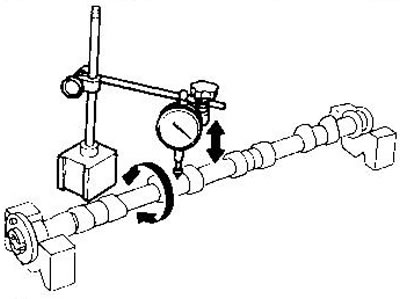
- Nominal runout - no more than 0.02 mm
Maximum permissible runout:
- GA and SR motors - 0.1 mm
- CD motors - 0.05 mm
If the runout exceeds the permissible limit, replace the camshaft.
Camshaft cam height
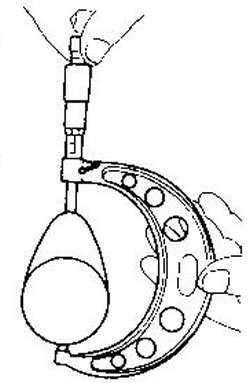
Measure the camshaft lobe height using a micrometer.
The wear limit for GA and SR engines is 0.2 mm. For CD engines, the cam lobe height must be within the limits specified below. If the wear exceeds the permissible values, replace the camshaft.
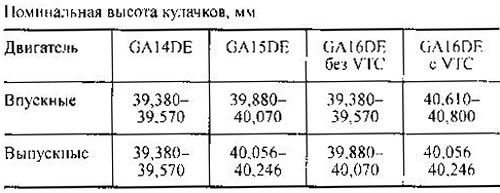
Nominal cam height for SR20DE (since 04.96):
- Intake 38.408-38.598 (37,989-38,179) mm
- Graduation 37,920-38,110 (37,309-37,499) mm
Nominal cam height for CD20 (CD20E):
- Intake - 49.20-49.25 (48,70-18,75) mm
- Graduation - 49.15-49.20 (49,15-49,20) mm
Diametrical clearance in camshaft bearings. Install camshaft bearing caps and tighten bolts to specified torque. Measure bearing inside diameter.
Nominal bore for GA motors:
- Bearing #1 - 28.000-28.021 mm
- Bearings No.2-5 - 24.000-24.021 mm
Nominal bore for SR motor:
- All bearings - 28.000-28.021 mm
Nominal internal diameter for CD motors:
- All bearings - 30.000-30.021 mm
Measure the camshaft journal diameter. Nominal journal diameter for GA engines:
- Neck #1 - 27.935-27.955 mm
- Necks #2-5 — 23.935-23.955 mm
Nominal journal diameter for SR engine:
- All necks - 27.935-27.955 mm
Nominal diameter of journals for CD engines:
- All necks - 29.935-29.955 mm
If the bearing clearance exceeds the limit specified below, replace the camshaft and/or cylinder head.
- Nominal clearance - 0.045-0.086 mm
Maximum permissible clearance:
- GA and SR motors - 0.15 mm
- CD motors - 0.1 mm
Camshaft axial clearance. Install the camshaft into the cylinder head and measure the axial movement of the shaft.
Nominal clearance, mm:
- GA 16DE without VTC and GAI4DE - 0.070-0.143
- GA16DE with VTC and GA15DE - 0.115-0.188
- SR Engine - 0.055-0.139
- CD engines - 0.115-0.188
Maximum allowable (GA and SR) - 0.20
For CD engines the gap should be within the limits specified above.
Runout of camshaft sprockets (c A and SR engines). Install the sprocket on the camshaft and measure the runout with a dial indicator.
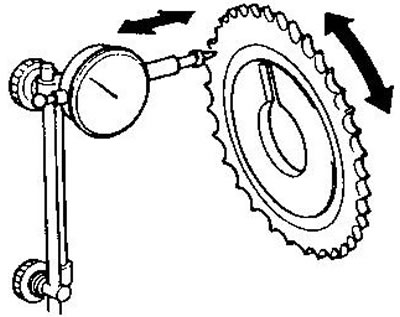
The difference in indicator readings for one shaft revolution should not exceed 0.1 mm for GA engines and 0.25 mm for SR engines.
Clearance between valves and guide bushings. Measure the valve clearance in the direction perpendicular to its axis. The distance from the valve plate to the valve seat should be about 25 mm for GA engines and about 15 mm for SR and CD engines.
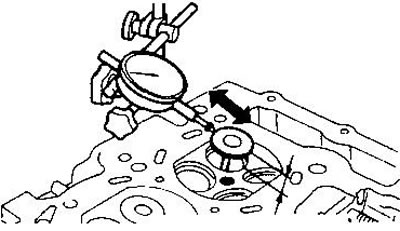
Maximum allowable clearance, mm:
- Engines GA and SR - 0.2
- CD Engines - 0.1
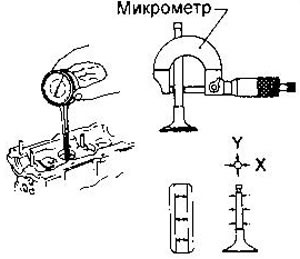
If the clearance exceeds the specified limit, check the clearance between the valve and the guide bushing by measuring the inner diameter of the bushing and the outer diameter of the valve stem.
Nominal clearance for intake valves, mm:
- GA and CD engines - 0.020-0.050
- SR engines - 0.020-0.053
Nominal clearance for exhaust valves:
- GA and CD engines - 0.040-0.070
- SR engines - 0.040-0.073
Maximum permissible gap, mm:
- Engine intake valves SR - 0.08
- The rest - 0.1
If the clearance exceeds the maximum allowable value, replace the valve or guide bushing.
Replacing valve guide bushings
1. Heat the cylinder head in an oil bath to 110-120°C (gA and SR engines) or 150-160°C (cD engines).
2. Knock out the guide bushing using a hammer and a suitable drift.
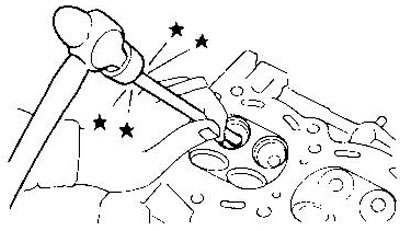
3. Ream the hole in the cylinder head for the repair size guide bushing (the holes for the inlet and outlet valve bushings have the same diameter).
Diameter of hole for guide bushing, mm:
- GA engines - 9.685-9.696
- Engine SR - 10.175-10.196
- CD engines - 11.185-11.196
4. Press in the new bushing, heating the cylinder head to the same temperature as when you pressed in the old bushing.
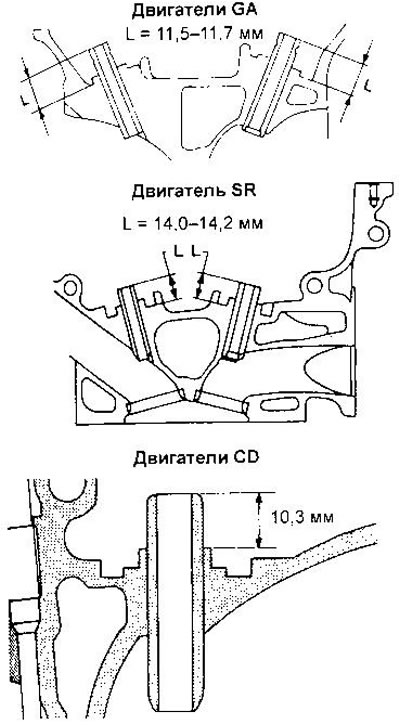
5. Unfold the new guide bushing. The inner diameters of the bushings for the intake and exhaust valves are the same.
Final diameter:
- GA engines - 5,500-5,515 mm
- SR Engine - 6.000-6.018 mm
- CD motors - 7,000-7,015 mm
Repair and replacement of valve seats. Valve seats are subject to repair or replacement if there is pitting, corrosion, damage or visible wear on the working chamfers.
Before repairing the seats, check the valves and guide bushings. Replace parts that are worn beyond acceptable limits, and only then begin milling and grinding the seats.
The replacement of the saddle is carried out as follows:
1. Drill out the old seat. Be careful not to damage the lower edge of the seat in the cylinder head.
2. Increase the diameter of the seat hole for the repair size seat.
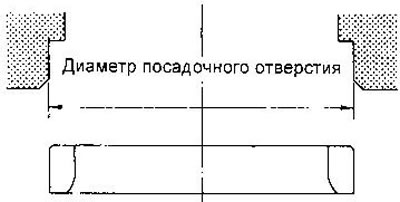
Diameter of the hole for the seat of the repair size of the intake valve, mm:
- Engines GA14DB/15DE - 30,500 30,516
- Engine GA16DE - 31,500-31,516
- Engine SR - 35,500-35,516
- CD engines - 41.432-41.454
Diameter of the hole for the seat of the repair size of the exhaust valve, mm:
- Engines GA14DE/15DE/16DE — 25,500 25,516
- Engine GA16DE with VTC — 26,500- 26,516
- Engine SR - 31,500-31,516
- CD engines - 35.432-35.454
Maintain alignment of the seat and guide bushing holes.
3. Heat the cylinder head in an oil bath to 110-120°C (gA and SR engines) or 150 160°C (cD engines) and press the new valve seat until it stops.
4. Use milling or grinding to give the saddle the required dimensions (see section "Data for adjustments and control"), then grind the valve.
For CD engines, the seat must be replaced at the same time as the valve.
Valves. Check the dimensions of each valve (see section "Data for adjustments and control"). If necessary, adjust the dimensions by grinding. The valve is subject to replacement if the thickness of the edge of the plate has decreased to 0.5 mm.
When grinding the valve stem tip, it is permissible to remove metal by no more than 0.2 mm (0.5mm for CD engines).
Valve springs. Measure the deviation from squareness (the value of S), using a steel square.
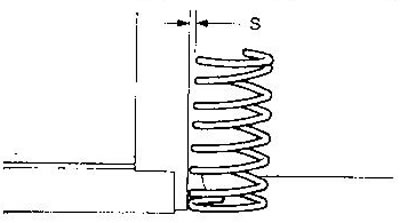
Maximum permissible value S, mm:
- GA engines - 1.8
- Engine SR - 2.1
- CD Engines:
- Outer springs - 2.1 (1.8 for CD20E)
- Inner springs - 1.9 (1.6 for CD20E)
Measure the height of the springs under load (see section "Data for adjustments and control").
If the permissible limits are exceeded, the spring must be replaced.
Valve lifters and adjusting washers (gA engines). Check the friction surfaces for visible wear, scratches and burrs.
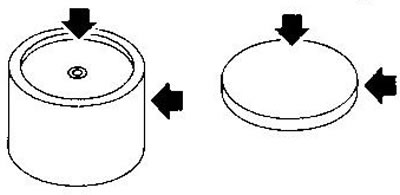
Measure the diameters of the tappets and guide holes in the cylinder head with a micrometer.
- Pusher diameter - 29.960-29.975 mm
- Hole diameter - 30.000-30.021 mm
- Permissible clearance - 0.025-0.061 mm
If the clearance is greater than the allowable limit, replace the tappet and/or cylinder head, depending on where the wear has exceeded the allowable limit.
Hydraulic compensators: gaps (sR engine). Check the friction surfaces for visible wear, scratches and burrs.
Measure the diameters of the hydraulic lifters and their mounting holes in the cylinder head.
- Hole diameter - 17,000-17,020 mm
- Permissible clearance - 0.007 0.040 mm
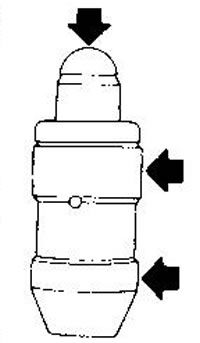
Hydraulic valve lifters (cD engines). Check the sight surfaces for visible wear, scratches and burrs. Measure the diameters of the tappets and guide holes in the cylinder head.
- Pusher diameter - 34.959-34.975 mm
- Hole diameter - 34.998-35.018 mm
- Nominal clearance - 0.023-0.059 mm
- Maximum permissible - 0.1 mm
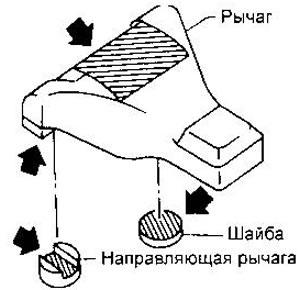
Valve drive levers (sR engine). Check the friction surfaces of the levers, washers and guides for visible wear, scratches and burrs.
Replacing the vortex chamber (cD engines). Replacing the swirl chamber is usually required quite rarely. The need for this arises when there are cracks or severe wear of the chamber.
1. Remove the glow plug connecting busbar, unscrew the glow plug and nozzle.
2. Heat the cylinder head in an oil bath to 150-160X.
3. Carefully knock out the swirl chamber, being careful not to damage the cylinder head and injector hole.
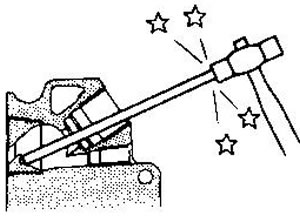
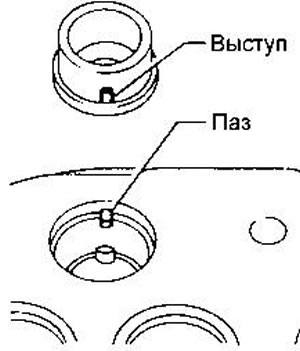
4. Install a new swirl chamber: To do this, heat the cylinder head again to 150-160X, align the chamber protrusion with the groove in the cylinder head and press the chamber in using a plastic hammer.
Assembly - SA engines
1. Install the valves.
Replace oil seals at each assembly (see the relevant section of this chapter).
Before installing the valve stem seal, install the valve spring seat.
After installing the valve, tap the valve stem with a plastic hammer to ensure that the spring is securely seated.
The spring coils with reduced pitch should face the cylinder head (if the spring has a color marking, it should be on the bottom).
Assembly - SR engine
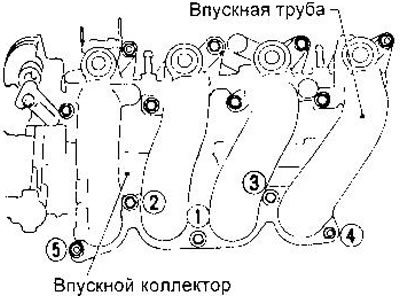
1. Attach the intake pipes to the intake manifold; observing the sequence of tightening the nuts as shown in the figure.
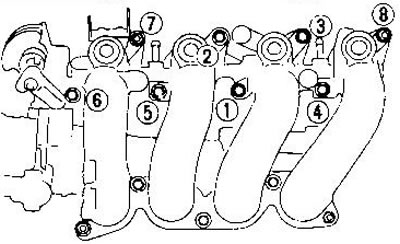
2. Install the intake manifold onto the cylinder head, following the specified tightening sequence of the nuts.
3. Install the fuel rail with injectors (see chapter "Engine management system").
4. Install the thermostat housing with water and hoses.
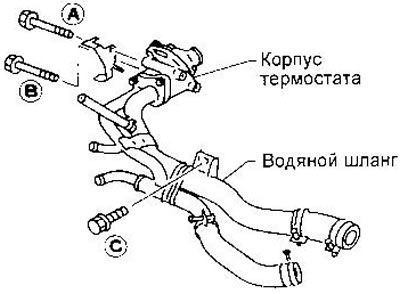
Tightening sequence:
- a) Tighten bolt A to 2-5 Nm.
- b) Tighten the bolt to a torque of 16-21 Nm.
- c) Tighten bolt A to 16-21 Nm.
- d) Tighten bolt B to 16-21 Nm.
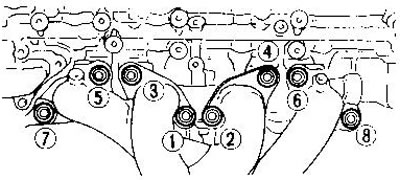
5. Install the exhaust manifold, tightening it in the sequence shown in the figure.
6. Install the exhaust manifold cover.
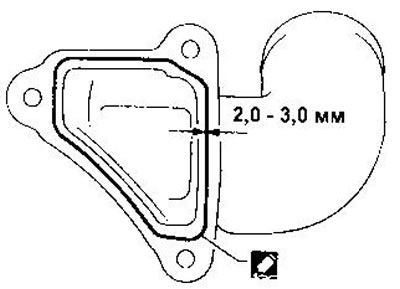
7. Install the water pipe, applying sealant to its flange. First remove all traces of old sealant from the pipe flange and cylinder head.
8. Install the intake manifold brackets.
9. Install the oil separator.
10. Install the valves.
The valve with the larger diameter disc is the inlet valve.
Install only new valve stem seals.
Before installing the valve stem seal, install the valve spring seat.
The spring coils with reduced pitch should face the cylinder head (color coding should be at the bottom).
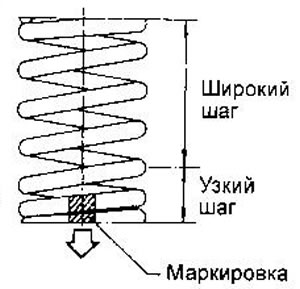
After installing the valve, tap the valve stem with a plastic hammer to ensure that the spring is securely seated.
11. Check the hydraulic clearance compensators.
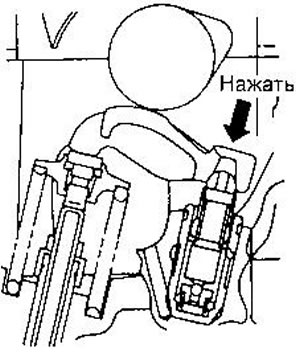
- a) Press the valve drive lever above the hydraulic compensator. If the lever moves down at least 1 mm, there is air in the high-pressure chamber. In this case, a specific valve noise will be heard when the engine is running.
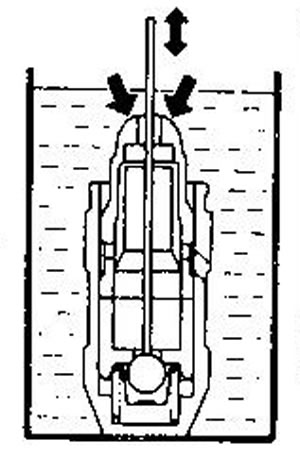
- b) To remove air from the hydraulic compensator, immerse it in a container with clean engine oil. Then, while pressing the plunger, press lightly on the ball with a suitable rod. The air is completely removed when the plunger no longer moves. Removing air from this type of hydraulic compensator is not possible with the engine starter.
12. Install the valve drive levers, washers and lever guides.
WARNING: All parts must be installed in their original locations.
13. When replacing the cylinder head, valve seat, washer or valve drive lever guide, it is necessary to select the thickness of the adjusting washer.
- a) Install all valve parts (except for the washer) into the cylinder head. The valve guide must be replaced with a new one.
- b) Remove the hydraulic clearance compensator.
- c) Insert the KV10115700 mandrel into the hole for the hydraulic compensator. The stand for the dial indicator is screwed into the mandrel.
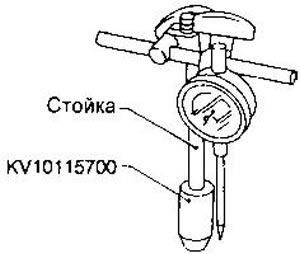
- d) Measure the height difference (T ₁) between the thrust surface of the lever guide and the end of the valve stem on which the washer is to be installed. When measuring, press lightly on the indicator stand to eliminate the influence of the clearance in the mandrel.
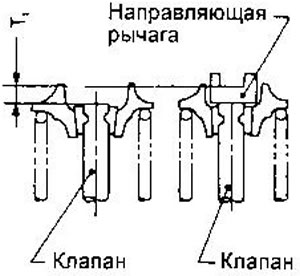
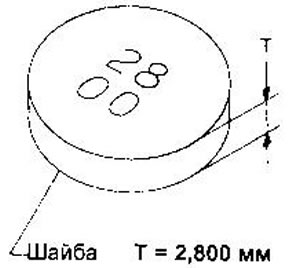
- e) Select a washer with thickness T = T ₁ = 0.025 mm. Washers with thicknesses from 2.800 to 3.200 mm in 0.025 mm increments are supplied as spare parts.
Assembly - CD engines
1. Install the valves.
Install only new valve stem seals.
Before installing the valve stem seal, install the valve spring seat.
The spring coils with reduced pitch should face the cylinder head (color coding should be at the bottom).
When installing the tapan, lubricate its rod and the edges of the oil deflector cap with engine oil.
Make sure there are no foreign particles on the valve disc.
The intake valves must be fitted with spring plates, and the exhaust valves must be fitted with valve rotators.
The valve rotators cannot be disassembled.
2. Install the camshaft and tighten the bearing cap nuts in two or three steps to a torque of 18-22 Nm.
Tightening should be done from the center to the edges, in the sequence shown in the figure.
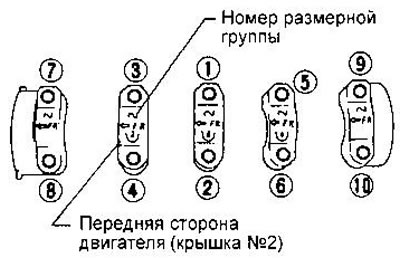
Apply sealant to caps #1 and #5.
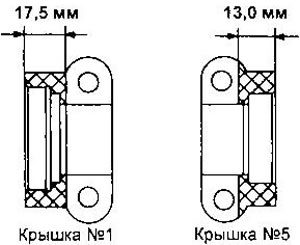
When installing the bearing caps, the camshaft must be installed in a position where the pin on its front end is on top.
Install new camshaft seals (see the relevant section of this chapter).
Installation - CD Motors
1. Install the cylinder head gasket.
When replacing only the gasket, install a gasket of the same thickness as the previous one.
When replacing or repairing the cylinder block, pistons, connecting rods and crankshaft, select the thickness of the gasket.
Pay attention to the installation direction of the cylinder head bolt washers.
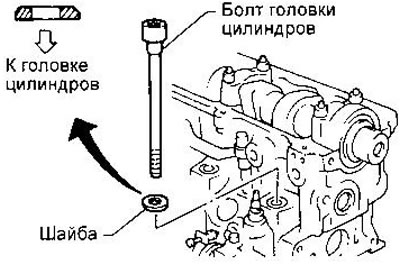
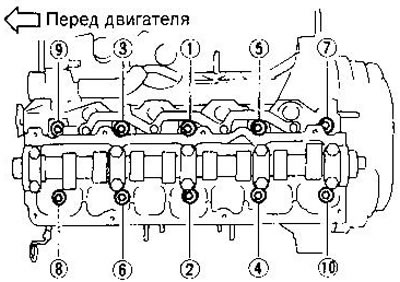
2. Install the cylinder head and tighten the bolts as follows:
- a) Tighten all bolts in the sequence shown in the figure to a torque of 39 Nm.
- b) Tighten the bolts to 83-93 Nm.
- c) Loosen all bolts completely.
- d) Tighten all bolts to 39 Nm.
- e) Tighten the bolts to an angle of 75-80°. If you do not have a spanner with a protractor, tighten the bolts to a torque of 83-93 Nm.
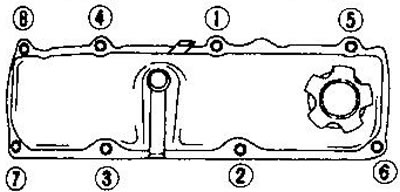
3. Install the cylinder head cover by tightening the bolts in the sequence shown in the figure.
Pre-apply THREE-BOND #10 or equivalent to the edges of bearing caps #1 and #5.
Selecting the thickness of the cylinder head gasket
4. Measure the amount of piston protrusion above the mating plane of the cylinder head.
- a) Place the dial indicator leg on the cylinder block and set the indicator to zero.
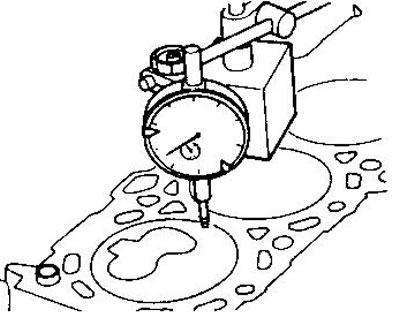
- b) Place the indicator foot on the piston bottom at the measuring point, being careful not to disturb the zero setting.
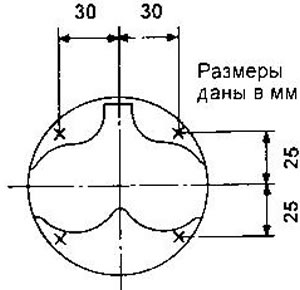
- c) Turn the crankshaft back and forth in the TDC area. Record the maximum indicator reading.
- d) Install the indicator leg on the cylinder block and make sure that the zero setting is not disturbed.
- e) Repeat steps c) and d) for all measuring points on the piston of each cylinder.
Make sure that the piston whose protrusion is being measured is set to TDC.
2. Calculate the arithmetic mean of the measurement results for each piston.
3. Calculate the arithmetic mean of the values obtained in step 2, rounding it to the 3rd decimal place.
4. Determine the required gasket thickness using the table.
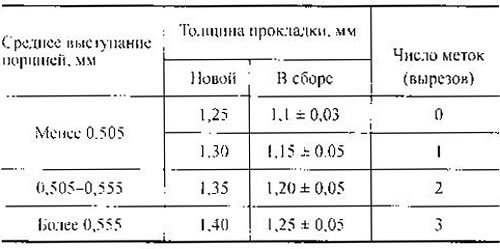
5. If the average protrusion of at least one of the pistons, determined in point 2, with an increase of 0.05 mm, exceeds the upper limit for a given gasket, use a gasket of the next thickness. Otherwise, use the gasket selected in point 4.