


Table of contents: Removal ↓ Check after removal ↓ Installation ↓ Post-installation check ↓ Check table ↓
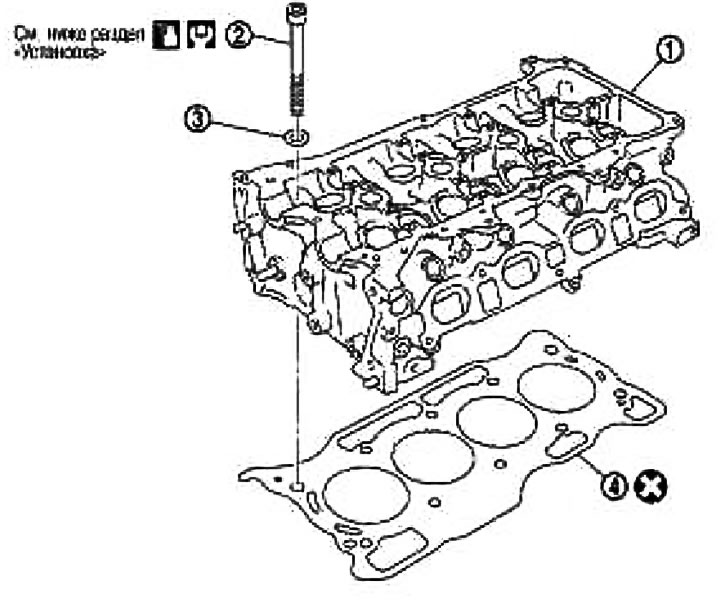
1. Cylinder head assembly; 2. Cylinder head bolt; 3. Washer; 4. Cylinder head gasket
Removal
1. Relieve the fuel pressure. See chapter Engine management system.
2. Drain the engine coolant and engine oil. See chapter Lubrication system and engine cooling system.
Caution: Perform this operation when the engine is cold.
3. Remove the following components:
- exhaust manifold; see section "Exhaust manifold";
- upper part of the intake manifold; see section "Upper part of the intake manifold";
- fuel injectors and fuel pipe assembly; see section "Fuel injectors and fuel line";
- outlet pipe; see chapter Lubrication system and engine cooling system;
- protective cover from the front right wing; see chapter Body;
- drive belts; see section "Drive belts";
- front cover; see section "Timing chain";
- camshaft; see section "Camshaft";
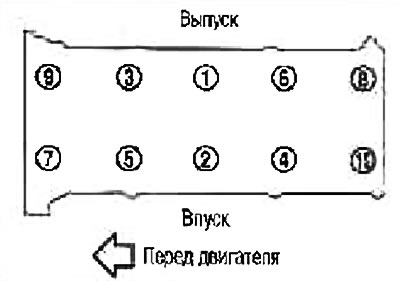
4. Remove the cylinder heads as an assembly by loosening the bolts in the reverse order shown in the figure using a wrench (suitable special tool).
5. Remove the gasket from the cylinder head.
Check after removal
Outside diameter of cylinder head bolts.
The cylinder head bolts are tightened using the plastic zone method. If the difference between "d1" and "d2" exceeds the limit value, replace the bolts with new ones.
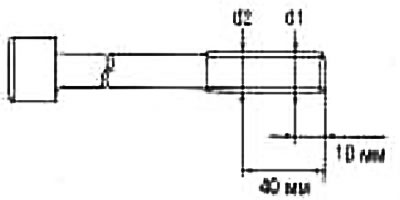
Limit ("d1" - "d2"): 0.15 mm
If the narrowing of the outside diameter is found at a location other than "d1", mark it as point "d2".
Cylinder head warping
Note: When performing this check, you should also check for warpage in the cylinder block. See section "Cylinder block warping".
1. Wipe off the oil and use a scraper to remove scale, gasket residue, sealant and carbon deposits from the surface of the cylinder head.
Caution: Do not allow gasket residue to enter the oil or water supply channels.
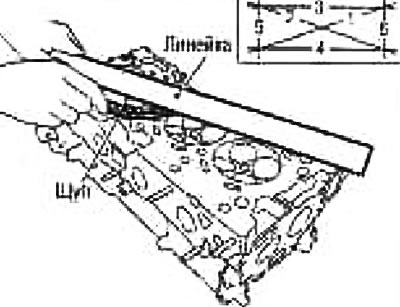
2. Check the cylinder head bottom surface for warpage by measuring in six directions.
Standard: 0.1mm
If warpage exceeds the limit, replace the cylinder head.
For more information, see the website (NissanBook.ru)
Installation
1. Install a new gasket on the cylinder head.
2. Install the cylinder head by performing the following operations and tightening the mounting bolts in the order indicated by the numbers in the figure.
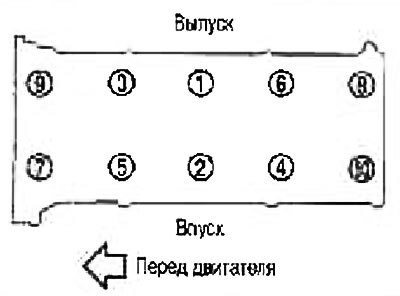
If cylinder head bolts are reused, check their outside diameter before installation. See "Cylinder Head Bolt Outside Diameter".
- a. Apply fresh engine oil to the threads and seating surface of the mounting bolts.
- b. Tighten all bolts. Tightening torque: 66.7 Nm (6.8 kg·m)
- c. Loosen completely to 0 Nm (0 kg·m)
Note: In step "c", loosen the mounting bolts in the reverse order to that shown in the figure.
- d. Tighten all bolts. Tightening torque: 40.0 N·m (4.1 kg·m).
- e. Tighten all bolts 75° clockwise (tightening at an angle).
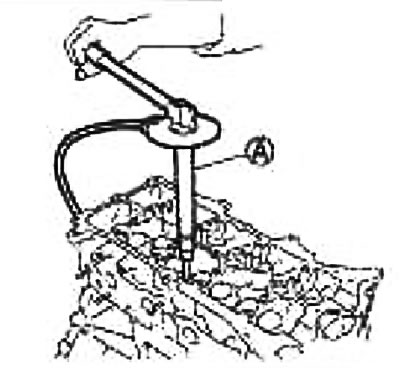
Note: Check the tightening angle with a protractor wrench (special tool: KV10112100) (A) Avoid eyeballing without using instruments.
- f. Tighten all bolts another 75° clockwise (tightening at an angle).
3. After this operation, installation is carried out in the reverse order of removal.
Post-installation check
Checking for leaks
Below are procedures for checking for fluid, engine oil and exhaust leaks.
Before starting the engine, check the oil/fluid levels including engine coolant and engine oil. If the level is low, top up to the required level. See chapter General information and maintenance.
Check for fuel leaks as follows:
- Turn the ignition key to the "ON" position (without starting the engine). After creating pressure in the fuel lines, check for fuel leaks at the joints.
- Start the engine. Increase the engine speed and check again for fuel leaks at the fuel line joints
Let the engine run and check for any unusual noise or vibration.
Note: If the hydraulic pressure inside the timing chain tensioner drops after removal/installation, a dull knocking sound may occur when the engine is started and immediately after the slack in the guide may result. However, this does not indicate a malfunction. The knocking sound will stop after the hydraulic pressure rises
Warm up the engine thoroughly and check for any fuel, exhaust or oil/fluid leaks, including engine coolant and engine oil.
Bleed air from the pipes and hoses of the relevant systems, such as the cooling system.
After the engine has cooled down, check the oil and fluid levels again, including engine coolant and engine oil. Top up as needed to the proper level.
Check table
| Component | Before starting the engine | With the engine running | After the engine has stopped |
| Engine coolant | Level | Leakage | Level |
| Motor oil | Level | Leakage | Level |
| Other oils and liquids* | Level | Leakage | Level |
| Fuel | Leakage | Leakage | Leakage |
| Exhaust gases | - | Leakage | - |
* Fluid for manual transmission, automatic transmission, brake fluid, etc