


Note: The direction of rotation indicated in the text refers to the rotation as viewed from the front of the engine.
Removal
1. Remove the front right wheel.
2. Remove the protective cover from the front right fender. See chapter Body.
3. Drain the engine oil. See chapter Lubrication system and engine cooling system.
Note: Perform this operation when the engine is cold.
4. Remove the following components:
- valve cover; see section "Valve cover";
- drive belts; see section "Drive belts";
- water pump pulley; see chapter Lubrication system and engine cooling system;
- grounding cable (between the right engine mount bracket and the radiator core support).
5. Support the bottom of the engine with a telescopic strut, then remove the bracket and the right engine mount insulator. See the Engine Assembly section.
6. Set the piston of cylinder No.1 to TDC in the compression stroke as follows:
- a. Turn the crankshaft pulley (2) clockwise and align the timing mark (colorless risk) (A) with timing indicator (1) on the front cover.
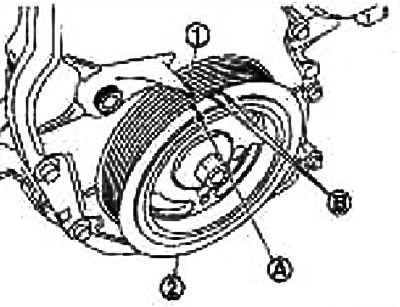
B. Mark with white paint (not used for maintenance).
- b. Make sure that the alignment marks on the camshaft sprockets are aligned as shown in the illustration.

1. Exhaust camshaft sprocket
2. Intake camshaft sprocket
(A) Alignment mark (stamped)
(B) Alignment mark (risk carved on the periphery)
Otherwise, rotate the crankshaft pulley one more revolution and align the marks as shown in the figure.
7. Remove the crankshaft pulley as follows:
- a. Secure the crankshaft pulley (1) with the holder (suitable special tool) (A).
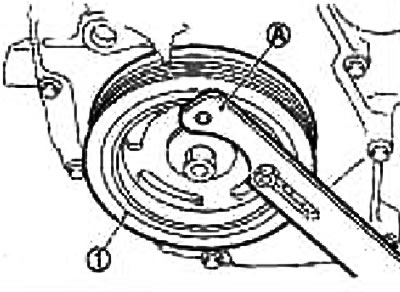
- b.Loosen the crankshaft pulley bolts so that they move away from their original position.
Caution: Do not remove the crankshaft pulley bolts as they will serve as a fulcrum for the pulley puller (special tool: KV111030000).
- c. Secure the crankshaft pulley puller (special tool: KV111030000) in the M6 holes of the crankshaft pulley and remove the crankshaft pulley
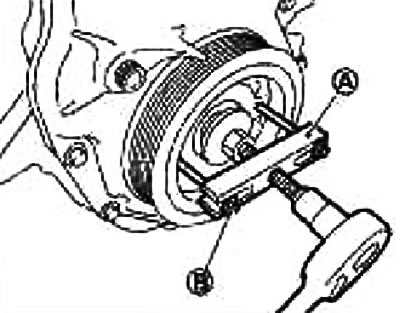
B. Bolt M6
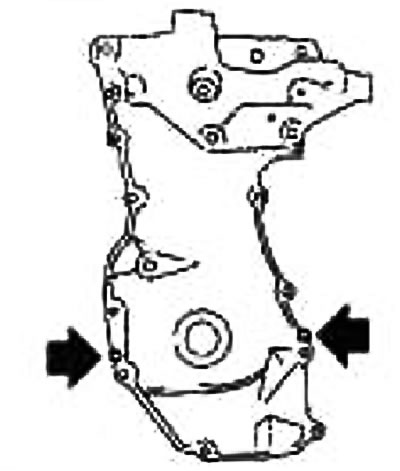
8. Remove the front cover as follows:
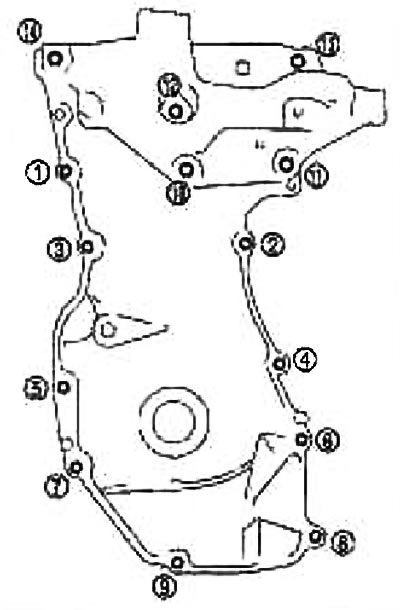
- a. Loosen the mounting bolts in the reverse order shown in the figure.
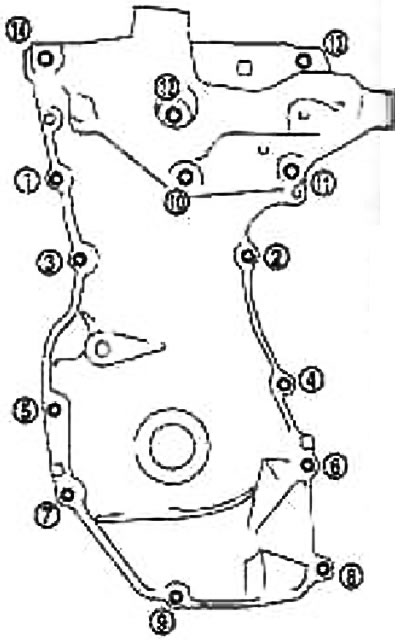
- b. Pry up the cover at the places indicated by the arrows in the figure, cut off the sealant and remove the front cover.
9. Remove the front oil seal from the front chain cover using a suitable tool.
Caution: Do not damage the front cover.
10. Remove the chain tensioner as follows:
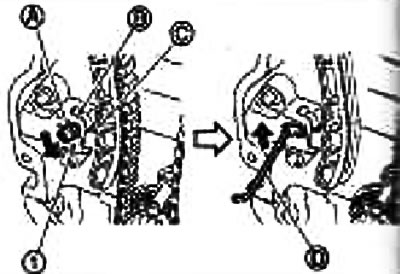
- a. Fully press the chain tensioner lever (A) and release the plunger (C) inside the tensioner.
The plunger locking tab (B) can be released by fully pressing the lever (coaxial with lever design).
- b. Pull the lever and align the hole in it with the hole in the body.
By aligning the holes in the lever and body, the plunger can be fixed.
When the protruding parts of the plunger ratchet and the locking tongue face each other, the holes are not aligned. Engage them correctly and align these holes by moving the plunger slightly.
- c. Insert the lock pin (D) into the hole in the tensioner body through the hole in the lever and lock the lever in the upper position.
As an example, a hex wrench (2.5mm) is used instead of a locking pin.
- d. Remove the chain tensioner
11. Remove the tensioner guide (2) and the timing chain guide at the bend (1).
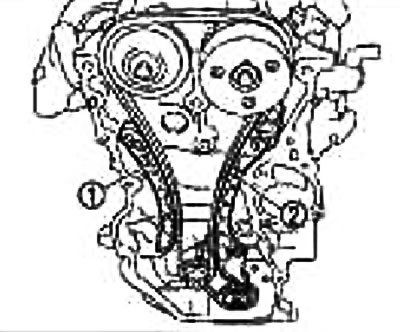
12. Remove the timing chain (2).
Tighten the timing chain on the exhaust camshaft sprocket side (1) and begin removing the chain from this side.
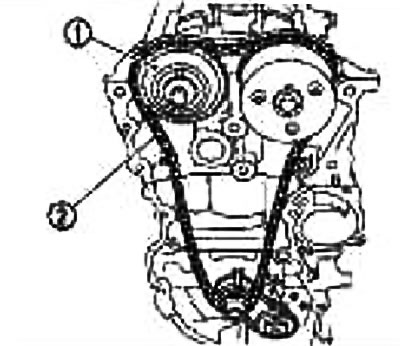
Caution: After removing the timing chain, do not turn the crankshaft or camshaft separately, otherwise the valves will hit the piston crowns.
13. Remove the crankshaft sprocket and components associated with the oil pump drive chain as follows:
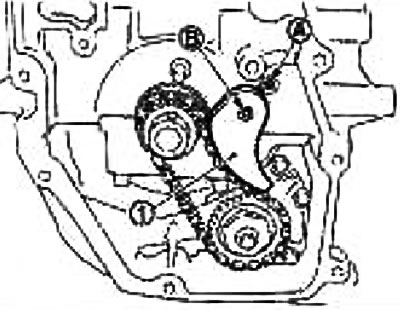
- a. Remove the chain tensioner (1).
Remove from axle (B) and from spring mounting hole (A).
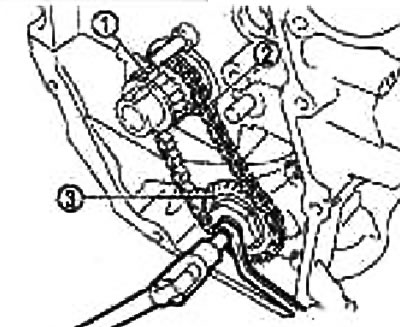
- b. Hold the tip of the oil pump shaft with a TORX head (size: E8), loosen the oil pump sprocket nuts and unscrew them.
- c. Simultaneously remove the crankshaft sprocket (1), oil pump drive chain (2) and oil pump sprocket (3).
Check after removal
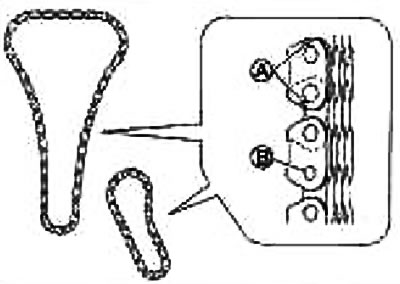
Timing chain
Check the timing chain roller links for cracks (A) or excessive wear (B). Replace the timing chain if necessary.
Installation
Note: The illustration shows the relative positions of the alignment marks on the chains and on the corresponding sprockets after the components have been installed.
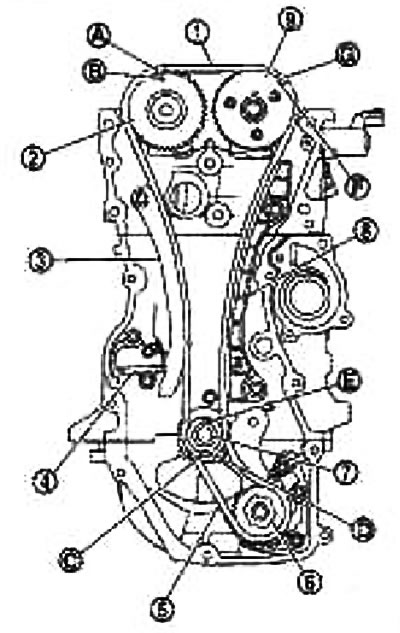
1. Timing chain.; 2. Camshaft sprocket (outlet); 3. Timing chain guide at the bend point; 4. Timing chain tensioner; 5. Oil pump drive chain; 6. Oil pump sprocket; 7. Crankshaft sprocket; 8. Timing chain tensioner guide; 9. Camshaft sprocket (intake); A. Yellow link; B. Alignment mark (stamped); C. Orange link; D. Alignment mark (stamped); E. Crankshaft key (facing straight up); F. Alignment mark (risk carved on the periphery); G. Yellow link
1. Install the crankshaft sprocket and oil pump drive chain related components as follows:
- a. Install the crankshaft sprocket (1), oil pump drive chain (2) and oil pump sprocket (3) at the same time.
Position the crankshaft sprocket with the teeth under the oil pump sprocket (A) toward the rear of the engine.
Install the oil pump sprocket with the hexagonal surface (B) facing the front of the engine.
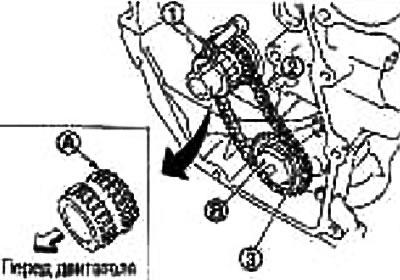
Note: There are no alignment marks on components related to the oil pump drive chain.
- b. Hold the tip of the oil pump shaft with a TORX head (size: E8), tighten the oil pump sprocket nuts.
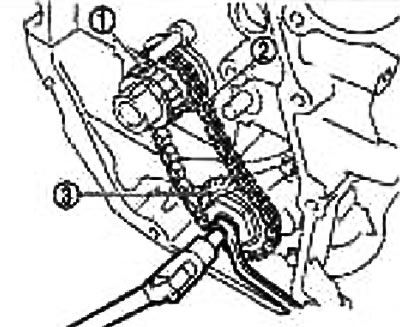
1. Crankshaft sprocket; 2. Oil pump drive chain; 3. Oil pump sprocket
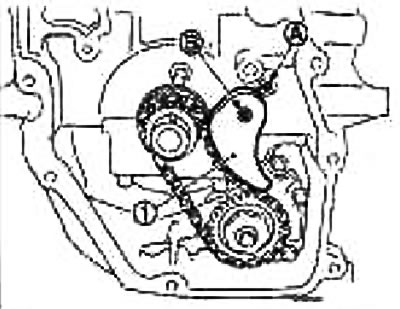
- c. Install the chain tensioner (1).
Place the housing on the axle (B), inserting the spring into the mounting hole (A) on the front surface of the cylinder block Fig.
2. Install the timing chain as follows:
Install the timing chain by aligning the marks on each sprocket and the timing chain.
If the marks do not align, slightly rotate the camshaft and align.
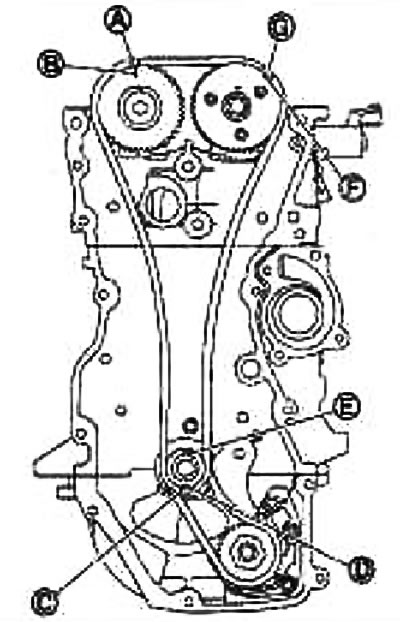
A. Yellow link; B. Alignment mark (stamped); C. Orange link; D. Alignment mark (stamped); E. Crankshaft key (facing straight up); F. Alignment mark (risk carved on the periphery); G. Yellow link
Attention:
- Once the marks are aligned, hold them in this position by holding the timing chain with your hand.
- To prevent teeth from shifting, do not rotate the crankshaft or camshaft until the front cover is installed.
3. Install the tensioner guide (2) and the chain guide at the bend (1).
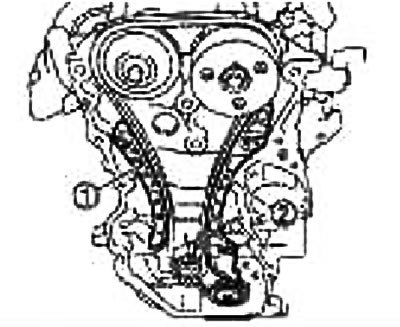
4. Install the chain tensioner (1).
Press the plunger in and hold it in place using the locking pin (A).
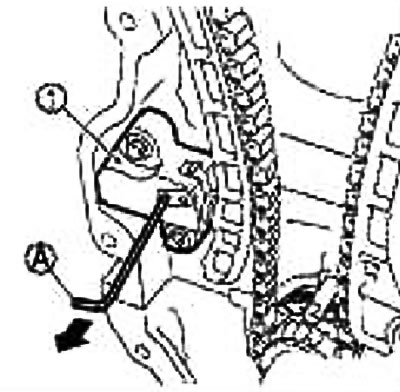
After installing the chain tensioner, carefully remove the lock pin.
5. Check again that the alignment marks on the sprockets and timing chain have not shifted.
6. Insert the front oil seal into the front cover.
7 Install the front cover as follows:
- a. Apply the sealant in a continuous line using a syringe (special tool: WS39930000) on the front cover as shown in the picture.
Use branded sealant or equivalent
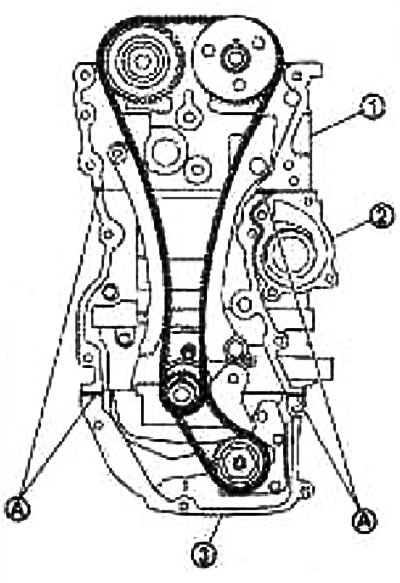
1. Cylinder head; 2. Cylinder block; 3. Oil pan (upper); A. Sealant application area. Diameter 3.0-4.0 mm
- b. Apply the sealant in a continuous line using a syringe (special tool: WS39930000) on the front cover as shown in the picture.
Use branded sealant or equivalent
- c. Tighten the bolts in the order shown by the numbers in the figure.
- d. After tightening, tighten them to the required torque in the order indicated by the numbers in Figure No.2.
Caution: Remove any excess sealant that appears on the surface.
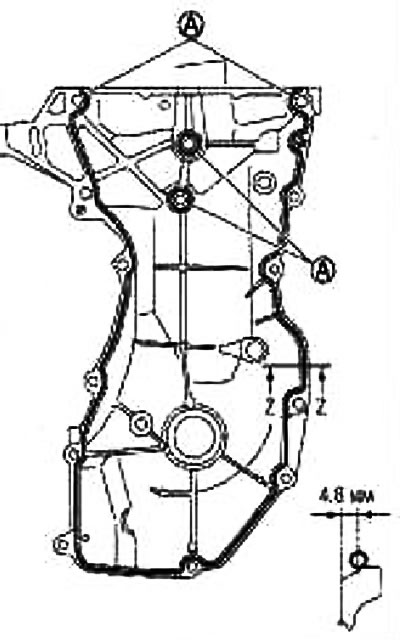
A. Sealant application area. Diameter 3.0-4.0 mm
8. Install the crankshaft pulley, aligning it with the key.
When pressing the crankshaft pulley with a plastic hammer, strike the center section (not in a circle).
Caution: Install the crankshaft pulley without damaging the lip of the front oil seal.
9. Tighten the crankshaft pulley mounting bolt as follows:
Secure the crankshaft pulley with the pulley holder (suitable special tool) and tighten the crankshaft pulley mounting bolt.
- a. Apply fresh engine oil to the threads and seating surface of the crankshaft pulley bolt.
- b. Tighten the crankshaft pulley mounting bolt.
Tightening torque: 35.0 N·m (3.6 kg·m)
Place a paint mark (B) on the crankshaft pulley opposite any angle mark (A) on the flange (1) of the crankshaft pulley bolt.
- d. Tighten the bolt 60° (tightening at an angle).
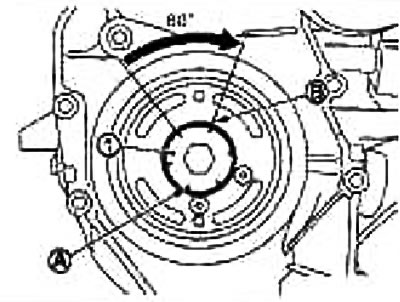
Check the tightening angle using the angle marks.
10. Turn the crankshaft pulley clockwise by hand and make sure it rotates freely.
11. After this operation, installation is carried out in the reverse order of removal.
Post-installation check
Checking for leaks
Below are procedures for checking for fluid, engine oil and exhaust leaks.
Before starting the engine, check the oil/fluid levels, including engine coolant and engine oil. If the level is low, top up to the required level. See chapter General information and maintenance.
Check for fuel leaks as follows:
- Turn the ignition key to the "ON" position (without starting the engine). After creating pressure in the fuel lines, check for fuel leaks at the joints.
- Start the engine. Increase the engine speed and check again for fuel leaks at the fuel line joints.
Let the engine run and check for any unusual noise or vibration.
Note: If the hydraulic pressure inside the timing chain tensioner drops after removal/installation, a dull knocking sound may occur when the engine is started and immediately after the slack in the guide may result. However, this does not indicate a malfunction. The knocking sound will stop after the hydraulic pressure rises.
Warm up the engine thoroughly and check for any fuel, exhaust or oil/fluid leaks, including engine coolant and engine oil.
Bleed air from the pipes and hoses of the relevant systems, such as the cooling system.
After the engine has cooled, check the oil/fluid levels again, including engine coolant and engine oil. Top up as needed to the proper level.