


Lubricate the piston pin and connecting rod eye hole thoroughly.
Insert the piston pin retaining ring into the piston from one side. Check that it fits into the groove properly.
Press the pin into the heated connecting rod using a suitable mandrel.
The following instructions must be observed during assembly:
- 1. Arrow on the bottom of the piston (either drawn or stamped on new pistons - see. illustration) should point towards the front of the engine.
- 2. The cylinder number markings on the connecting rods and bearing caps must match (illustration). Consider the difference between an injection and a carburetor engine.
1. Check that the pistons can move freely on the connecting rods after assembly.
2. Piston rings are installed either with the help of special pliers from the side of the piston bottom (illustration), or using the metal strips mentioned during removal. When the ring is flush with the groove, the metal strip is removed so that the ring fits into the groove. It is possible to mix up the two compression rings, so you should pay attention to their cross-section before installing them. If the rings are well marked, it is quite difficult to mix them up. In addition, both compression rings have a designation on one side (the letter "R" may be stamped on a carburetor engine) which should be visible from the piston bottom.
3. Place the assembled pistons on a clean surface before installation and cover them to prevent dust from getting on them. Since the parts are already lubricated, you need to make sure that no foreign bodies get on the pistons.
Assembly of pistons and connecting rods
1. Lubricate the cylinder bore well.
2. Insert the connecting rod bolts and connecting rods, insert the bearing shells.
3. Arrange the connecting rods according to the cylinder numbers. The oil spray holes must be on the specified side of the cylinder block illustrations shows how the pistons and connecting rods should be positioned on an injection engine. The illustration below shows the position of the parts on a carburetor engine.
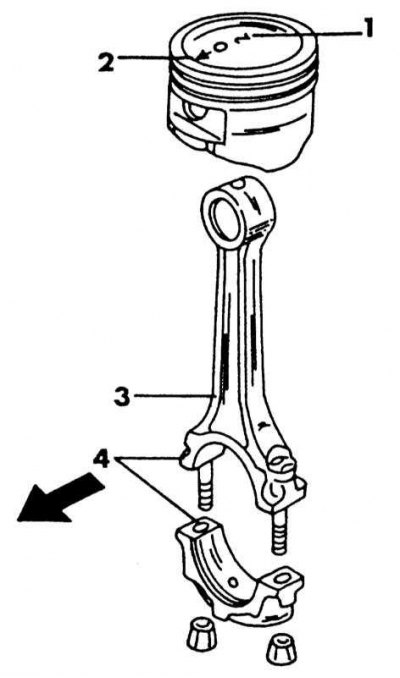
Correct assembly of piston and connecting rod on carburetor engine. Arrow points to front of engine
1 - piston size; 2 - mark "before"; 3 - oil spray hole; 4 - cylinder number
4. Marks on the bottom of the pistons, i.e. the mark on the edge (injection engine) or arrow (carburetor engine) should point towards the front of the engine.
5. Position the piston ring joints around the circumference at 120° to each other. The illustration shows how the ring joints are offset relative to the piston pins. The rings are positioned identically on both engine designs.
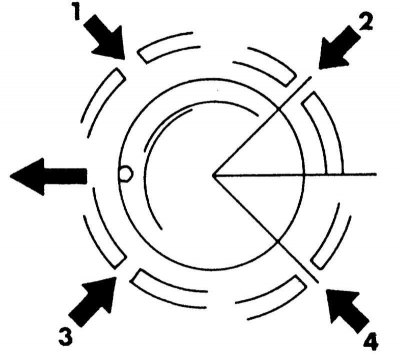
Location of piston ring locks. Large arrow points to the front of the engine
1 - oil scraper ring expansion element lock; 2 - lock of the upper ring and the upper element of the oil scraper ring; 3 - second ring lock; 4 - lock of the lower element of the oil scraper ring
6. Apply the piston ring clamp and press the rings into the grooves. Check that they are properly seated. If you do not have a clamp, you can use a large hose clamp or place thin metal strips around the rings and squeeze the ends so that the rings fit into the grooves. Insert the piston after checking again that there are no foreign objects on it. If you are using a hose clamp, you can place it around the ring until the ring fits into the cylinder. Then move the clamp to the next ring and insert it into the hole. Then do the same with the top ring.
7. Place a short piece of rubber or polymer hose over the connecting rod bolts to avoid scratching the hole.
8. Turn the crankshaft until the two crankshaft journals are at BDC.
9. Insert the connecting rod into the bore from above. To do this, lay the engine on its side so that the connecting rod can be installed on the journal without scratching the bore or the crankpin. The connecting rod bearing shells should already be in the connecting rod, with the protrusions in the recesses and both oil holes in line.
10. Push the piston in until the rings fit into the hole as shown in the illustration below and the end of the connecting rod fits onto the crankshaft journal.
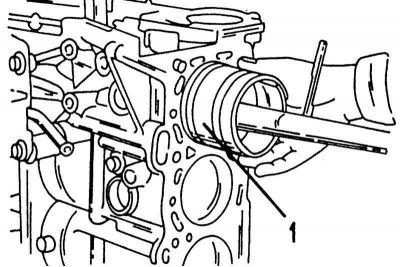
Installing the piston. The installed tension band (1) slides when the piston is pushed in
11. Insert the second bearing shell, lubricate the shell well and press the cap onto the connecting rod bolt and lightly hammer it in. The rubber hose sections should be removed beforehand. Be sure to check that the numbers on the connecting rod and the bearing cap are on the same side and match each other, as a mistake can be made at the last moment.
The original is available on the web page: www.NissanBook.ru
12. Lubricate the mating surfaces of the nut on the connecting rod bearing caps.
13. Tighten the new connecting rod nuts alternately to 14-16 N·m. To maintain the tightening torque, the cylinder head must be positioned on the sealing surface. Ask an assistant to hold the block and tighten both connecting rod bearings located on top. Tighten the connecting rod bearing nuts again in the same way to 40-45 N·m for an injection engine or 23 - 29 N·m for a carburetor engine.
14. After installing the connecting rod, turn the crankshaft several times to immediately identify any jamming.
15. Recheck the markings on all connecting rods and make sure the pistons are facing the correct direction.
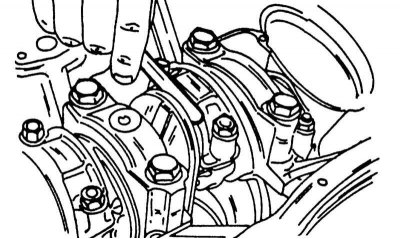
Measuring the axial clearance of connecting rods installed on the crankshaft. The feeler gauge is inserted between the connecting rod and the working surface of the crankshaft.
16. Using a feeler gauge, measure the clearance between the side surface of the connecting rod and the crankshaft, as shown in the illustration. This is the axial clearance of the connecting rod bearings, which should be no more than 0.50 mm. If exceeded, replace the corresponding connecting rod or crankshaft.