


Table of contents: Carburetor engine ↓ Injection engines ↓
Injector and carburetor engines have different designs of the oil pan. The carburetor engine uses a conventional oil pan, which has already been shown in illustrations. On an injection engine, the oil pan consists of two parts, the upper part made of aluminum and the lower part made of steel plate. Accordingly, removal and installation differ.
Carburetor engine
1. Unscrew the panels under the front of the car.
2. Drain the engine oil.
3. Place the front of the vehicle on supports.
4. Remove the engine center beam. Support the engine accordingly.
5. Remove the exhaust pipe.
6. Unscrew and remove the oil pan. If it is firmly seated, do not insert a screwdriver between the sealing surfaces. Try to loosen the connection with a rubber mallet.
7. Thoroughly clean the surfaces of the oil pan and cylinder block. Carefully scrape off the remains of the old seal with a scraper. The oil pan is installed with a sealant, which can be purchased at Nissan retail outlets. The sealant is supplied in tubes, the end of which must be cut off to obtain a strip 4.5 mm wide. Apply the sealant evenly around the circumference of the oil pan, namely on the inside of the bolt holes. Make sure that the bolt holes are not filled with sealant. The oil pan must be bolted to the cylinder block within 5 minutes after applying the sealant. Tighten the bolts evenly with the appropriate Specifications force. After tightening the bolts, 30 minutes must pass before you can add oil or start the engine. Install the removed parts in the reverse order and add the required amount of engine oil after 30 minutes have passed since tightening the pan bolts.
8. Start the engine and check that no oil is leaking from the sealing surfaces.
Injection engines
The work of removing the oil pan on injection engines is a little more complicated. The illustration below shows the parts of the pan.
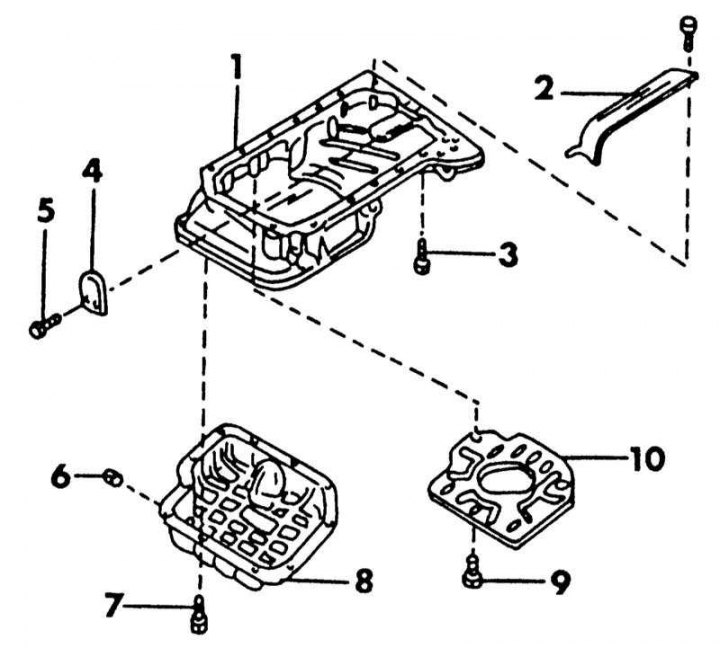
Oil pan parts for injection engine
1 - aluminum tray; 2 - oil conductive plate; 3 - oil pan bolt; 4 - back plate; 5 - bolt, 6.5-7.5 Nm; 6 - oil drain plug, 30-40 Nm; 7 - oil pan bolts, 6.5-7.5 Nm; 8 - steel oil pan; 9 - bolt, 6.5-7.5 Nm; 10 - oil conductive plate
1. Unscrew the panels under the front of the car.
2. Drain the engine oil.
3. Loosen the steel pan bolts (8). Loosen the bolts evenly around the perimeter, remove the pan. Do not insert a screwdriver between the surfaces.
4. Allow the oil to drain completely and unscrew the visible oil drain plate (10).
5. Place the front of the vehicle on supports, lift the power unit with a crane and remove the engine center beam. If an automatic transmission is installed, disconnect the shift cable; if an air conditioner is installed, loosen its fastening and put it aside.
6. Unscrew the cover from the back.
7. Loosen the aluminum pan bolts. Loosen all bolts evenly. Since the pan may be overtightened, the sequence of loosening should be the opposite of that shown in the illustration below.
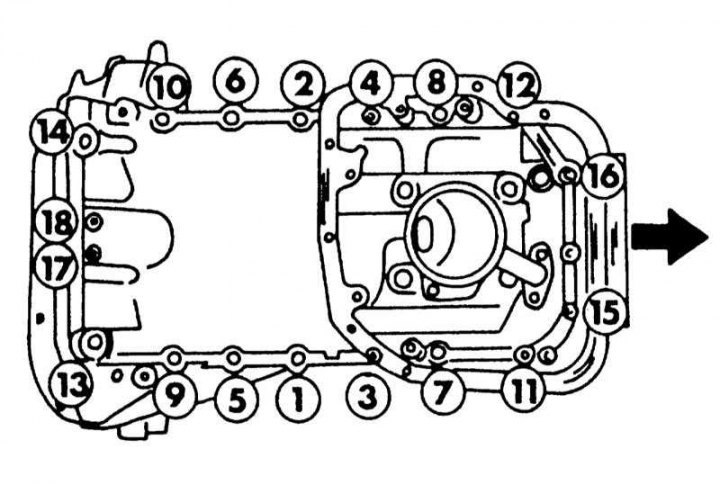
Tightening sequence of aluminum pan. Arrow points to the front of the engine.
8. Now the oil pan should be pressed away from the cylinder block, as it sits quite firmly. To do this, follow the illustration. This illustration shows two bolts holding the engine to the gearbox. Unscrew the bolts in places (1), and screw in and tighten them in places (2) until the pan comes away from the block. Then carefully press the pan away, without damaging the metal. Of course, you should first remove both screwed-in bolts.
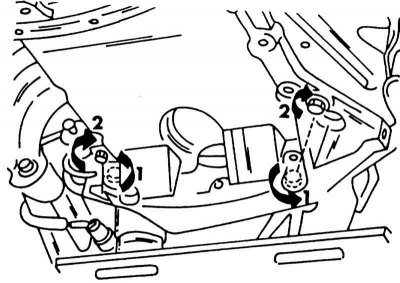
Pressing out the oil pan.
9. Installation is carried out in the reverse order. Cover the sealing surfaces of the aluminum pan with sealant, as described for the carburetor engine.
The source of the article is on the website: NissanBook.ru
10. Install the oil pan and tighten bolts 1 through 16 in the sequence shown on the illustrations, with a force of 16 - 19 N·m. Tighten bolts 17 and 18 with a force of 6.5 - 7.5 N·m.
11. Reinstall and tighten both bolts between the engine and gearbox.
12. Install all removed parts.
13. Screw on the oil passage plate and tighten the bolts to 6.5 - 7.5 N·m.
14. Coat the steel pan with sealant as described for the carburettor engine. Tighten the bolts evenly in a crisscross pattern to 6.5 - 7.5 N·m.