


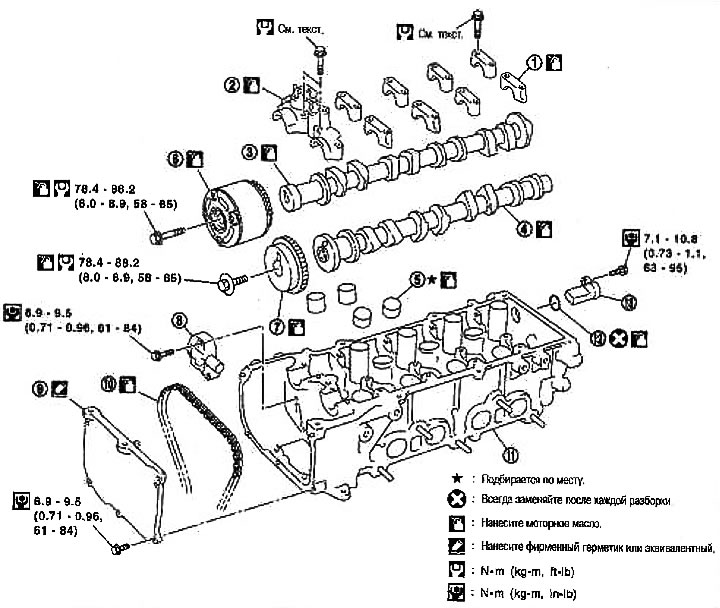
1. Brackets (No. 2-5) of camshafts; 2. Bracket No.1 of camshafts; 3. Camshaft (intake); 4. Camshaft (exhaust); 5. Valve lifter; 6. Camshaft sprocket (intake); 7. Camshaft sprocket (outlet); 8. Timing chain tensioner; 9. Front cylinder head cover; 10. Timing chain; 11. Cylinder head; 12. Camshaft angle sensor (PHASE)
Removal
1. Remove the protective cover from the front right fender.
2. Secure the engine in one of the following ways: Remove the right engine mount stand and the engine mount bracket (upper). See Section "Removal and installation".
Install lifting eyes on the engine and secure with a winch. See section "Removal and installation".
Support the bottom of the oil pan with a jack, safety stand, etc.
3. Remove the valve cover. See the section above "Valve cover".
4. If necessary, remove the camshaft angle sensor (PHASE) from the back of the cylinder head.
Attention:
- Handle the delivery device with care, do not drop or hit it.
- Do not allow metal powder to come into contact with the magnetic part of the sensor tip. Do not leave sensors in places where they may be exposed to magnetism.
5. Remove the right headlight. See chapter Electrical equipment.
6. Remove the front cylinder head cover.
7. Set the piston of cylinder No.1 to TDC in the compression stroke by performing the following operations.
- a. Turn the crankshaft pulley clockwise.
- b. Make sure that the working lobes of the intake and exhaust camshafts of cylinder No.1 are facing outward,
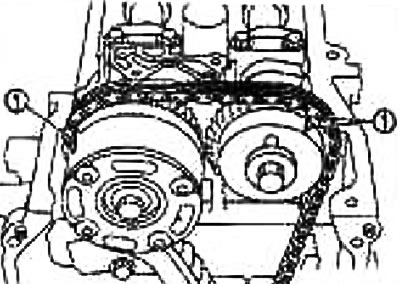
- c. Make sure that the timing marks (1) stamped on the intake and exhaust camshaft sprockets are aligned as shown in the figure.
- Otherwise, rotate the crankshaft pulley one more revolution and align the marks as shown in the figure.
- d. Make sure that the timing marks stamped on the intake and exhaust camshaft sprockets are aligned as shown in the illustration, then apply paint marks to the timing chain links.
- e. Make sure that the intake camshaft sprocket is in the maximum advance position.
Attention:
- Removal and installation of the intake camshaft sprocket is required to maintain the maximum advance position for the following reasons. Therefore, perform the procedure exactly as indicated below.
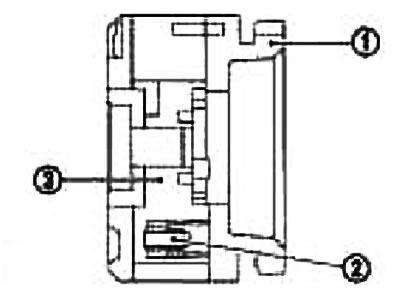
- This model uses a design in which the sprocket (1) and blade (at the camshaft junction) (3) rotate and shift relative to each other at some given angles.
- When the engine is stopped, the blade (3) is in the maximum retardation position. It does not rotate because it is locked in the sprocket by the internal locking pin (2).
- If you turn the camshaft sprocket mounting bolts under the specified conditions (in the position of maximum lag), then apply a transverse load (shear force) to the locking pin (2). This will damage the locking pin (2) and cause the mechanism to malfunction.
Set the intake camshaft sprocket to the maximum advance position as follows:
Caution: Do not remove the chain tensioner before performing this operation.
Note: "Direction of rotation" means the direction of rotation when viewed from the front of the engine.
- a. Secure the hexagonal part with an adjustable wrench (1) so that the intake camshaft cannot turn.
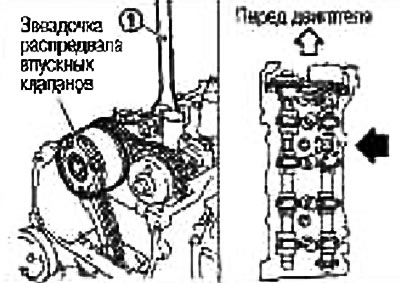
- b. Using a pneumatic gun (2), apply pressure to the lubrication channel of the intake valve timing mechanism from the advance side above the camshaft bracket No.1 (1).
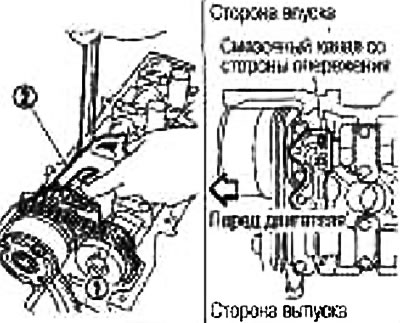
Air pressure: 300 kPa (3.06 kg/cm²) or more
Note: The locking pin is held in the unlocked position by compressed air.
Maintain pressure until step "e" is completed.
Attention:
- Do not damage the grease channel with the gun tip.
- Before applying compressed air, carefully wipe off any oil from the top of camshaft bracket #1. When applying pressure, cover the area adjacent to the gun with a rag. If necessary, wear safety glasses.
- c. Slowly turn the intake camshaft counterclockwise in direction "A" (towards the top of the intake manifold).
Perform the operation by supplying compressed air.
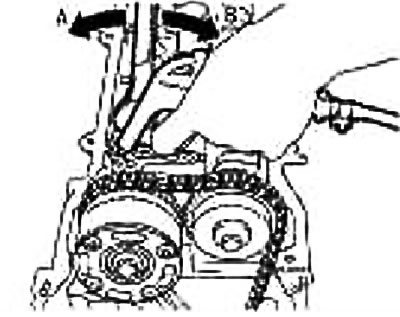
Caution: Do not allow the wrench holding the camshaft to move.
- d. While performing the above operation, you will hear a clicking sound from inside the intake camshaft sprocket (sound indicating that the internal locking pin has come out of engagement). When you hear this sound, slowly turn the intake camshaft in the opposite direction "B" (clockwise: towards the exhaust manifold) and set it to the maximum advance position.
Perform the operation by supplying compressed air.
If the blade part (at the camshaft junction)one rotates relative to the sprocket, then the locking pin has come out of engagement, even if the click is not heard.
If the locking pin does not disengage, lightly shake the camshaft with a wrench.
If the lock pin is still tight after performing the above operation, lightly tap the front end of the camshaft on the intake side with a plastic hammer.
- i.e. As soon as the blade starts to rotate by itself, and then, when the camshaft is turned, the sprocket also starts to rotate, the maximum advance position is reached. When this state is reached, this operation is completed.
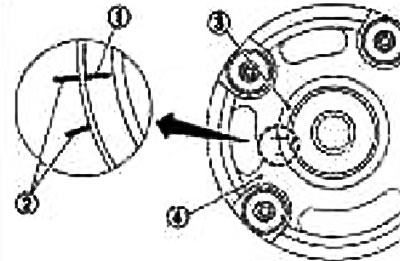
Make sure that the mark (1) of the maximum advance position of the intake valve timing mechanism on the blade (3) and the alignment mark (2) on the sprocket (4) are positioned as shown in the figure.
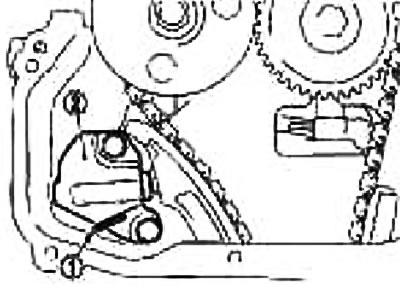
9. Lock the plunger in the fully compressed position by inserting the locking pin (1), e.g. a paper clip, and remove the chain tensioner (2).
10. Holding the camshaft by the hexagonal part with an adjustable wrench, loosen the mounting bolts and remove the intake and exhaust camshaft sprockets.
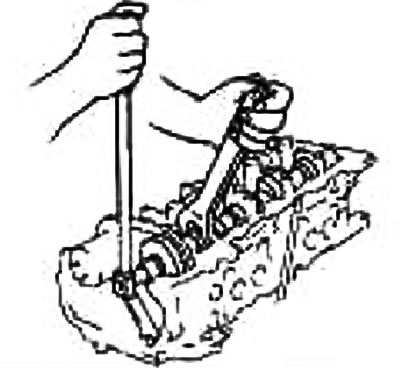
Attention:
- Be careful not to let the tool touch the air conditioner pipes.
- Do not loosen the mounting bolts by holding the camshaft in areas other than the hexagonal portion or by tightening the timing chain.
Note: With the front cover installed, the timing chain and crankshaft sprocket will not come off, so there is no need to maintain chain tension.
When removing/installing the intake camshaft sprocket, observe the following precautions:
Attention:
- To prevent the blade from turning so that the locking pin does not engage in the maximum lag position, secure it with vinyl tape.
- Handle the camshaft sprocket with care, do not hit it or drop it.
- Do not disassemble the star. (Do not loosen the four bolts on the front surface).
If, during removal, the locking pin has engaged in the maximum lag position, restore the original position as follows:
- a. Install the intake camshaft sprocket back onto the camshaft and tighten the mounting bolts until there is no air leak.
Caution: To avoid damaging the internal locking pin, tighten the mounting bolts to a minimum torque.
- b. Apply compressed air, disengage the locking pin as in step 8, and rotate the blade to the maximum advance position (This operation can be performed with the timing chain removed).
- c. Remove the sprocket from the camshaft.
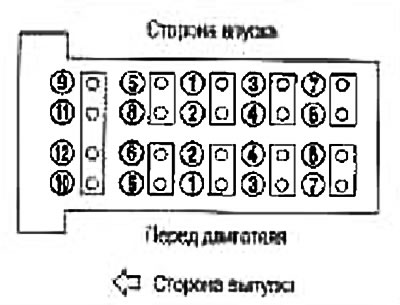
11. Remove the camshaft brackets.
Loosen the bolts in several passes in the reverse order shown in the figure
12. Remove the camshafts.
Caution: Do not damage the signal disc on the rear end of the intake camshaft.
13. Remove the valve lifters.
Mark the locations and place the components in order without mixing them.
Installation
1. Install the valve lifters.
Install them in the same places they were before removal.
2. Install the camshafts.
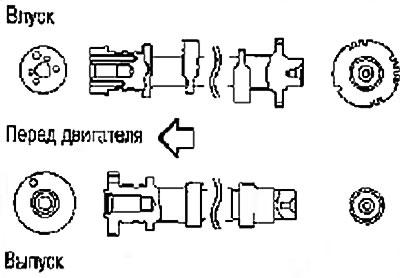
The intake and exhaust camshafts can be distinguished by the shape of the front and rear ends.
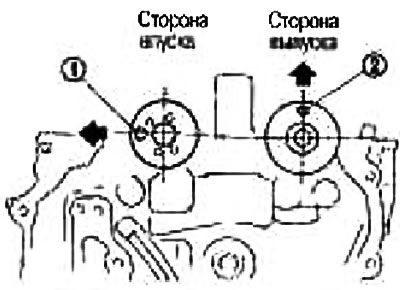
3. Install the camshaft brackets.
Completely remove foreign matter from the underside of the camshaft brackets and the top surfaces of the cylinder head.
Install the camshaft brackets in the same places and in the same direction as before removal, using the markings stamped on the top surface as a guide.
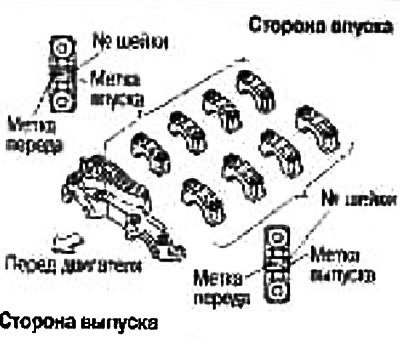
4. Tighten the camshaft bracket bolts as follows:
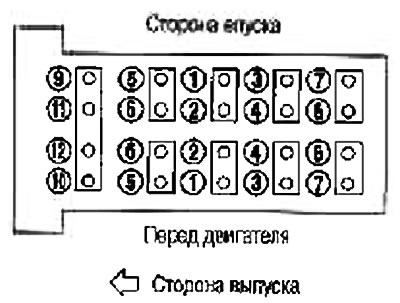
- a. The bolts have different sizes depending on the installation location:
Bolt color: 1-10: black; 11,12: golden;
- b.First tighten 9 to 12 in order, then tighten 1 to 8 in order. Tightening torque: 2.0 N·m (0.2 kg·m)
- c. Tighten all bolts in the order indicated by the numbers in the illustration. Tightening torque: 5.9 N·m (0.6 kg·m)
- d. Tighten all the bolts again in the order indicated by the numbers in the figure. Tightening torque: 9.0 - 11.8 N·m (0.92 - 1.2 kg·m)
5. Install the intake camshaft sprocket as follows:
Make sure that the mark (1) of the maximum advance position of the intake valve timing mechanism on the blade (3) and the alignment mark (2) on the sprocket (4) are positioned as shown in the figure.
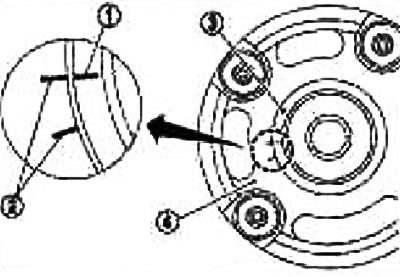
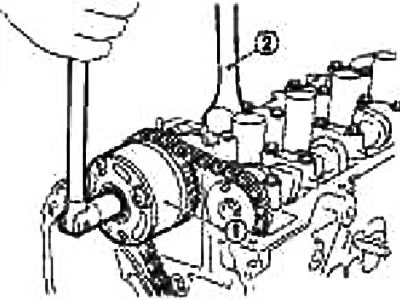
- a. Put on the timing chain (2), aligning the mark (3) (applied to it when removed) with mark (4) on the camshaft sprocket (1).
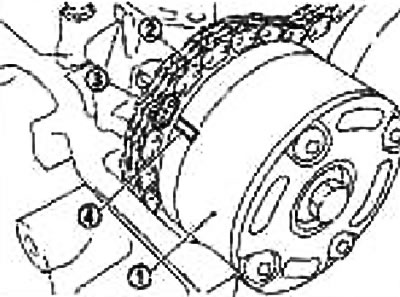
Align the dowel pin on the back of the sprocket with the dowel hole on the camshaft, then install.
- b. After securing the camshaft by the hexagonal part with an adjustable wrench (2), tighten the intake camshaft sprocket mounting bolt (1).
- c. Remove the tape from the camshaft sprocket.
6. Install the exhaust camshaft sprocket (1) as follows:
- a. Put on the timing chain (2), aligning the mark (3) (applied to it when removed) With mark (4) on the camshaft sprocket (1).
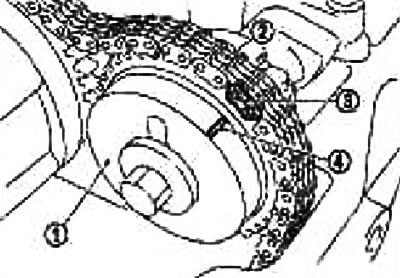
Align the dowel pin on the front surface of the camshaft with the dowel groove on the camshaft sprocket, then install.
- b. After securing the camshaft by the hexagonal part with an adjustable wrench, tighten the exhaust camshaft sprocket mounting bolt.
- c. Make sure that the marks on the intake and exhaust camshaft sprockets are aligned with the marks on the timing chain.
7. Install the chain tensioner (2).
Secure the plunger with the locking pin (1).
After installation, remove the locking pin (1) and release the plunger.
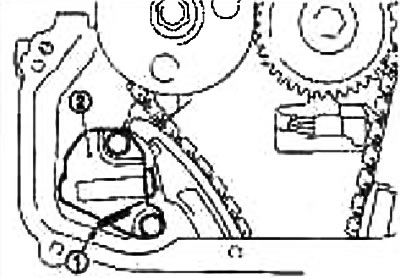
Once again, make sure that the marks on the intake and exhaust camshaft sprockets are aligned with the marks on the timing chain.
8. Slowly turn the crankshaft pulley (1) clockwise and set the intake camshaft sprocket to the maximum retard position.
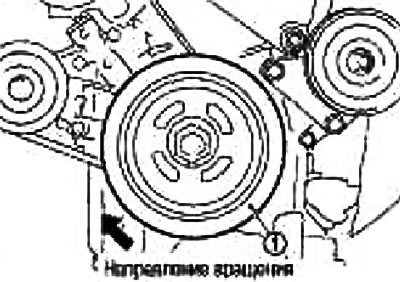
When you first turn the crankshaft, the sprocket starts to rotate. Continue turning the crankshaft until the blade also starts to rotate (camshaft), and the position of maximum delay is reached.
By turning the crankshaft slightly counterclockwise, you can ensure that the locking pin is engaged if you see the blade and sprocket rotating together.
9. Install the front cylinder head cover.
Apply sealant evenly to the areas shown in the picture. Use brand sealant or equivalent.
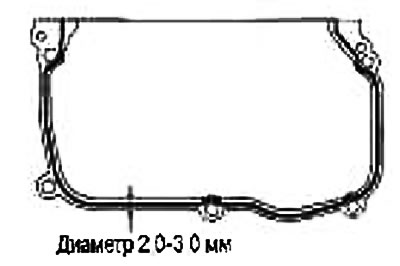
Install so that the front cylinder head cover aligns with the dowel pin on the cylinder head side.
The source of the article is on the website [NISSANBOOK.RU]
10. Install the camshaft angle sensor (PHASE).
Make sure that no foreign particles enter the flange, O-ring or mounting hole.
Tighten the mounting bolt, making sure the sensor is fully seated in the mounting hole.
11. Check and adjust valve clearances. See section "Valve clearances".
12. After this operation, installation is carried out in the reverse order of removal.
Check after removal
Camshaft runout
Install the camshaft on two prisms with journals No.2 and No.5.
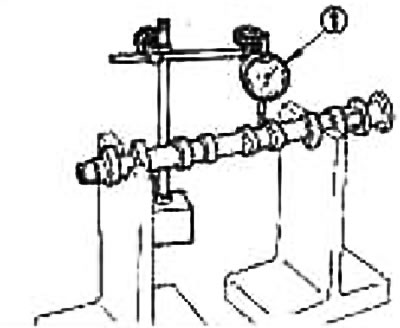
Caution: Do not install the camshaft on the prisms with journal No.1 (from the camshaft sprocket side), because its diameter differs from the other four.
Fix the sensitive indicator head (1) vertically on the neck No.3.
Turn the camshaft manually in one direction and measure the runout with a dial indicator (maximum indicator reading).
Limit: 0.04mm or less.
If the runout exceeds the limit, replace the camshaft.
Camshaft lobe height
Measure the camshaft lobe height with a micrometer (1).
Standard cam height:
| Engine CR14DE | |
| Inlet | 40.359-40.549 mm |
| Release | 39.743-39.933 mm |
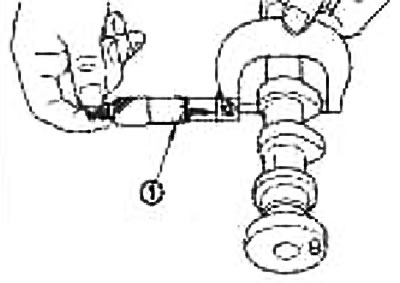
If the height is different from the norm, replace the camshaft.
Clearance in camshaft journals
Camshaft journal outer diameter
Measure the outside diameter of the camshaft journal with a micrometer (1)
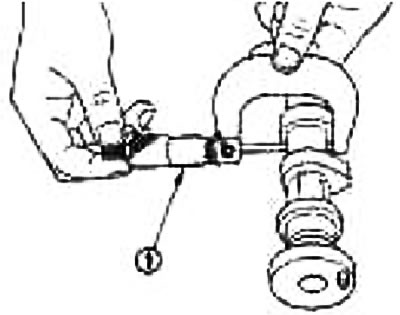
| Standard | №1 | 27,935-27,955 mm |
| №№ 2-5 | 23,450-23,470 mm |
Inner diameter of the camshaft bracket
Tighten the camshaft bracket bolts to the specified torque.
Measure the inside diameter of the camshaft bracket with a bore gauge (1)
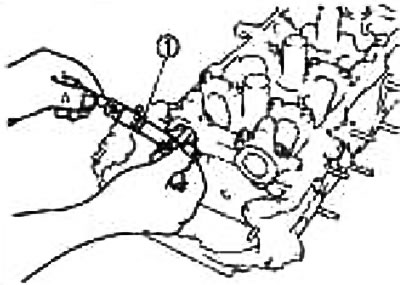
| Standard | №1 | 28,000-28,021 mm |
| №№ 2-5 | 23,500-23,525 mm |
Calculation of clearance in camshaft journals
(Gap in the necks) = (camshaft bracket inner diameter) - (camshaft journal outer diameter)
| Standard | №1 | 0.045-0.086 mm |
| №№ 2-5 | 0.030-0.071 mm |
If the obtained value is different from the norm, replace either the camshaft or the cylinder head, or both.
Note: The camshaft brackets are integral with the cylinder head. Replace the cylinder head as an assembly.
Camshaft axial play
Set the indicator (1) in the axial direction with the sensitive head towards the front end of the camshaft. Measure the axial clearance by moving the camshaft forward/backward (in the axial direction).
Standard: 0.070-0.143 mm.
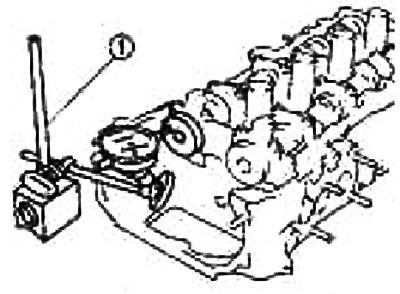
If the axial clearance is not normal, replace the camshaft and recheck.
If it is still different from the norm, replace the cylinder head.
Camshaft Sprocket Runout
Install the camshaft on two prisms with journals No.2 and No.5.
Measure the camshaft sprocket runout with a dial indicator.
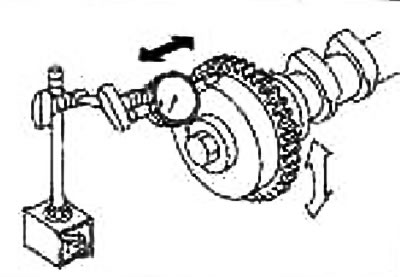
| Limit | Inlet | 0.20 mm |
| Release | 0.015 mm |
If the runout exceeds the limit, replace the camshaft sprocket.
Valve tappet
Check the valve lifter surface for wear or chipping.
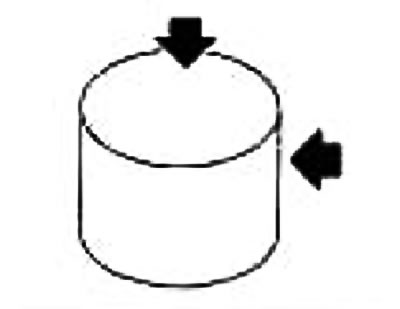
If any defects are found, replace the valve lifter.
Valve tappet clearance
Valve tappet outer diameter
Measure the outside diameter with a micrometer (1)
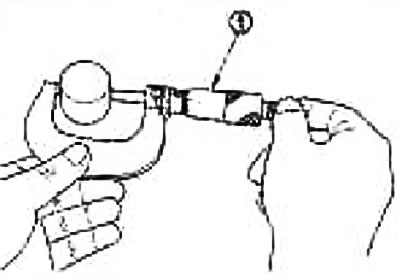
Standard: 29.960-29.975 mm.
Valve tappet bore diameter
Measure the diameter of the valve tappet hole in the cylinder head using a bore gauge (1).
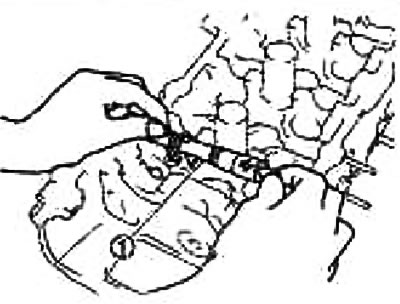
Standard: 30,000-30,021 mm
Calculating valve tappet clearance
(Valve tappet clearance) = (valve tappet hole diameter) - (valve tappet outer diameter).
Standard: 0.025-0.061 mm
If the obtained value differs from the standard for both the inside and outside diameters, replace either the valve lifter or the cylinder head, or both.
Post-installation check
Checking the oil groove on the intake camshaft sprocket
Caution: To avoid burns from engine oil splashes, perform the check when the engine is cold.
1. Check the engine oil level. See chapter Lubrication system and engine cooling system.
2. Perform the following procedure to avoid accidental engine starting during the test.
- a. Relieve the fuel pressure. See chapter Engine management system.
- b. Disconnect the connectors from the ignition coils and injectors.
3. Remove the intake valve timing control solenoid valve. See the section above "Valve cover".
4. Crank the engine and check whether engine oil flows out from the oil hole of the intake valve timing mechanism cover. Stop cranking after checking.
Attention:
- Do not touch rotating components (drive belts, tension pulley and crankshaft pulley, etc.).
- When turning, oil may splash out from the installation hole of the solenoid valve of the variable valve timing mechanism of the intake valves. Use a napkin to protect the engine and vehicle components. Do not allow engine oil to come into contact with rubber parts, such as the drive belt or engine mount insulators. Immediately wipe off any spilled engine oil.
If engine oil does not flow out of the oil hole of the intake valve timing mechanism cover, clean the oil groove between the coarse filter and the intake valve timing mechanism solenoid valve. See Chapter Lubrication system and engine cooling system.
5. Remove the components between the intake valve timing solenoid valve and the intake camshaft sprocket and check whether the oil passages are clogged.
6. After checking, install the removed components.