


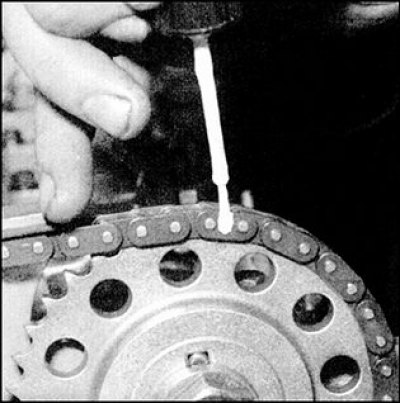
The alignment marks on the chain links and on both sprockets can be applied by the owner himself and used to correctly orient the sprockets during assembly. This method is applicable under one condition - the sprockets must be installed without the slightest disturbance of their original orientation.
Relative orientation marks
 |
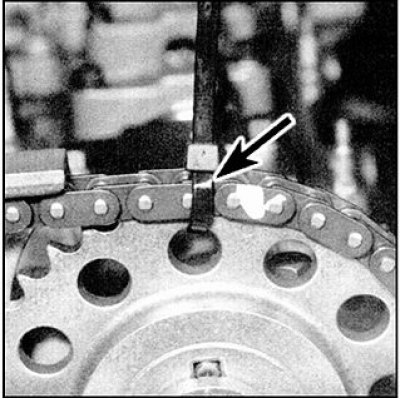 |
To maintain the mutual orientation of the sprocket and chain, it is advisable to put mutual orientation marks on each of the sprockets and on the chain, tie the sprockets to the chain and ensure reliable mutual fixation see figure (the arrow indicates the strapping using an insulating tube).
This method requires special care, but should make the work of the car owner much easier, since there is no need to remove the timing chain cover.
Tightening sequence of bearing journal cover bolts
Removal
1. Remove the ignition distributor (see subsection 7.7.4).
2. Remove the chain and camshaft driven sprockets (see subsection 3.2.1.7). If the chain remains on the engine, mark its relative orientation (in Fig. Relative orientation marks) and unscrew the sprocket bolts (see p. 9 of subsection 3.2.1.7).
3. All camshaft journal covers are identical, with the exception of the front (right) exhaust camshaft cover. Therefore, before removing the covers, it is necessary to apply identification marks to them.
The source is published on the portal nissanbook.ru
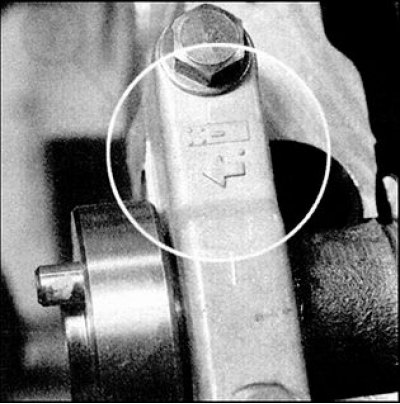
4. An arrow is cast on the top of the covers to indicate the correct orientation of the cover during assembly (all arrows must point towards the chain). The intake and exhaust camshafts have distinctive markings: "I" on the intake camshaft and "E" on the exhaust camshaft.
5. Using a marker or scribe, number all the covers in order, starting from the front ones, located on the chain side. This measure ensures that the covers are installed in their original places during assembly.
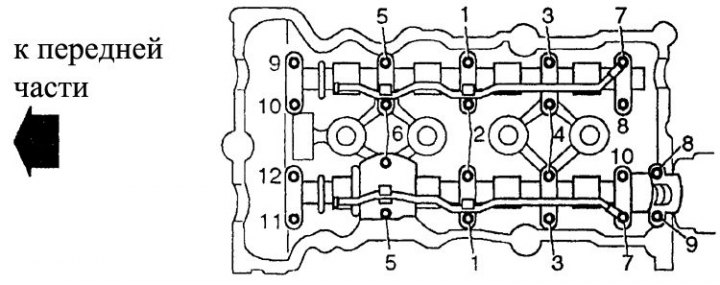
6. Loosen the camshaft journal cover mounting bolts in the reverse order to that shown in Fig. Tightening sequence of bearing journal cover bolts.
7. Loosen the bolts in several stages, one turn at a time. This is necessary to evenly and gradually loosen the force from the valve springs acting on the covers. After the springs have been completely released, the bolts can be completely unscrewed. The bolts for fastening the covers are divided into three size groups by length, so remember the location of the bolts on the covers as you unscrew them.
8. Remove the oil feed tube from the bearing journal covers and remove the oil deflector plate from the 2nd cover. Remove the exhaust camshaft covers, then remove the camshaft itself.
9. Repeat steps 6–8 and remove the intake camshaft covers, then remove the camshaft itself (please note that these covers do not have an oil deflector plate).
Checking the status
1. Inspect the surfaces that come into contact with the camshaft journals in the covers and in the cylinder head. Check for scoring and deep wear on the surfaces. Check for signs of metal chipping on the camshaft cams (areas of bluish tint), deep grooves, chips, flat areas formed due to wear.
2. Install the camshaft in the prismatic supports and use a dial indicator to check the runout in the middle journal. If the runout exceeds the norm, replace the camshaft.
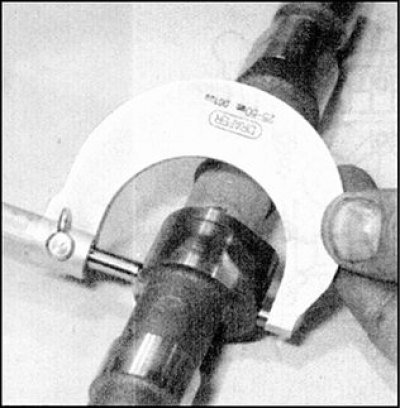
3. Using a micrometer, measure the size of each camshaft lobe and compare the results with those specified in subsection 3.2.1.1. If signs of damage are found or if excessive wear occurs, replace the camshaft.
4. Now check the clearance in the camshaft journals. This can be done in two ways - either by direct measurement or by using a plastic Plastigage gauge.
5. When measuring the clearance using the direct method, install the camshaft journal caps into the cylinder head, in accordance with the marks applied before disassembly, so as not to disturb the previous order and orientation. Install the oil supply pipe and tighten the cap bolts to the specified torque, in the sequence shown in Fig. Tightening sequence of bearing journal cover bolts. Measure the inner diameter of the bearing surfaces of the covers and compare with that specified in subsection 3.2.1.1. If the internal diameter in any cover exceeds the limit, replace the cylinder head.
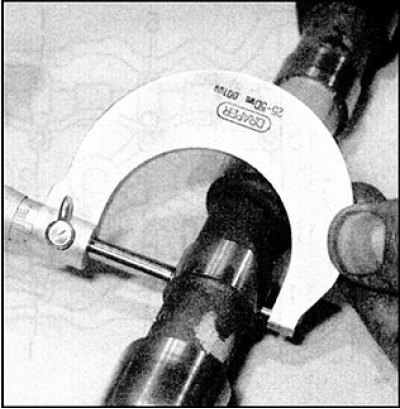
6. The gap is defined as the difference between the internal diameter of the cover support surface and the diameter of the support neck.
7. When measuring clearance with a Plastigage, clean the camshafts and journal bearing surfaces in the cylinder head and caps with a clean, lint-free cloth. Place the camshafts in the cylinder head.
8. Place sections of plastic calibration wire along the surfaces of the camshaft bearing journals parallel to their axis. Having taken measures to prevent the camshafts from turning, perform the actions in the order described in paragraphs 3–11 (see below), except for the stage associated with applying sealant to the lids.
9. Loosen the cover mounting bolts (see p. 6 above) and carefully remove the covers and oil supply pipe, without allowing the camshafts to rotate.
10. Compare the largest width of the crushed wire from each neck with the scale on the gauge package and determine the gap.
11. Compare the measurement result with the one specified in subsection 3.2.1.1. If the clearance exceeds the norm, measure the diameter of the camshaft bearing journal with a micrometer. If the diameter is less than the maximum permissible, replace the camshaft and check the clearances in the bearing journals again. If the clearances are still higher than the norm, replace the cylinder head and bearing journal covers.
Installation
1. Make sure that each lever is correctly engaged with the corresponding hydraulic regulator and the guide disc installed on one of the valves that the lever operates.
2. Generously lubricate the camshaft journal bearing surfaces in the cylinder head with clean engine oil.
3. Install the camshafts in their places in the cylinder head. The exhaust camshaft is easily distinguished by the spline on the left side for the ignition distributor drive.
4. Make sure the crankshaft is at TDC on the compression stroke (the groove on the crankshaft nose for the key should be facing vertically upwards when viewed from the right side of the engine).
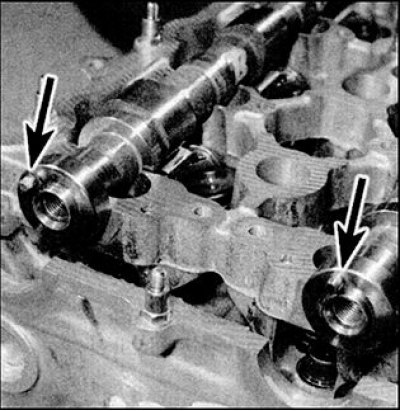
5. Install the camshafts in their places in the cylinder head so that the cams of the 1st cylinder are facing away from the corresponding valves, orienting the pins on the ends (indicated by arrows). When the camshafts are correctly positioned, the locating pin of the intake camshaft sprocket at the front of the camshaft should be pointing at 10 o'clock (if you look from the right side of the engine), and the exhaust camshaft pin should be in the upper vertical position.
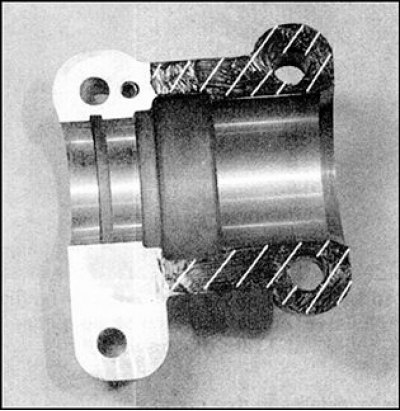
6. Make sure that the contact surfaces of the bearing journal covers and cylinder head beds are absolutely clean, and that there are no foreign inclusions or traces of oil on these surfaces. Apply a thin layer of sealant to the split surface of the leftmost exhaust camshaft cover, which is marked with an inclined hatch.
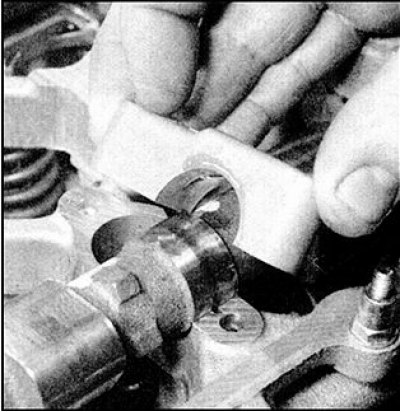
7. Install the bearing journal covers in the same order, using the marks made during disassembly as a guide.
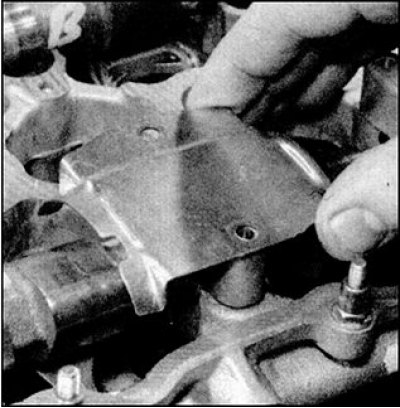
8. Install the oil deflector plate on the 2nd exhaust camshaft cover, install the oil supply pipe.
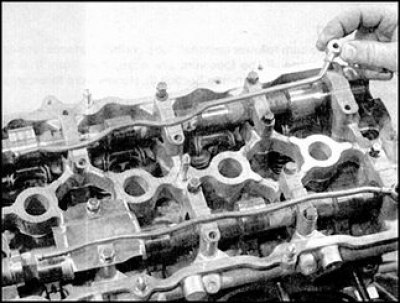
9. Then install the oil supply tubes, securing them to the bearing journal cover bolts. Screw in the bearing journal cover bolts and tighten by hand.
10. Tighten the intake camshaft cover bolts in the sequence shown. Tighten the bolts evenly, gradually increasing the force, turning the bolts one turn at a time, until the covers contact the cylinder head (see Fig. Tightening sequence of bearing journal cover bolts). Then tighten the bolts to the specified torque. Tighten only in the specified order to ensure a uniform and gradual increase in the force from the valve springs to the bearing journal covers.
11. Tighten the exhaust camshaft cover bolts by repeating the steps in the previous step.
12. Install the chain and camshaft sprockets (see subsection 3.2.1.7).
13. If the chain has not been removed, then put the sprockets on the corresponding camshafts, put the chain on, precisely aligning the marks on the chain and sprockets, applied before disassembly. Tighten the sprocket bolts, having previously put washers on them, tighten the bolts to the specified torque.
14. Install the ignition distributor (see subsection 7.7.4).