


Table of contents: Check on the car ↓ Carburetor models 4.2 l and 3.0 l ↓ 4.2L EFI Models (since 1992.) ↓ Disassembly ↓ Cleaning of components ↓ Assembly ↓
Note: To perform the procedures below, you will need a voltmeter and ammeter with a measuring range of 80-0-80 A.
1. Observe the polarity of the battery connection (see size and adjustment tables at the end of the Guide).
2. Do not short or ground the terminals common to the charging circuit.
3. Disconnect the battery before connecting the charger.
4. When using an auxiliary battery, connect it in parallel, i.e. positive to positive, negative to negative, so that the total output voltage remains equal to 12 V.
5. Never disconnect the battery or charging circuit terminals while the engine is running.
6. Check the condition and tension of the drive belt regularly.
7. Make sure the battery terminals are clean and all contact connections are secure.
8. When performing electric welding work on a vehicle, be sure to disconnect the battery and generator.
Check on the car
Note: If the charge indicator lamp remains on after the engine has been started and the engine speed has reached 1,000 rpm, or if there is reason to suspect that the battery charge level is abnormal in either direction, perform the following series of tests.
1. Turn off the engine.
2. Check that the drive belt tension is adjusted correctly.
3. Check the condition of the fuse link.
4. Clean the battery terminals. Tighten all contact connections, checking the wiring for short circuits.
5. Check the battery level. If it is low, recharge the battery or replace it.
6. Start the engine and warm it up to normal operating temperature.
7. Stop the engine and disconnect the negative battery cable.
8. Loosen the nut securing the generator output terminal (VAT) (the accompanying illustration shows the generator of the 4.2L engine), remove the washer and disconnect the generator output wire.
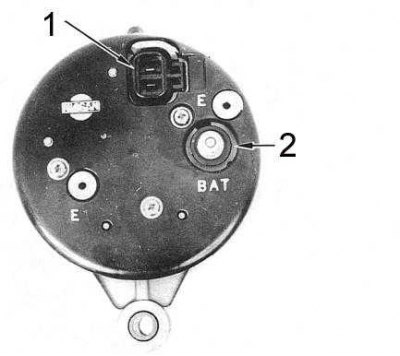
1 - connector terminals
2 - output terminal
9. Connect one of the wires of the 80-0-80 ammeter to the generator output terminal, the second to the output wire.
Note: Do not use alligator clips to connect the ammeter wires. Use bolt clamps or special clamps - accidental disconnection of the wires during testing may result in failure of the generator diode assembly.
10. Connect the negative wire to the battery, connect a voltmeter between the battery terminals.
11. Connect the tachometer.
12. Turn on the high beam headlights. Leave the headlights on for about five minutes to reduce the battery charge and create a load on the circuit.
13. Start the engine and gradually increase its speed to about 2,500 rpm. The ammeter reading should be about 75% of the nominal value of this generator (see size and adjustment tables at the end of the Guide).
14. Turn off all lights and reduce engine speed to 2,000 rpm, until the instrument reading drops below 10 A. The voltage should be between 14.1 and 14.7 V.
Note: If the alternator does not provide the required output, it must be removed for overhaul or replacement. If the measured voltage is outside the specified limits, the voltage regulator must be replaced.
Carburetor models 4.2 l and 3.0 l
Removal
1. Disconnect the negative cable from the battery.
2. Loosen the generator output terminal (BAT) nut, remove the washer and disconnect the output wire.
3. Release the clamp and disconnect the electrical connector at the rear of the generator.
4. Loosen the terminal E bolt and remove the noise suppressor with the wire from the generator.
5. Loosen the position adjustment lock bolt, remove the bolt assembly from the drive belt(s).
6. On 3.0L models, support the generator, loosen the mounting bolt and nut and remove the spacer sleeve.
7. On 4.2L models, support the generator and loosen the mounting bolts.
8. Remove the generator from the vehicle.
Installation
Installation is carried out in reverse order.
1. Do not overtighten the drive belt(s).
2. Check the reliability of the fastening of the contact terminals and connectors of the generator.
4.2L EFI Models (since 1992.)
Removal
1. Disconnect the negative cable from the battery.
2. Remove the fuel filter from the bracket and move it away from the generator.
3. Loosen the mounting bolts and remove the fuel filter bracket from the generator.
4. Loosen the generator position adjustment locking bolt and the adjusting bracket mounting bolt. Remove the bracket from the generator.
5. Disconnect the electrical wiring from the generator.
6. Support the generator and loosen its axle bolts. Remove the generator from the vehicle.
Installation
Installation is carried out in reverse order.
1. Install the drive belts and adjust their tension.
2. Make sure that the electrical connectors are securely fastened.
3. Be sure to connect the ground wire to the fuel filter bracket.
Disassembly
Carburetor models 4.2 l and 3.0 l
4.2L Engine Generator Components
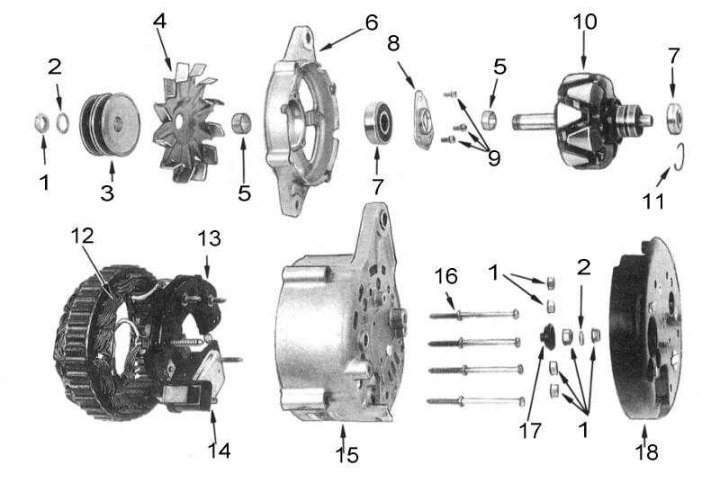
1 - nuts; 2 - washers; 3 - pulley; 4 - fan impeller; 5 - spacer sleeve; 6 - drive side cover; 7 - bearing; 8 - plate; 9 - screws; 10 - rotor; 11 - retaining ring; 12 - stator; 13 - diode assembly; 14 - regulator; 15 - cover from the sliding ring side; 16 - bolts; 17 - insulator; 18 - plastic cover
1. Remove the generator from the vehicle.
2. Loosen the mounting screws and remove (if such is installed) plastic cover from the back of the generator.
3. Draw a line across the drive end cover, stator and slip ring end cover to indicate the relative positions of the components.
4. Remove the through bolts securing the drive side cover to the slip ring side cover.
5. Using suitable levers, carefully pry the slip ring side cover assembly with the stator away from the drive side cover assembly with the rotor. To avoid damaging the stator, do not insert the levers too deeply.
Note: If the assembly of the cover from the side of the sliding rings with the stator is not amenable, it makes sense to heat it for 3-4 minutes in the area of the protrusion for installing the bearing with a powerful (200 W) soldering iron.
6. Clamp the drive side cover assembly with the rotor in a vice with soft jaws and loosen the drive pulley mounting nut to the rotor.
7. Remove the pulley, fan impeller and rotor shaft spacer sleeve.
8. Using a soft-faced hammer, knock the rotor assembly out of the cover and remove the spacer sleeve from the rotor shaft.
9. If necessary, loosen the screws securing the bearing retainer plate to the drive-side cover and carefully remove the bearing from the cover.
10. If necessary, remove the bearing from the rotor shaft on the sliding ring side using a suitable puller.
11. Loosen the nuts and remove the washer and insulator from the cover on the sliding ring side.
12. Remove the cover from the stator assembly.
13. If necessary, unsolder the diode assembly regulator from the stator.
Note: Try not to overheat the contacts to avoid damaging the diode assembly and/or the regulator. Clamp the wire with pliers as close to the soldering point as possible - the pliers will act as a heat sink.
4.2L EFI Models (since 1992.)
4.2L EFI Generator Components
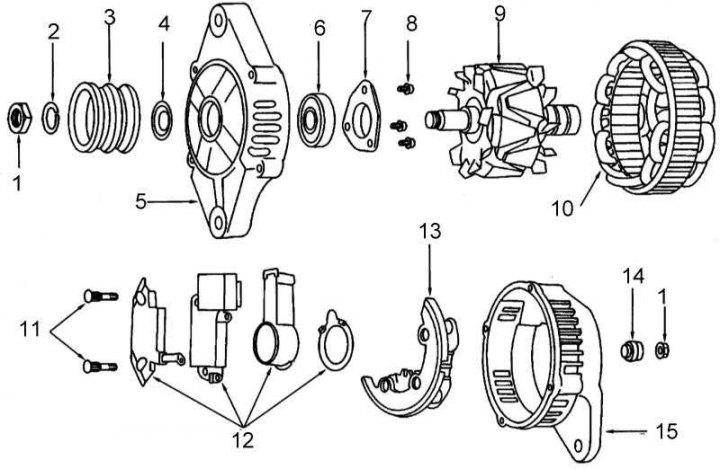
1 - nut; 2 - washer; 3 - pulley; 4 - shield; 5 - drive side cover; 6 - bearing; 7 - plate; 8 - screws; 9 - rotor; 10 - stator; 11 - hairpins; 12 - Brush holder and regulator components; 13 - diode assembly; 14 - insulator; 15 - cover from the sliding ring side
1. Remove the generator from the vehicle.
2. Draw a line across the drive end cover, stator and slip ring end cover to indicate the relative positions of the components.
3. Remove the through bolts securing the drive side cover to the slip ring side cover.
4. Using suitable levers, carefully pry off the cover assembly from the slip ring side of the drive side with the rotor. To avoid damaging the stator, do not insert the levers too deeply.
Note: If the assembly of the cover from the side of the sliding rings with the stator is not amenable, it makes sense to heat it for 3-4 minutes in the area of the protrusion for installing the bearing with a powerful (200 W) soldering iron.
5. Clamp the drive side cover assembly with the rotor in a vice with soft jaws.
6. Loosen the nut securing the drive pulley to the rotor and remove the pulley.
7. Using a soft-faced hammer, knock the rotor assembly out of the cover and remove the spacer sleeve from the rotor shaft.
8. If necessary, loosen the screws securing the bearing retainer plate to the drive-side cover and carefully remove the bearing from the cover.
9. If necessary, remove the bearing from the rotor shaft on the sliding ring side using a suitable puller.
10. Loosen the nuts and remove the insulator from the cover on the sliding ring side. Remove the cover from the stator assembly.
11. If necessary, loosen the mounting screws and remove the rectifier, regulator and brush assembly from the stator.
Cleaning of components
1. To avoid damage to the windings, do not immerse generator components in solvent.
2. The end caps can be washed in kerosene or other cleaning fluid after removal from the block. They should then be thoroughly dried.
3. Compressed air can be used to remove dust from the stator and rotor windings.
4. Burnt or scratched slip rings can be polished with fine sandpaper.
5. Wipe the brushes and brush holders with a rag soaked in gasoline. Inspect the brush holders and remove any burrs.
6. Check the bearings for signs of wear, evaluate their freedom of rotation and the condition of the lubricant. Replace if necessary.
Attention! Checking the condition and proper functioning of components
Note: All components to be electrically tested must be mounted on dielectric stands.
Assembly of the rotor with excitation windings
1. Check for short circuits of windings to ground using an ohmmeter. Connect one of the measuring probes of the device to one of the excitation windings/slip rings, and the second to one of the rotor pole pieces (see accompanying illustration).
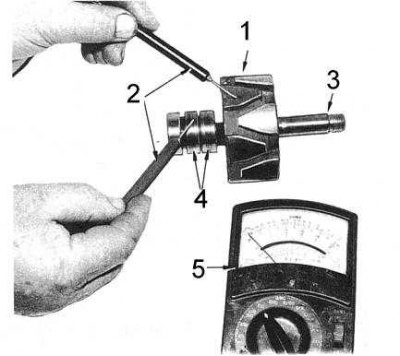
1 - pole tip; 2 - measuring probes; 3 - rotor; 4 - sliding rings; 5 - ohmmeter
2. If conductivity is present and the visible causes of the short circuit cannot be identified and eliminated, replace the rotor assembly.
3. To check the resistance of the rotor windings, connect the ohmmeter test leads to the slip rings (see accompanying illustration). If there is no conductivity, replace the rotor.
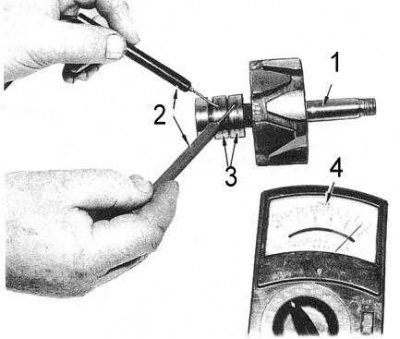
1 - rotor; 2 - measuring probes; 3 - sliding rings; 4 - ohmmeter
4. The stator is checked using a test lamp and an ohmmeter.
5. The stator wires must be disconnected from the rectifier assembly.
6. Connect one of the ohmmeter probes to one of the stator wires, and the other probe to the second wire. Read the reading.
7. Repeat the measurement for the remaining wires, thus checking all phases.
8. If there is a difference between the measurement results, the stator assembly must be replaced.
9. Connect a jumper wire between the negative terminal of a charged 12-volt battery and the stator winding frame. Connect one of the test lamp wires to all stator wires in turn.
10. Turning on the probe paw (dim glow) should be regarded as a sign of a short circuit. The stator assembly should be replaced.
Diode assembly
Note: The diode assembly can be tested with an ohmmeter after removing it from the stator.
1. Connect the ohmmeter probes between the case and one of the contacts of the diode assembly. Reverse the order of connecting the probes and make sure that conductivity occurs in only one direction.
2. Repeat the test for all other contacts in the assembly. If the test condition is not met (conductivity on any of the contacts occurs in both directions, or is absent altogether), replace the diode assembly.
Brushes and brush springs
1. Check the brush springs for signs of overheating and deformation. Check the free sliding of the brushes in the brush holders.
2. Measure the length of the brushes, compare the measurement result with the requirements size and adjustment tables, replace the brushes if necessary.
Assembly
Assembly is carried out in the reverse order of disassembly.
Carburetor models 4.2 l and 3.0 l
1. Install the new bearing into the drive side cover, secure it with the holder plate, tighten the mounting screws.
2. Install the new bearing on the rotor from the side of the sliding rings - press on the inner race. Make sure that the groove for installing the retaining ring does not get under the sliding rings.
3. Install the retaining ring on the side of the bearing facing the sliding rings. Make sure that the protruding part of the ring is located in the deepest part of the groove.
4. Using a soldering iron and a pair of pliers (as a heat sink) solder the contacts of the diode assembly and the regulator to the stator assembly.
Note: To avoid damage to the diodes and/or regulator, try not to overheat the contacts excessively. Before soldering, make sure that the diode assembly wires are positioned correctly.
5. Install the stator, rectifier and regulator assembly into the cover from the sliding ring side and tighten the mounting nuts.
6. Install the cover, washer and nuts onto the generator BAT terminal.
7. Fix the brushes in the protruding position with a piece of wire (straightened paper clip), threaded through a special hole in the lid from the side of the sliding rings.
8. Clamp the rotor in a vice with soft jaws and place the cover on its shaft from the side of the sliding rings, assembled with the bearing.
Note: If necessary, heat the cover for 3-4 minutes in the area where the bearing is installed using a powerful (200 W) soldering iron.
9. Place the cover on the rotor shaft from the drive side with the bearing. Make sure that the spacer sleeve is installed correctly.
10. Align the marks of the mutual positions of the generator units, then screw in and tighten the through bolts securely.
11. Place the spacer sleeve, fan impeller, pulley and spring washer onto the rotor shaft, then screw on the nut and tighten it to the required torque.
12. Remove the wire (paper clip) used to fix the brushes in the protruding position and manually check the freedom of rotation of the rotor.
4.2L EFI Models (since 1992.)
1. Install the new bearing into the drive side cover, secure it with the holder plate, tighten the mounting screws.
2. Install the new bearing on the rotor from the slip ring side (the inner race should be pressed on).
3. Install the rotor shaft into the drive side cover (make sure the spacer sleeve is installed correctly).
4. Install the pulley on the rotor shaft and tighten its mounting nut with a force of 49÷64 Nm.
5. Clamp the drive side cover assembly to the rotor in a soft jawed vice.
6. Fix the brushes in the protruding position using a piece of wire threaded through a special hole in the cover on the side of the sliding rings.
7. Place the cover on the rotor assembly from the drive side with the bearing. Ensure that the marks of the mutual position of the generator units are aligned.
8. Screw in the through bolts and tighten them with a force of 3÷4 Nm, remove the wire (paper clip) used to fix the brushes in the protruding position, then manually check the freedom of rotation of the rotor.