


Attention! Maintenance of the battery must be performed in accordance with the vehicle's routine maintenance schedule.
Note: You will need a hydrometer and charger to perform the procedures below
Removal
1. Disconnect the negative and positive cables from the battery.
2. Remove the clamp bar and remove the battery from the engine compartment of the vehicle.
Installation
Installation is carried out in reverse order.
1. Check the condition of the battery terminals.
2. When connecting the wires, make sure to observe the polarity. Connect and secure the positive wire first.
3. Do not tighten the terminal clamp nuts too tightly.
4. To prevent corrosion, lubricate the terminals and wire ends with acid-free petroleum jelly.
Battery Care
Warning! Battery electrolyte produces highly explosive hydrogen gas - never approach the battery with an open flame!
1. Keep the battery and its surrounding surfaces clean. Do not allow dirt or moisture to get on the top of the battery. If necessary, clean the outside of the battery:
- Remove the battery from the car;
- Carefully pour hot water over the battery, making sure that it does not get inside through the ventilation holes of the filler caps;
- Wipe the battery case thoroughly.
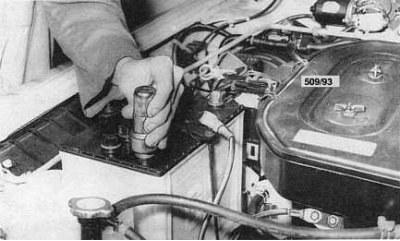
2. Clean the battery terminals and terminal clamps with a wire brush, sandpaper, or special tool (see accompanying illustration). Remove all traces of dirt and corrosion.
3. Remove the filler caps and make sure the ventilation holes are clear.
4. Check the electrolyte level in the battery jars, add distilled water if necessary. The electrolyte should completely cover the plates. Do not overfill the battery, do not pour electrolyte from one jar to another.
5. If you frequently need to add water, check the battery case for signs of leaks. If cracks are found, replace the battery.
6. By measuring the generator output parameters, check whether the battery charge level is too high.
7. To prevent corrosion, lubricate the terminals with acid-free petroleum jelly.
8. If electrolyte overflows onto the battery tray and surrounding body panels, proceed as follows:
- Treat contaminated surfaces with soda bicarbonate;
- Rinse off the soda with hot water - remember that soda reacts violently with water, causing abundant foaming;
- After foaming has stopped, rinse the surfaces with clean water and let them dry;
- Remove any blistered paint from treated surfaces;
- Cover the surfaces with anti-corrosion paint.
Checking the status and charging
1. Use a hydrometer to measure the density of the battery electrolyte (follow the instructions supplied with the device). Compare the measurement results with the standard data:
| Hydrometer readings | Charge level |
| 1.110÷1.130 | Completely discharged |
| 1.140÷1.160 | Almost discharged |
| 1.170÷1.190 | About a quarter discharged |
| 1.200÷1.220 | Half discharged |
| 1.230÷1.250 | Approximately three quarters charged |
| 1.260÷1.280 | Fully charged |
The data are given for an electrolyte temperature of 20°C. For every 10°C above 20°C, add 0.007 to the values given. For every 10°C decrease in temperature relative to 20°C, subtract 0.007.
Note: It is not possible to obtain a correct electrolyte specific gravity reading if distilled water has recently been added to the jars. If the electrolyte level has dropped below the top of the plates, add water to the battery, then recharge the battery before measuring the specific gravity of the electrolyte.
2. If the battery level is insufficient, charge it using one of the commercially available types of charger:
- Disconnect the negative and positive cables from the battery (in the order given);.
- Check the electrolyte level in the cans, add distilled water if necessary;
- Remove the filler caps from the battery;
- Next, follow the charger manufacturer's instructions.
3. If the battery does not provide the required performance after charging, it should be sent to the nearest automotive electrical equipment repair shop for a load test using special equipment. The load test in combination with the specific gravity measurement will allow an adequate assessment of the battery's performance.