


Table of contents: Check on the car ↓ Removal ↓ Installation ↓ Disassembly ↓ Checking the status ↓ Assembly ↓
Check on the car
Note: If the starter fails when starting the engine, perform the following checks.
1. Check the battery status and charge level.
2. Clean the battery terminals, paying particular attention to the cleanliness of the positive terminal and its clamp.
3. Check the condition and reliability of the grounding contacts.
4. Turn on the headlights and ignition. If the headlights are on but the starter does not function, this may indicate a short circuit in the starter circuit. Check to see if the engine or starter pinion assembly is seized in the flywheel ring gear (in these cases the symptoms will be similar).
5. If the headlights do not light and the starter does not function, check the ignition switch and electrical wiring for breakage.
6. Inspect the external wiring for signs of breakage. If no defects are found, the starter should be removed for detailed diagnostics.
Removal
Assembly of the starter of the 4.2L engine
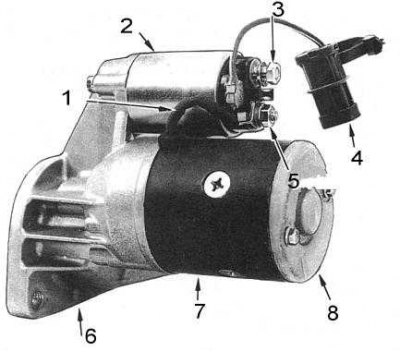
1 - pole connector bus; 2 - electromagnetic traction relay; 3 - main terminal; 4 - connector; 5 - terminal of the pole winding; 6 - rear end cover; 7 - drive side cover; 8 - body
1. Disconnect the negative cable from the battery.
2. Disconnect the battery cable from the starter solenoid.
3. Disconnect the electrical connector on the starter.
4. Loosen the mounting bolts and remove the starter from the vehicle.
Note: If the starter is difficult to remove from the transmission housing, try gently prying it off with a lever.
Installation
1. Installation is carried out in reverse order.
2. Before installing the starter on the transmission, lubricate its mating surface with a high-quality liquid sealant.
Disassembly
3.0L models
3.0L Engine Starter Components
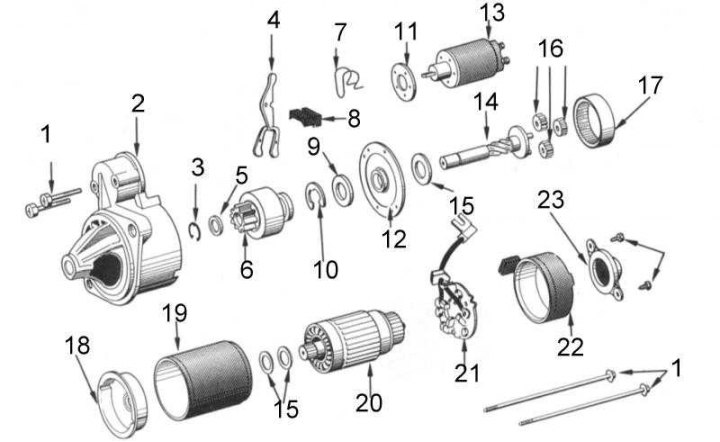
1 - bolts; 2 - drive side cover; 3 - retaining ring; 4 - drive lever; 5 - thrust ring; 6 - drive gear; 7 - spring; 8 - anther; 9 - washer; 10 - retaining ring; 11 - plate; 12 - intermediate front cover; 13 - electromagnetic traction relay; 14 - drive gear shaft; 15 - adjusting washer; 16 - planetary gears; 17 - internal gear wheel; 18 - intermediate rear cover; 19 - body; 20 - anchor; 21 - brush holder; 22 - cover from the collector side; 23 - screws
1. Disconnect the brush connector bus from the lower terminal of the traction relay.
2. Loosen the mounting bolts and remove the rear boot from the manifold side of the cover.
3. Draw a line showing the relative positions of both covers and the starter housing.
4. Unscrew the through bolts and remove the cover from the housing on the manifold side.
5. Remove the brush holder assembly, housing, armature and intermediate rear cover from the drive side cover.
6. Remove the intermediate rear cover and adjusting washers from the anchor. Remember the number of adjusting washers.
7. Loosen the mounting bolts and slightly separate the traction relay from the bracket, disengaging the drive lever from the plunger. Remove the traction relay. Remove the drive lever tension spring and adjusting plate.
8. Remove the intermediate front cover, drive pinion shaft with planetary assembly and lever from the drive side cover.
9. Using pliers, press down on the drive pinion thrust ring and remove the retaining ring, thrust ring and drive pinion from the pinion shaft.
10. Using a small screwdriver, remove the snap ring, washer, intermediate front cover and adjusting washer from the drive pinion shaft.
11. Clean all components thoroughly, but do not immerse the armature solenoid or drive gear assembly in solvent.
Models 4.2L
3.0L Engine Starter Components
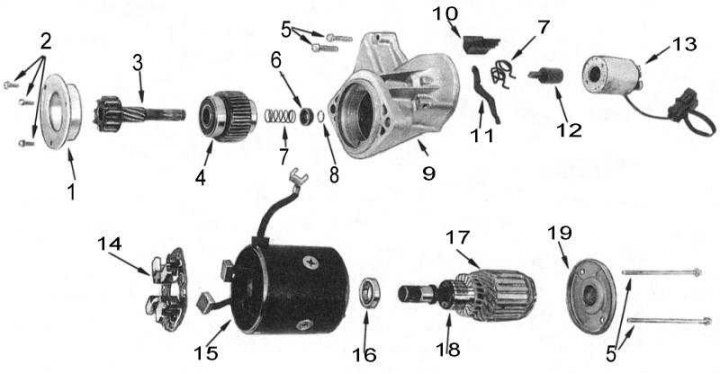
1 - gear casing; 2 - screws; 3 - drive gear; 4 - clutch; 5 - bolts; 6 - bushing; 7 - spring; 8 - retaining ring; 9 - drive side cover; 10 - seal; 11 - drive lever; 12 - plunger; 13 - electromagnetic traction relay; 14 - brush holder; 15 - body; 16 - bearing; 17 - anchor; 18 - collector; 19 - rear end cover
1. Remove the starter from the vehicle.
2. Clamp the starter in the installation position in a vice with soft jaws (for the cover on the drive side).
3. Loosen the terminal nut of the pole winding and disconnect the wire from the traction relay.
4. Having drawn a line, mark the relative positions of the covers and the body.
5. Loosen the mounting bolts and remove the rear end cover from the starter.
6. Remove the housing, armature and brush holder assembly from the drive side cover. Note the position of the sealing ring on the housing.
7. Release the brush springs and remove the brushes from the brush holder.
8. Remove the brush holder and armature from the housing.
9. Using a line, mark the position of the traction relay in relation to the cover bracket on the drive side.
10. Loosen the mounting bolts and remove the traction relay, plunger, spring, drive lever, rubber seal and adjusting washers from the cover (if such are installed). Try to remember the installation position of the components.
11. Clamp the drive side cover in a vice with soft jaws (drive gear up) and remove the screws securing the gear housing to the cover.
12. Remove the casing and take the gear assembly out of the cover
13. Clamp the gear in a vice with soft jaws, press down the sleeve and remove the retaining ring from the gear.
14. Remove the sleeve with the spring from the gear, then remove the gear from the clutch.
15. If necessary, you can use a pair of screwdrivers to remove the bearings from the clutch. Remember the position of the larger one.
16. If necessary, remove the bearings from the anchor using a puller for this purpose.
17. Clean all components thoroughly. Never immerse the housing, anchor or clutch in solvent.
Checking the status
1. Use an ohmmeter to check the brush holder insulator for conductivity. Connect one of the probes of the device to the positive side of the brush holder, the second to the negative. If conductivity is present, perform the necessary repairs or replace the brush holder.
2. Measure the length of the brushes, compare the measurement result with the requirements size and adjustment tables. Replace the brushes if necessary. The brushes should slide freely in the holders - check.
3. Check the forces developed by the brush springs, compare the results with the regulatory requirements (see size and adjustment tables at the end of the Manual). Replace the springs if necessary.
4. Check the manifold for cavities and burnouts. Wipe it with a rag soaked in gasoline and polish it with fine sandpaper. In case of severe wear, the manifold can be clamped in the chuck of a lathe and lightly turned with a very sharp cutter at high speed. After finishing turning, measure the outside diameter of the manifold and compare it with the standard requirements (see size and adjustment tables at the end of the Manual). Trim the insulation between the segments to the required depth.
5. Connect one of the ohmmeter probes to the armature shaft or core and move the second along the collector's generating surface. If conductivity occurs at any point, the armature is faulty and must be replaced.
6. Check the pole windings for conductivity between the winding wire and each of the brushes. If there is conductivity, the pole winding wire is broken.
7. Connect one of the ohmmeter probes to the pole winding wire, and the other to the housing. If there is conductivity, the pole windings with the housing should be replaced.
8. Check the drive gear teeth for signs of wear and chipping.
9. Make sure that the clutch sleeve transmits rotation in one direction only. In the opposite direction, the sleeve should turn easily and smoothly, and the entire assembly should move freely along the screw splines.
Assembly
3.0L models
1. Lubricate the planetary gears, internal gear and drive lever with high temperature grease.
2. Place the planetary assembly, adjusting washers and intermediate front cover onto the drive pinion shaft.
3. Place the washer and retaining ring on the gear shaft.
4. Place the drive gear, thrust ring and retaining ring on the shaft.
5. Install the drive lever and drive gear into the drive side cover.
6. Install the tension spring of the lever and, if removed, the adjusting plates on the electromagnetic traction relay. Carefully install the traction relay on the cover from the drive side. Ensure that it is correctly positioned relative to the drive lever. Screw in the traction relay mounting bolts and tighten them to the required force.
7. Install the intermediate rear cover and adjusting washers onto the anchor (maintaining the previous order).
8. Secure the brushes in their holders and install the brush holder assembly, housing and commutator side cover onto the armature.
9. Install the housing assembly with the brush holder and anchor onto the drive side cover (taking into account the landing risk). Insert the through bolts and tighten them securely.
10. Install the dust cover and screw the mounting screws into the cover from the manifold side. Tighten the screws securely.
11. Use your hand to pull the gear out of the casing until it rests against the stop and measure the distance from the end of the gear to the surface of the casing.
12. Apply 12 V between the traction relay bayonet terminal and the pole winding terminal on the traction relay. Repeat the measurement in the previous paragraph. Subtract the first result from the second to determine the axial clearance of the gear, compare the calculation result with the standard requirements (see size and adjustment tables at the end of the Guide).
13. If necessary, add an adjustment plate between the support surface of the traction relay and the cover on the drive side, or remove the excess.
14. Connect the wire to the terminal of the pole winding of the traction relay and secure it firmly with a nut.
15. Install the starter on the vehicle.
Models 4.2L
Assembly is carried out in the reverse order of disassembly.
1. If removed, install new bearings into the clutch assembly and onto the armature. Lubricate the armature bearings with high-temperature grease. Sealed clutch bearings are factory-packed with grease and do not require additional lubrication.
2. Lubricate the gearbox teeth, drive gear helical splines, traction relay plunger and drive lever with high-temperature grease.
3. Install the gear into the clutch, install the spring and sleeve on the gear.
4. Press the sleeve down and install the retaining ring on the end of the gear. Make sure that the sleeve is seated correctly on the retaining ring.
5. Install the clutch gear assembly into the drive side cover.
6. Install the gear housing onto the cover. Screw in and tighten the mounting screws securely. Check that the gear rotates freely.
7. Assemble the lever, spring and traction relay in the same order.
8. Install the traction relay assembly and rubber seal onto the drive side cover. Install and tighten the traction relay mounting bolts securely.
9. Using your hand, pull the gear out of the casing as far as it will go and measure the amount of its protrusion.
10. Apply 12 V between the traction relay bayonet terminal and the pole winding terminal on the traction relay. Repeat the measurement in the previous paragraph. Subtract the first result from the second to determine the axial clearance of the gear, compare the calculation result with the regulatory requirements (see size and adjustment tables at the end of the Guide).
11. If necessary, add an adjustment plate between the support surface of the traction relay and the cover on the drive side, or remove the excess.
12. Install the anchor into the hull.
13. Install the brush holder assembly into the housing. Insert the brushes into the holders and place the springs on them.
14. Install the sealing ring on the housing. Make sure that it does not twist.
15. Install the housing assembly with the anchor and brush holder on the cover from the drive side. Ensure that the mounting marks are aligned.
16. Install the end cover onto the housing. Screw in the mounting bolts and tighten them securely.
17. Connect the wire to the pole terminal of the traction relay and secure it firmly with a nut.
18. Install the starter on the vehicle.