


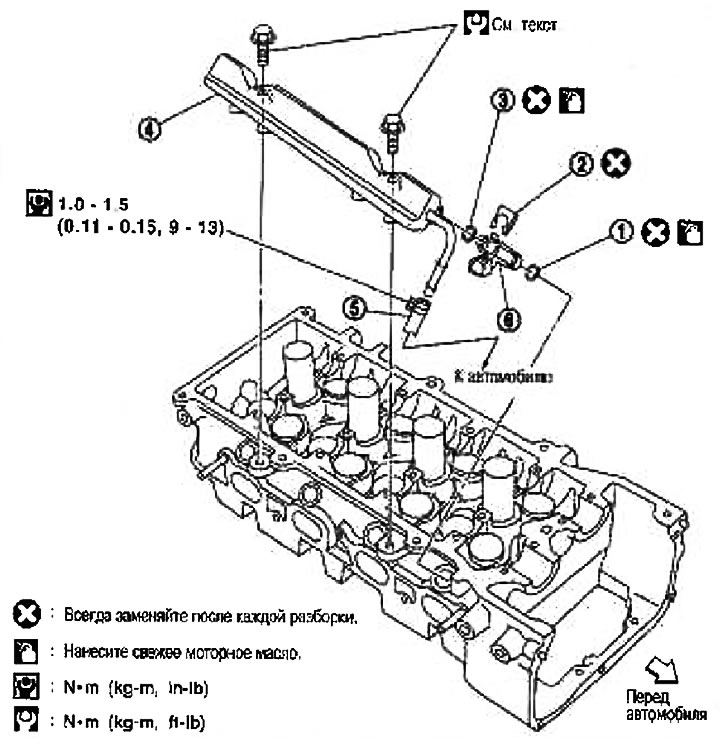
1. O-ring seal (brown); 2. Clamp; 3. O-ring (black); 4.Fuel pipe; 5. Fuel hose; 6. Fuel injector
Removal
1. Relieve the fuel pressure. See chapter Engine management system.
2. Remove the air duct and air cleaner assembly. See the section above "Air purifier and air duct".
3. Remove the upper intake manifold support bracket.
4. Disconnect the fuel hose from the fuel pipe side.
Caution: To prevent fuel from leaking after disconnecting, plug the fuel hose with a cap.
5. Disconnect the electrical wiring from the fuel injectors and move it to the side so that it does not interfere with work.
If it is difficult to disconnect, remove the fuel injector and fuel pipe assembly from the cylinder head and disconnect the electrical wiring from the fuel injectors in a more convenient location.
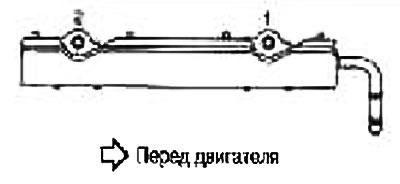
6. Loosen the mounting bolts in the reverse order shown in the illustration and remove the fuel injector and fuel pipe assembly.
Attention:
- Make sure the fuel injector nozzle does not come into contact with other components.
- Do not tilt it, otherwise the remaining fuel will spill out of the tubes.
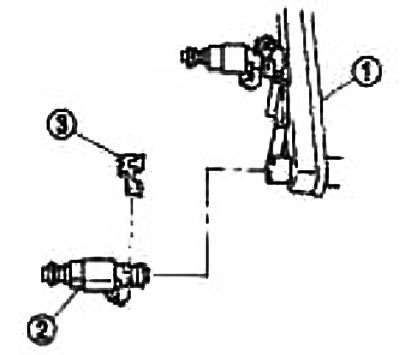
7. Remove the fuel injector (2) from the fuel pipe (1) by performing the following operations:
- a. Release the clamp (3) and remove it.
- b. Remove the fuel injectors from the fuel pipe at a right angle.
Attention:
- Do not damage the injector nozzle.
- Do not drop or hit the top nozzles.
- Do not disassemble or adjust fuel injectors.
Installation
1. When installing new O-rings into the fuel injector, observe the following:
Attention:
- The upper and lower O-rings are different. Do not mix them up. Fuel pipe side: black; From the nozzle side: brown.
- Handle O-rings with bare hands. Do not wear gloves.
- Lubricate the O-rings with fresh engine oil.
- Do not clean O-rings with solvent.
- Make sure there are no foreign particles on the O-ring or sealing surface.
- When installing, do not scratch the seals with a tool or fingernails. Also, do not twist or stretch the O-rings. If the O-ring is stretched during installation, do not insert it into the fuel pipe immediately.
2. Insert the fuel injector into the fuel pipe as follows:
Insert the clamp (3) into the groove (2) on the fuel injector (1).
Insert the clamp so that the protrusion (4) on the fuel injector aligns with the notch (5) on the clamp.
Caution: Always replace the clamps with new ones. Position the clamp so that it does not touch the O-ring. Otherwise, replace the O-ring.
Insert the fuel injector (1) into the fuel pipe (6) with the clamp secured.
Insert it, keeping it centered.
Insert the fuel injector so that the protrusion (7) of the fuel pipe fits into the notch (8) on the clamp.
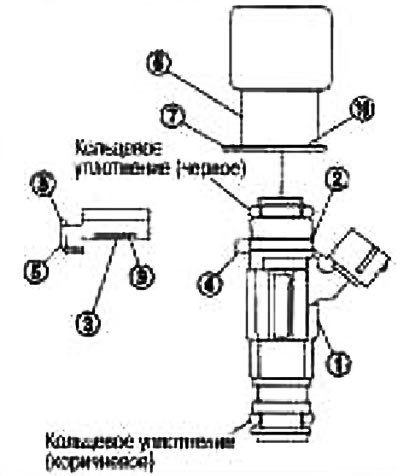
Make sure that the flange (10) of the fuel pipe is securely fixed in the installation groove (9) on the clamp.
Check for proper installation by ensuring that the fuel injector does not rotate or come off.
3. Install the fuel pipe and fuel injector assembly onto the cylinder head
Caution: Do not allow the fuel injector nozzle tip to come into contact with other components.
Tighten the mounting bolts in two passes in the order shown by the numbers in the illustration.
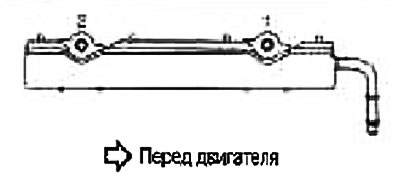
1st pass: 11.8-13.8 N·m (1.2-1.4 kg·m)
2nd pass: 20.8-28.2 N·m (2.1-2.9 kg·m)
4. Connect the fuel hose.
Caution: Tighten the hose clamp securely where it does not contact the flange.
5. Install the intake manifold upper support bracket.
Tighten the mounting bolts as follows:
- Tighten the bolts by hand in the order shown by the numbers in the illustration.
- Tighten the bolts to the specified torque in the order shown by the numbers in the illustration.
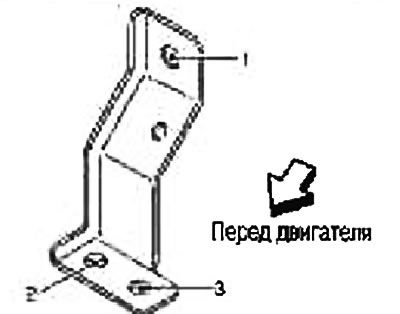
Bolt 1: 6.9-9.5 N·m (0.7-0.96 kg·m)
Bolts 2 and 3: 8.4-10.8 N·m (0.86-1.1 kg·m)
6. After this operation, installation is carried out in the reverse order of removal.
Post-installation check
Checking for fuel leaks
1. Create pressure in the fuel lines by turning the ignition key to the "ON" position (without starting the engine). Then check for fuel leaks at the joints.
2. Start the engine. Increase the engine speed and check again for fuel leaks at the fuel line joints.