


Attention! Valve clearances are checked only on a hot engine. The manufacturer has established standard clearances for a warm and cold engine. Clearances on a cold engine are checked only before starting the engine after a major overhaul. After warming up the engine, check the clearances again.
Checking and adjusting clearances is performed only after a significant mileage of the vehicle, major engine repairs, or when searching for reasons for a drop in engine power, if there is a suspicion of a malfunction of the valve drive mechanism.
1. The clearances should be checked only in the case of increased noise from the valve drive, after a major engine overhaul, or when searching for reasons for a drop in engine power, if there is a suspicion of a malfunction of the valve timing mechanism.
2. Draw the outline of the engine on a piece of paper and indicate the location of cylinders 1 through 4, taking into account that cylinder 1 is located on the side of the camshaft drive chain cover. Indicate the position of each valve, and also write the clearance that must be maintained in accordance with the technical data. Draw two lines near the image of the valve on the diagram, which will indicate the measured clearance and the amount by which the clearance must be corrected.
Attention! The manufacturer sets two groups of valve clearance tolerances. One group is for checking clearances, and the other is for adjusting and setting valve clearances. The tolerances of the checking group are the largest, but it is strongly recommended to maintain all clearances within the adjustment group of tolerances (although compliance with this condition is not strictly necessary).
3. Warm up the engine, turn off the ignition and remove the cylinder head cover.
4. Set the piston of the 1st cylinder to TDC of the compression stroke.
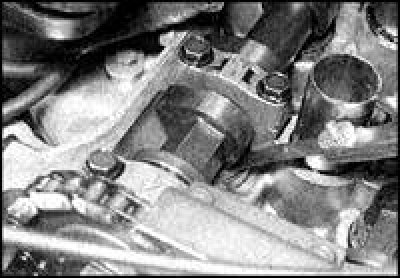
5. Measure the clearance between the camshaft lobe and tappet on the following valves using feeler gauges, recording each result:
- 1st cylinder - intake and exhaust valves;
- 2nd cylinder - intake valves;
- 3rd cylinder - exhaust valves.
6. Turn the crankshaft clockwise by 360°, aligning the TDC mark with the pointer. In this position of the crankshaft, the piston of the 4th cylinder is at TDC of the compression stroke.
7. Measure the clearance in the following valves, recording each result:
- 2nd cylinder - exhaust valves;
- 3rd cylinder - intake valves;
- 4th cylinder - intake and exhaust valves.
8. Calculate and record the difference between the measured and standard clearances. If the clearance in any valve differs from the standard, replace the adjusting washer of this valve, selecting a new washer according to thickness.
9. To get the adjusting washer, you need to push the pusher back a sufficient distance, overcoming the force of the valve spring. To do this, the camshaft must be turned so that the cam of the corresponding valve is facing away from the pusher. Then turn the pusher so that the groove on it is located at a right angle to the camshaft axis.
10. Using an open-end wrench or heavy-duty screwdriver against the camshaft, lever the tappet out far enough to allow the gasket to slide out. Once the gasket is removed, slowly release the tappet. If the gasket is difficult to remove, the camshaft will need to be removed (see subsection 3.1.1.10).
11. The thickness of the adjusting shim is indicated on its bottom surface (for example 224 means thickness 2.24 mm), however, it is recommended to measure the washer with a micrometer, as the thickness may decrease due to wear.
Attention! The spare parts supplied include washers with a thickness from 2.00 to 2.98 mm with a step of 0.02 mm.
12. If the measured gap is less than the standard, subtract the measured gap from the standard, then subtract the result from the thickness of the removed washer.
Example:
- Intake valve clearance is less than normal
- Measured gap 0.26 mm
- Standard clearance 0.36 mm (from 0.32 to 0.40 mm)
- Difference 0.10 mm
- The thickness of the installed washer is 2.50 mm
Required thickness 2.50 - 0.10 = 2.40 mm 13. If the measured gap exceeds the standard, subtract the standard from the measured gap, then add the resulting value to the thickness of the removed washer.
Example:
- The clearance in the exhaust valve is greater than the norm
- Measured gap 0.51 mm
- Standard clearance 0.41 mm (from 0.37 to 0.45 mm)
- Difference 0.10 mm
- The thickness of the installed washer is 2.76 mm
- Required thickness 2.76 + 0.10 = 2.86 mm
14. Press the tappet back, then install the adjusting washer of the selected thickness in place with the side with the marking facing down. Make sure the washer is installed correctly, then repeat the procedure for the remaining valves whose clearances differ from the standard (if any).
15. After adjusting the clearances, rotate the crankshaft at least 4 revolutions in the direction of normal rotation. Check the valve clearances again.
16. If all gaps are within the norm, then install the cylinder head cover and install the remaining removed parts.