


Note: This procedure requires a special tool - ask at car accessory stores.
1. Disconnect the negative cable from the battery.
Note: If your car stereo is equipped with a security code, make sure you have the correct combination to activate the audio system before disconnecting the battery!
2. Remove the cylinder head cover (see section Removal and installation cylinder head covers).
3. On models with manual transmission, set the parking brake and select neutral gear.
4. Remove the spark plugs (see Chapter Settings and ongoing maintenance).
5. Bring the piston of the first cylinder to the TDC position at the end of the compression stroke, - ensure that the alignment marks are correctly aligned (see section Bringing the piston of the first cylinder to the top dead center (TDC) position).
6. Measure the clearances of the relevant valves. Record the measurement results and compare them with the requirements of the Specifications. Mark the valves whose clearances are outside the permissible range.
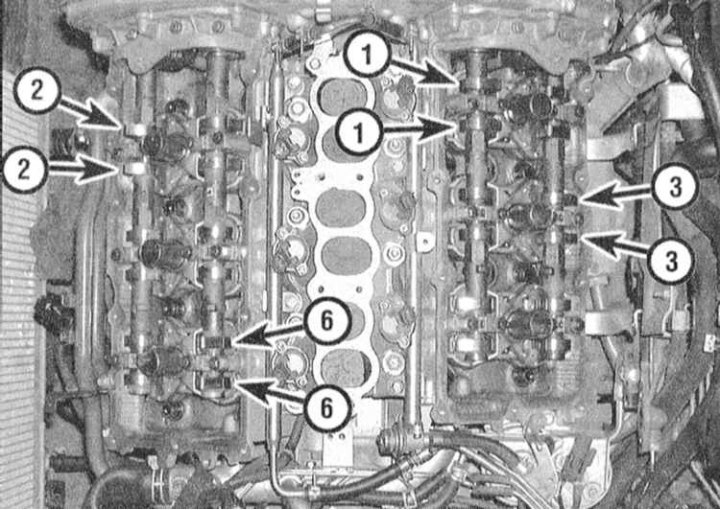
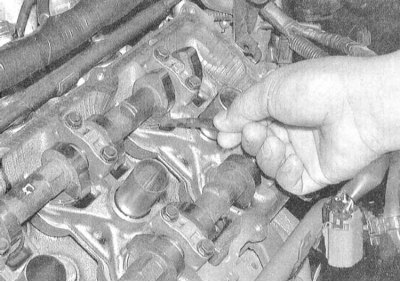
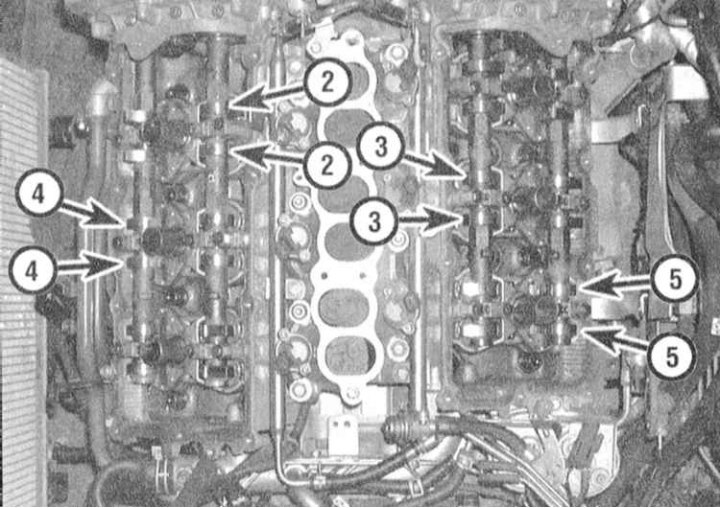
7. Turn the crankshaft in the normal direction (clockwise) by 240° in order to bring the piston of the third cylinder to the TDC position and measure the valve clearances of the next set.
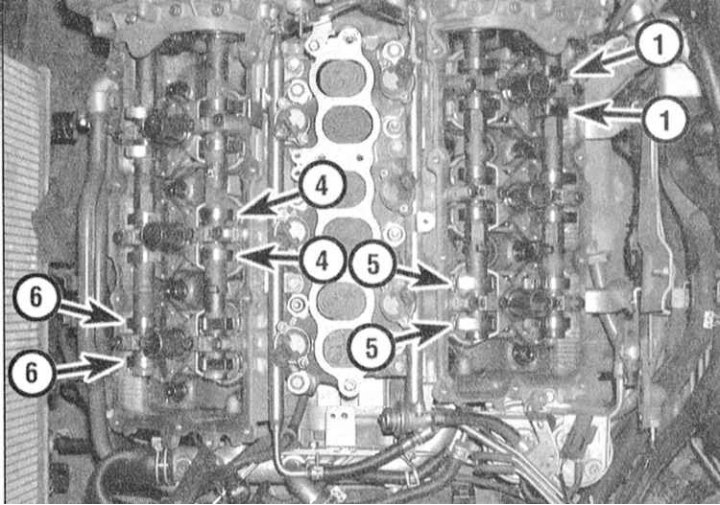
8. Rotate the shaft another 240° (TDC 5th cylinder) and check the clearances of the remaining valves.
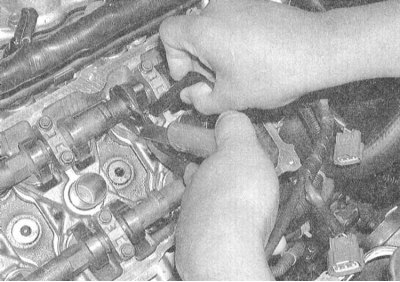
9. After completing the measurement, turn the crankshaft pulley so that the cam of the first valve to be adjusted is turned with the working protrusion upwards (from the pusher).
Information copied from the website nissanbook.ru
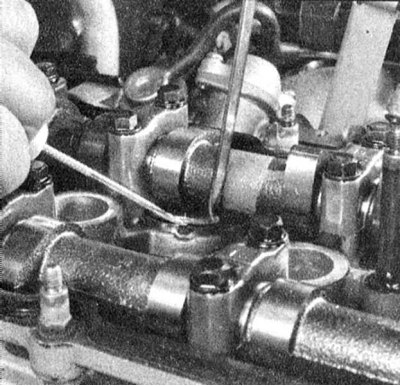
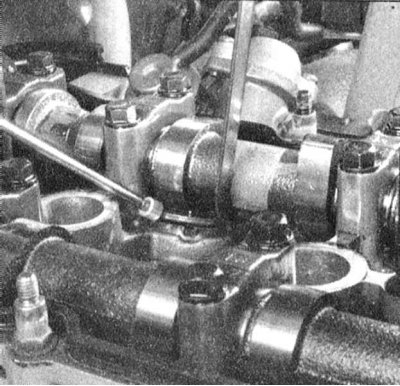
10. Turn the adjusting washer with the hole towards the central part of the cylinder head casting. Install the special pliers so that their upper jaws grip the shaft at the cam cheek, and the lower ones rest against the top of the washer. Squeeze the handles of the pliers and turn the tool away from the camshaft, pressing the pusher. Pass the tip of the second special tool into the gap between the edge of the pusher and the camshaft, then release the pusher. You can use tweezers to remove the adjusting washer (lift the washers with a screwdriver) or a magnetized rod.
Note: Blowing compressed air into the hole in the washer will help remove it.
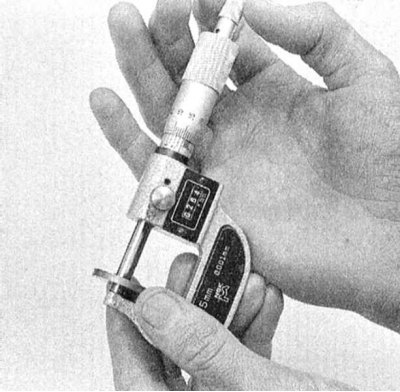
11. Measure the thickness of the removed washer using a micrometer or a caliper equipped with a vernier scale (see accompanying illustration). To calculate the thickness of the new washer that must be installed on the tappet in order to adjust the valve clearance, use the following formula:
Inlet valves: N = R (M - 0.30 mm)
Exhaust valves N = R (M - 0.33 mm)
Where:
R - Thickness of the old washer in millimeters
M - Measured valve clearance in millimeters
N - Thickness of the new washer in millimeters
12. Select a new washer so that its thickness matches the required value as closely as possible. Washers are available in 64 sizes in 0.01 mm increments, ranging from 2.32 mm to 2.95 mm.
Note: A washer removed from one valve tappet may be suitable as a new one for adjusting the clearance of another - make the appropriate calculations before going out to buy new washers.
13. Proceeding in a manner similar to that described in paragraph 10, install new selected washers one by one onto the tappets of the corresponding valves.
14. Make sure that the valve clearances are adjusted correctly (see above), and re-select the washers if necessary.
15. The head is assembled in the reverse order of dismantling the components.