


Timing drive diagram for DOHC engines
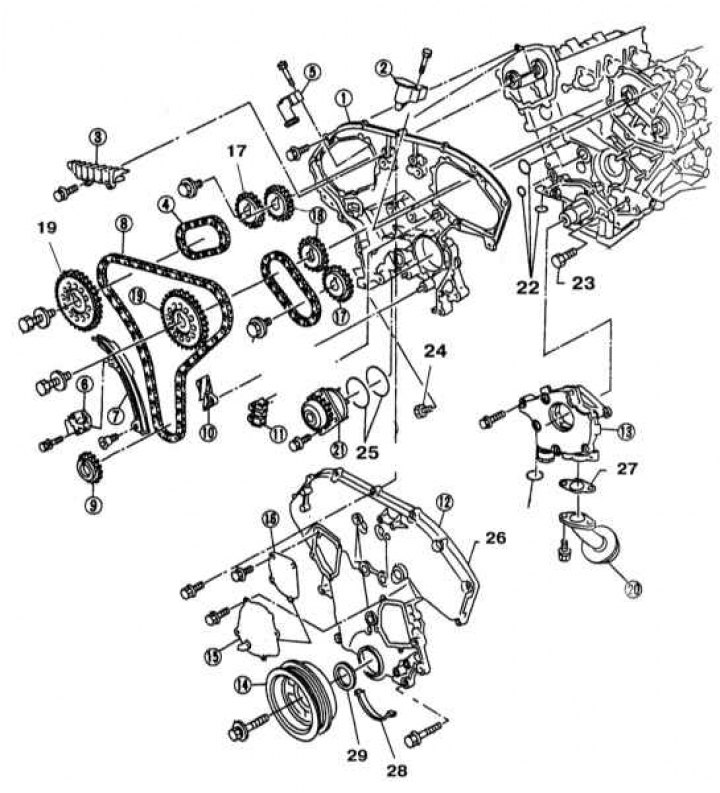
1 - Rear timing belt cover; 2 - Front (left) secondary chain tensioner; 3 - Upper guide; 4 - Rear (right) secondary chain; 5 - Rear (right) secondary chain tensioner; 6 - Main chain tensioner; 7 - Guide for the sagging section of the chain; 8 - Main timing chain; 9 - Crankshaft sprocket; 10 - Lower guide of the main chain; 11 - Upper guide of the main chain; 12 - Front timing belt cover; 13 - Oil pump; 14 - Crankshaft pulley; 15 - Water pump cover; 16 - Chain tensioner access cover; 17 - Secondary exhaust camshaft chain sprockets; 18 - Secondary intake camshaft chain sprockets; 19 - Intake camshaft main chain sprockets; 20 - Oil filter; 21 - Water pump; 22 - Sealing rings; 23 - Water drain plug; 24 - Cork; 25 - sealing rings; 26 - Sealing ring; 27 - Sealing gasket; 28 - Seal; 29 - Front crankshaft oil seal
Attention! Before starting the procedure, wait until the engine has completely cooled down.
Removal
1. Disconnect the negative cable from the battery.
Warning! If the car stereo system is equipped with a security code, make sure you have the correct combination to activate the audio system before disconnecting the battery!
2. Support the rear wheels of the car with wheel chocks. Set the parking brake.
3. Loosen the nuts securing the right front wheel, then jack up the front of the car and place it on supports. Remove the wheel.
4. Remove the crankcase guard and the right front wheel arch protection liner.
5. Release the pressure in the fuel system (see Chapter Power and exhaust systems). Drain the cooling system (see Chapter Settings and ongoing maintenance).
6. Remove the upper section of the intake manifold (pressure chamber) (See Section Removal and installation the intake manifold) and cylinder head covers (see section Removal and installation cylinder head covers).
7. Remove the spark plugs (see Chapter Settings and ongoing maintenance). Bring the piston of the first cylinder to the TDC position of the end of the compression stroke (see section Bringing the piston of the first cylinder to the top dead center (TDC) position).
8. Remove the drive belts (see Chapter Settings and ongoing maintenance) and the intermediate roller bracket.
9. Remove the steering pump with the bracket (see Chapter Suspension and steering).
10. Remove the air conditioning compressor (see Chapter Cooling and heating systems).
11. Remove the crankshaft pulley (see section Removal and installation the crankshaft pulley).
Note: Do not allow the crankshaft to turn while removing the pulley - the engine must remain in the TDC position of the piston of the first cylinder.
12. Disconnect the electrical wiring from the oxygen sensor, then separate the exhaust pipe from the exhaust manifolds and catalytic converter (see Chapter Power and exhaust systems).
13. Suspend the power unit from above using a winch or beam.
Attention! Make sure the unit is securely fastened!
14. Unscrew the through bolts of the front and rear powertrain suspension supports and remove the cross member from the vehicle as an assembly with the supports attached to it (see section Checking the condition and replacing the powertrain suspension supports).
15. Remove the A/C compressor bracket and the upper and lower sections of the oil pan (see section Removal and installation the engine oil pan).
16. Remove the right suspension support of the unit through the top (see section Checking the condition and replacing the powertrain suspension supports).
17. Remove the camshaft position sensor from the chain cover (see Chapter Engine management systems).
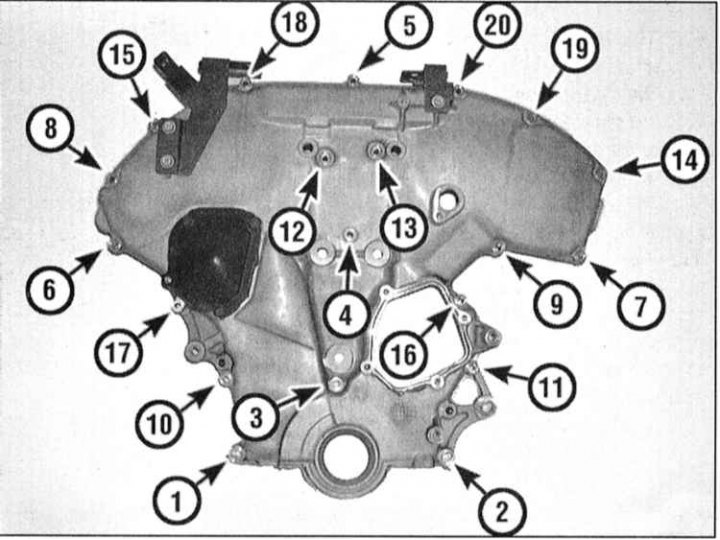
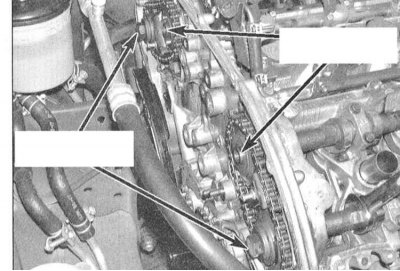
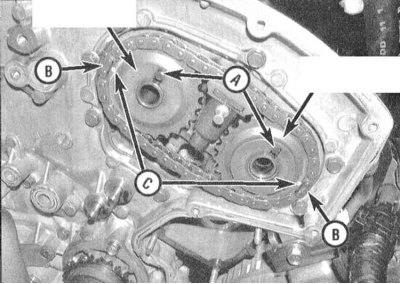
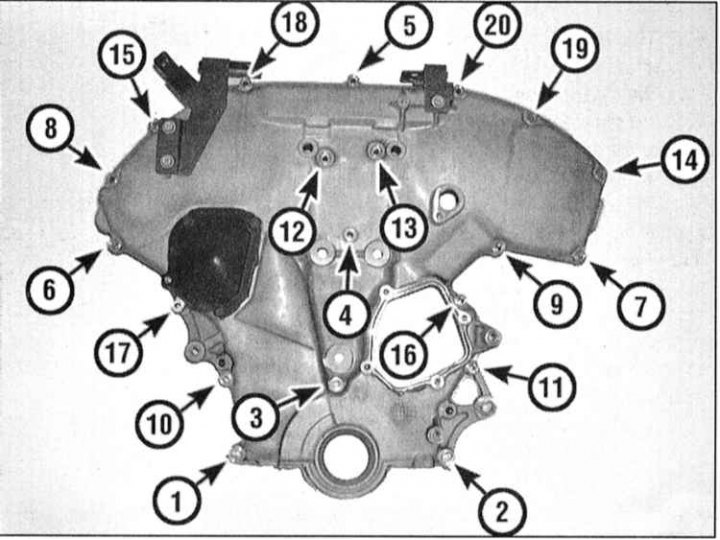
18. Release the wiring harness from the brackets on the upper timing chain cover. In the reverse order to that shown in the illustration, unscrew the front cover mounting bolts. Please note that bolts of different sizes are used to secure the cover, which must be installed strictly in their original places during assembly - if necessary, mark accordingly.
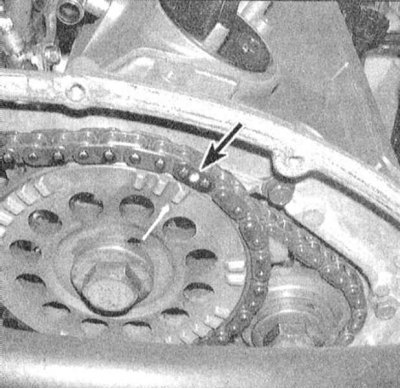
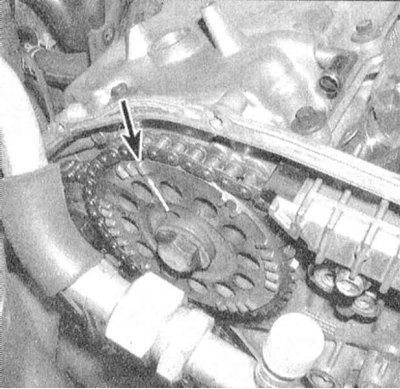
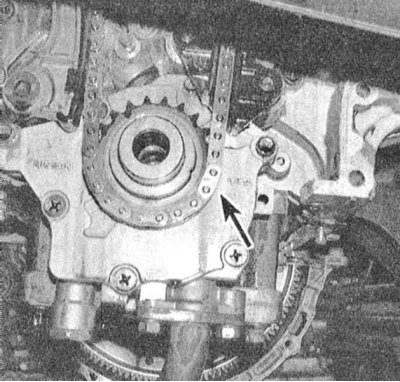
19. On the engines under consideration (DOHC, 3.0L) the required valve timing is provided by means of three chains. The main chain is put on the sprockets of the crankshaft, water pump and two intake camshafts and serves to bring the operation of the valve mechanism into phase correspondence with the rotation of the crankshaft and the movement of the piston groups. Two secondary valve timing chains are put on separate sprockets of the intake camshafts and sprockets of the exhaust shafts and serve to synchronize the drive of the intake and exhaust valves. Remove the front cover of the valve timing chain and once again make sure that the piston of the first cylinder is in the TDC position of the end of the compression stroke by the correct position of the timing marks on the sprockets of the camshafts and crankshafts relative to the colored links of the chain.
 |
 |
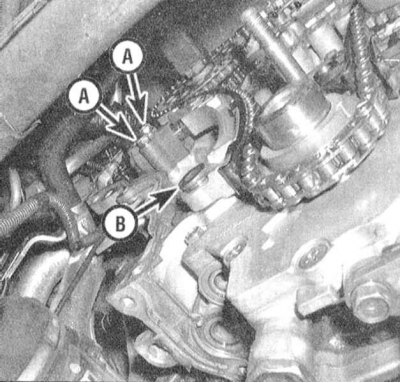
20. To relieve tension on the main timing chain, remove the main timing chain tensioner and its tensioner arm/chain guide.
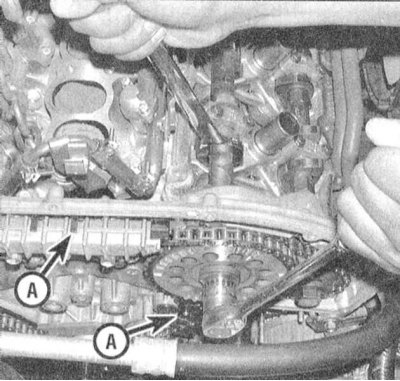
21. Remove the upper chain guide mounting bolts and the main chain sprocket bolts for the intake camshafts.
22. Remove the main chain sprockets from the inlet camshaft journals.
Note: When installing, the sprockets must be seated on their original shafts - mark accordingly.
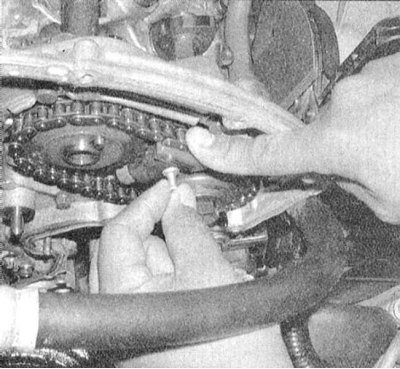
23. Press the secondary chain tensioners and lock them by inserting the locking pins into the specially provided holes.
24. Remove the bolts securing the secondary chain sprockets of the exhaust camshafts. Make sure that the timing marks are aligned correctly, then remove both secondary chains with sprockets.
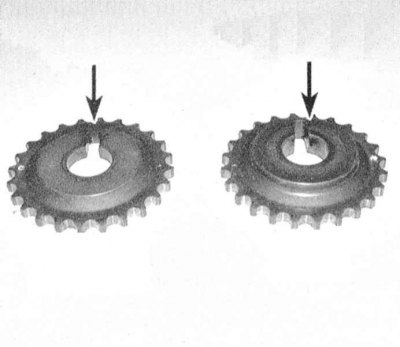
Note: The sprockets of the secondary chains of the intake and exhaust camshafts differ from each other in thickness and during assembly must be installed strictly in their original places - apply the appropriate marking.
 |
 |
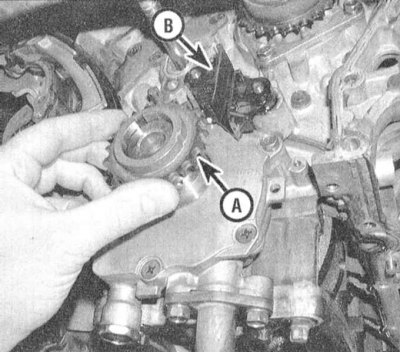
25. Remove the crankshaft sprocket and the lower guide of the main chain.
Examination
Inspect the camshaft sprockets, water pump and crankshaft for signs of wear on the teeth and keyways, and the chains for cracks and signs of wear on the rollers. Assess the condition of the working surfaces of the chain guides.
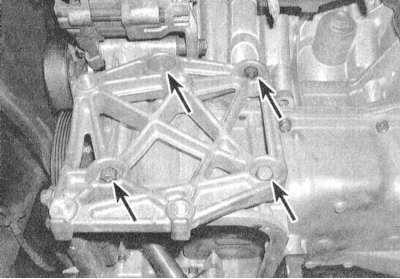
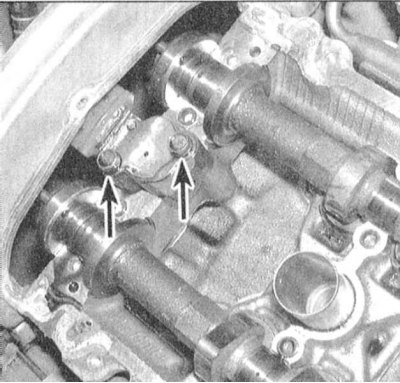
Note: To gain access to the secondary chain guide mounting bolts, the journal of the relevant camshaft [relevant camshaft bearing cap] must be removed from its head to gain access to the mounting bolts.
 |
 |
Installation
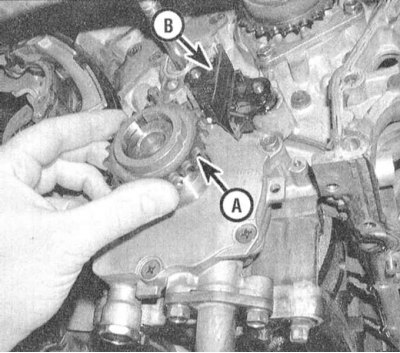
1. Install the crankshaft sprocket and main chain lower guide (with the mark up).
2. Make sure that the size of the new chains you have prepared corresponds to the requirements of your car engine - compare them with the old ones. Make sure that the arrangement of the colored links corresponds.
3. If the secondary chain tensioners were removed, install them in their places, making sure that the springs are fixed correctly. Place the secondary chain assemblies with sprockets on the camshaft journals, making sure that the installation points are aligned correctly. Tighten the exhaust shaft sprocket mounting bolts with the required force.
4. Remove the locking pins from the secondary chain tensioner assemblies.
5. With the colored links correctly aligned with the marks on the sprockets, prepare the main timing chain for installation.
6. After placing the chain on the crankshaft and water pump sprockets, install it together with the remaining sprockets on the engine. Make sure that the light chain link is correctly aligned with the mark on the crankshaft sprocket.
7. Install the upper main chain guides.
8. Install the main chain tensioner lever/chain guide. Make sure that the piston of the number one cylinder is still at the TDC position at the end of the compression stroke and that the colored links of the chain are not misaligned with the marks on the sprockets.
9. Remove all traces of old sealant from the front timing cover and its mounting bolts.
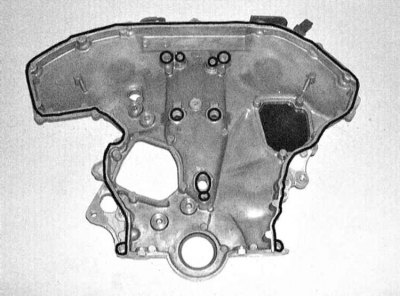
10. Apply fresh RTV sealant to the cover. Install the cover on the engine, screw the mounting bolts back into their original places. Moving in a strictly defined order, tighten the fasteners to the required force.
11. Further installation is carried out in the reverse order of dismantling the components.