


Electrical equipment of the car engine Nissan Maxima 4 (A32)

Engine Electrical Specifications
Ignition system Type Direct, electronically controlled Battery voltage, V With the engine off 12 Engine running 14 ÷ 15 Ignition order 1-2-3-4-5-6 Resistive resistance...
Ignition system Type Direct, electronically controlled Battery voltage, V With the engine off 12 Engine running 14 ÷ 15 Ignition order 1-2-3-4-5-6 Resistive resistance...

General information and precautions
The layout of the components of the electrical equipment of the engine in the engine compartment of cars in 1993 and 1994. issue 1 - spark plug; 2 - Battery; 3 - Battery...
The layout of the components of the electrical equipment of the engine in the engine compartment of cars in 1993 and 1994. issue 1 - spark plug; 2 - Battery; 3 - Battery...

Checking the condition and replacing the battery
Attention! The negative cable must always be disconnected from the battery first and connected last! When the battery is disconnected, the operating parameters entered...
Attention! The negative cable must always be disconnected from the battery first and connected last! When the battery is disconnected, the operating parameters entered...
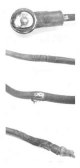
Checking the condition and replacing the battery wires
1. Regularly inspect the battery wires along their entire length for signs of mechanical damage, cracks and insulation burnouts, as well as corrosion. Do not forget that...
1. Regularly inspect the battery wires along their entire length for signs of mechanical damage, cracks and insulation burnouts, as well as corrosion. Do not forget that...
Ignition system — general information and precautions
The ignition system is used to ignite the air-fuel mixture supplied to the combustion chambers of the engine at the right time. This task is performed by generating a...
The ignition system is used to ignite the air-fuel mixture supplied to the combustion chambers of the engine at the right time. This task is performed by generating a...

Check of functioning of system of ignition
Attention! Due to the very high voltage generated in the ignition system, the maintenance of its components must be carried out with extreme care. This note applies not...
Attention! Due to the very high voltage generated in the ignition system, the maintenance of its components must be carried out with extreme care. This note applies not...

Check of a condition and replacement of coils of ignition
Models 1993 and 1994 issue Examination 1. With the ignition off, disconnect the electrical wiring from the coil. Connect an ohmmeter between the primary circuit...
Models 1993 and 1994 issue Examination 1. With the ignition off, disconnect the electrical wiring from the coil. Connect an ohmmeter between the primary circuit...

Checking the condition and replacing the power transistor (1993 and 1994 models)
Attention! The power transistor is one of the fragile and rather expensive components. Violation of the procedure suggested below may lead to failure of the PCM. Please...
Attention! The power transistor is one of the fragile and rather expensive components. Violation of the procedure suggested below may lead to failure of the PCM. Please...
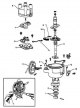
Check, adjustment, removal and installation of the distributor of ignition (models 1993 and 1994 of release)
The design of the ignition distributor with a contact breaker 1 - Retainer; 2 - sealing ring; 3 - Diaphragm of the vacuum corrector; 4 - Grounding; 5 - Breaker plate; 6...
The design of the ignition distributor with a contact breaker 1 - Retainer; 2 - sealing ring; 3 - Diaphragm of the vacuum corrector; 4 - Grounding; 5 - Breaker plate; 6...

Checking and adjusting ignition timing settings
Note. The ability to adjust the settings for the ignition timing is provided only on models 1993 and 1994. issue on models since 1995 vol. the ignition advance angle...
Note. The ability to adjust the settings for the ignition timing is provided only on models 1993 and 1994. issue on models since 1995 vol. the ignition advance angle...
Charging System — General Information and Precautions
The components of the charge system include an alternator, a voltage regulator mounted on its rear wall, a charge control lamp / charge indicator, a battery, a...
The components of the charge system include an alternator, a voltage regulator mounted on its rear wall, a charge control lamp / charge indicator, a battery, a...

Checking the state of the charge system
1. Remember that charging system malfunctions are not necessarily related to generator failures. Always do the following simple checks first: a) Check the condition of...
1. Remember that charging system malfunctions are not necessarily related to generator failures. Always do the following simple checks first: a) Check the condition of...

Removal and installation of the generator
Generator design (1993 and 1994 models issue) 1 - Pulley; 2 - Front cover; 3 - Rotor; 4 - Rear bearing; 5 - Nut (39 ÷ 59 Nm); 6 - Front bearing; 7 - Bearing holder; 8 -...
Generator design (1993 and 1994 models issue) 1 - Pulley; 2 - Front cover; 3 - Rotor; 4 - Rear bearing; 5 - Nut (39 ÷ 59 Nm); 6 - Front bearing; 7 - Bearing holder; 8 -...
Starting System — General Information and Precautions
The system provides engine cranking in order to start it. The main components of the system are a starter with a traction relay installed on it, a blocking relay, a...
The system provides engine cranking in order to start it. The main components of the system are a starter with a traction relay installed on it, a blocking relay, a...

Check of serviceability of functioning of a starter and a chain of start
1. If the starter does not rotate at all when the ignition key is turned to the START position, first of all, make the following simple checks: a) Check the battery...
1. If the starter does not rotate at all when the ignition key is turned to the START position, first of all, make the following simple checks: a) Check the battery...

Removal and installation of a starter
Starter design S114-461 (1993 and 1994 models issue) 1 - Holder; 2 - Coupling; 3 - Bolt (6.4 ÷ 7.8 Nm); 4 - Housing; 5 - Spring; 6 - Adjusting washer; 7 - Nut (7.4 ÷ 9.8...
Starter design S114-461 (1993 and 1994 models issue) 1 - Holder; 2 - Coupling; 3 - Bolt (6.4 ÷ 7.8 Nm); 4 - Housing; 5 - Spring; 6 - Adjusting washer; 7 - Nut (7.4 ÷ 9.8...

Replacing the traction relay
1. Remove the starter (see Section Removal and installation of a starter ). 2. Disconnect the electrical wiring from the bottom terminal of the traction relay. 3. Screw...
1. Remove the starter (see Section Removal and installation of a starter ). 2. Disconnect the electrical wiring from the bottom terminal of the traction relay. 3. Screw...
This section is available on: russian, bulgarian, belarusian, ukrainian, serbian, croatian, romanian, polish, slovak, hungarian
Similar information for other Nissan models
➜ Power unit: Engine electrical equipment Nissan Terrano 1 (1986-1995, petrol)
➜ Power unit: Engine electrical equipment Nissan Patrol 4 (1987-1997, petrol)
➜ Power unit: Engine electrical equipment Nissan Example 1 (1990-1996, petrol)
➜ Power unit: Engine electrical equipment Nissan Qashqai 1 (2006-2013)
➜ Power unit: Engine electrical equipment Nissan Sunny 7 (1990-1998)
Link in different formats to this section
TEXTHTMLBB Code
- General information
- Introduction to the guide
- User manual
- Maintenance
- Power unit
- SOHC engines
- DOHC engines
- Engine overhaul
- Cooling and heating
- Power and exhaust systems
- Engine electrical equipment
- Control systems
- Transmission
- Mechanical gearbox
- Automatic gearbox
- Clutch and drive shafts
- Chassis
- Brake system
- Car suspension
- Steering
- Body
- Exterior (external elements)
- Interior (internal elements)
- Doors, locks and windows
- Electrical equipment
- Equipment and devices
- Electrical circuits
NissanBook.ru © 2018–2024 · Mobile version · Articles about Nissan · Sitemap: EN BG BY UA RS HR RO PL SK HU · Feedback · Site search · Bookmark
Almera 1 (N15) · Maxima 4 (A32) · Terrano 1 (petrol) · Patrol 4 (Y60, petrol) · Example 1 (P10, petrol) · Qashqai 1 (J10) · Serena 2 (C24) · Sunny 7 (B13) · Note 1 · Micra 3 (petrol) ·
Almera 1 (N15) · Maxima 4 (A32) · Terrano 1 (petrol) · Patrol 4 (Y60, petrol) · Example 1 (P10, petrol) · Qashqai 1 (J10) · Serena 2 (C24) · Sunny 7 (B13) · Note 1 · Micra 3 (petrol) ·