


- a) Check the battery charge level, as well as the condition and reliability of the wires on the battery terminals and the starter solenoid relay;
- b) Check the condition of the battery cables (see section Checking the condition and replacing battery wires). Replace defective components;
- c) Check the battery status (see section Checking the battery status and replacing it). If necessary, replace it with a new one;
- d) Check the condition of the wiring and terminal connections of the starter (see the electrical connection diagrams in Chapter On-board electrical equipment);
- e) Check that the starter mounting bolts are securely tightened;
2. If the starter does not start to rotate when the ignition key is turned to the START position, check the correctness of the battery power supply to the traction relay when the ignition is off. There should be battery voltage at the positive battery cable connection terminal.
3. Use a voltmeter to probe the S terminal on the rear side of the traction relay connector. When the key is turned to the START position, there should be voltage at the terminal. This check confirms that the power supply to the starter from the ignition switch is working properly. If there is no voltage, check the condition of the corresponding fuses in the mounting block in the engine compartment of the vehicle (see Chapter On-board electrical equipment). If the inserts fail, the cause of the overload that occurred should be found and eliminated. Also check the corresponding fuses in the fuse box located in the passenger compartment (see Chapter On-board electrical equipment). If the fuses and fusible links are OK, check the condition of the starter locking relay and its wiring circuits (see Chapter On-board electrical equipment).
4. If there are no signs of the starting system functioning, check the condition of the starter circuit enable/opening switch sensor (see Chapter Transmission or Clutch and drive shafts). Make sure that the selector lever is set to the "P" or "N" position/check that the clutch pedal is fully depressed.
5. On vehicles equipped with an anti-theft alarm, inspect the alarm circuit and control module for signs of short circuits or component damage.
6. If the voltage is supplied to the starter properly, but it is not activated, then the traction relay has failed (it is also possible that the engine is jammed - check by turning it manually by the crankshaft pulley bolt).
(Data taken from this portal: nissanbook.ru)
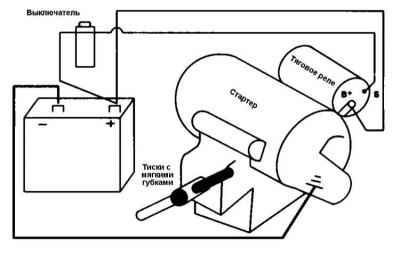
7. Remove the starter from the engine (see section Removal and installation the starter) and clamp the assembly in a soft-jawed vice mounted on a sturdy workbench. Connect the negative (-) battery terminal to the assembly housing with a jumper wire. Connect the positive battery terminal to the "B" terminal of the starter with a second jumper wire. Connect the starter switch and apply power to the S terminal of the traction relay (no more than 10 seconds). Make sure that the plunger of the traction relay extends forward, moving the drive lever and overrunning clutch accordingly, and that the extended starter pinion begins to rotate properly. If the pinion extends but does not rotate, then the electric motor is faulty. If the plunger does not extend, despite the relay clicking properly, the cause of the failure may be a defect in any of the components of the assembly. On a serviceable starter, the pinion should extend and rotate when power is applied.