


Table of contents: Examination ↓ Replacement ↓
Caution! The negative cable should always be disconnected from the battery first and connected last!
When the battery is disconnected, the operating parameters stored in the PCM memory are lost, which can lead to a certain disruption in the stability of idle speed in the first minutes after starting the engine.
Examination
Note: This test only makes sense if the battery is fully or almost fully charged. Disconnect both cables from the battery (negative at first).
The negative wire should always be disconnected first and reconnected last.
1. If the car stereo system is equipped with a security code, make sure you have the correct combination to activate the system before disconnecting the battery!
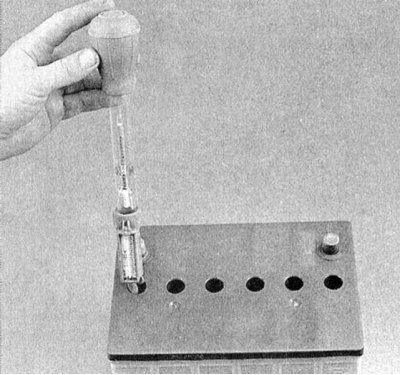
a. Checking the battery charge level. Visually assess the brightness of the indicator color spot mounted on the top of the battery (if such is provided)If the stain is dark, recharge the battery (see Chapter Settings and Routine Maintenance). On batteries to be serviced, remove the special covers and check the electrolyte level in the jars - the liquid should completely cover the upper edges of the lamellas. If necessary, add the required amount of distilled water to the corresponding jars. Try not to pour more liquid than is really necessary, as this can lead to the displacement of the electrolyte under increased loads on the engine. To determine the density of the electrolyte poured into the jars, use a hydrometer. Remove the covers and suck a sample of the electrolyte into the measuring container of the device. Based on the position of the float of the measuring chamber, determine the specific gravity of the electrolyte in each of the battery jars (follow the appliance manufacturers instructions)The specific gravity of the electrolyte of a fully charged battery should be 1.270 units (green zone of the measuring scale). When the specific gravity is too low (red zone of the scale) the battery needs to be recharged (see Chapter Settings and Routine Maintenance).
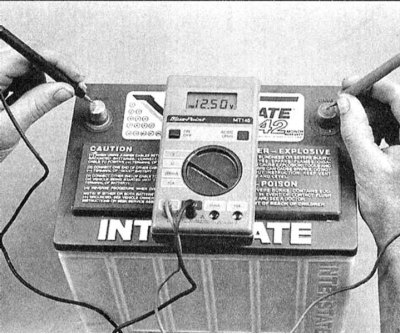
b. Open circuit voltage test. Prepare a digital voltmeter.
Note: Before measuring the voltage, you must remove the surface charge from the battery by turning on the high beam for 10 seconds, then turning off the headlights and waiting about two more minutes.
With the engine off and all electrical consumers disconnected, connect the negative probe of the voltmeter to the negative pole of the battery, then the positive probe to the positive pole. If the battery is in good condition, the device should register a reading of at least 12 V, otherwise, before proceeding with further checks, the battery should be recharged (see Chapter Settings and ongoing maintenance).
The material is taken from a web resource NissanBook.ru
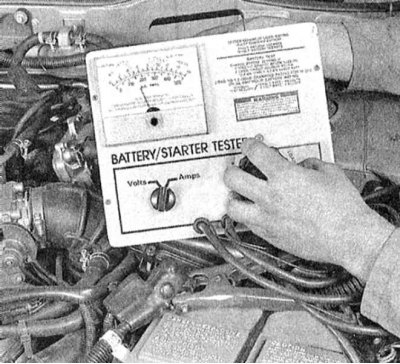
c. Checking the voltage generated by the battery under load. It is impossible to adequately assess the battery condition without performing this test. Prepare a special universal meter (see accompanying illustration). The device allows you to evaluate the battery's ability to turn the starter and generate the required energy under increased engine loads. Connect the meter to the battery terminals and follow the device manufacturers' instructions. The load is simulated by a carbon rod built into the meter. After holding the load for about 15 seconds, read the device's reading - the voltage should not fall below 9.6 V.
Note. The voltage generated by the battery is directly proportional to the temperature. The results are adjusted using a special state map, usually included with the device. The minimum acceptable value at 0°C is approximately 9.1 V.
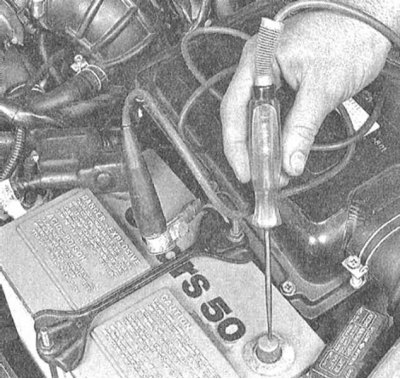
d. Checking for leakage currents. Make sure that all on-board power consumers are switched off. If the car is equipped with an engine compartment light, make sure that it is functioning properly, then switch off the lamp. Disconnect the negative cable from the battery and connect one of the terminals of the test lamp instead. Connect the second terminal to the tip of the negative cable - when the lamp turns on, there is a leakage current leading to the battery discharge.
Note. On models equipped with a powertrain control processor, digital clock, electric seat adjustment with a memory module, or other devices that consume electricity when the ignition is off, a weak glow of the test lamp is permissible. If you suspect current leaks, replace the test lamp with an ammeter - the measurement result should not exceed 50 mA.
 |
 |
 |
 |
Replacement
Caution! The negative cable should always be disconnected from the battery first and connected last!
1. Disconnect both wires from the battery (negative at first).
Caution! The negative cable should always be disconnected first and reconnected last. If the car stereo system is equipped with a security code, make sure you have the correct combination to activate the system before disconnecting the battery!
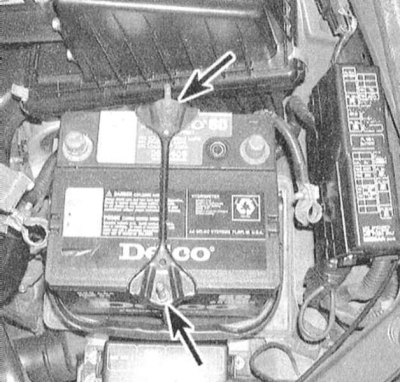
2. Loosen the clamping nuts and remove the battery mounting bar from the tray.
3. Remove the battery from the tray.
Note: Special brackets with handles are available. Using such brackets significantly simplifies the procedure of removing the battery from the engine compartment.
4. Carefully inspect the pan for signs of corrosion.
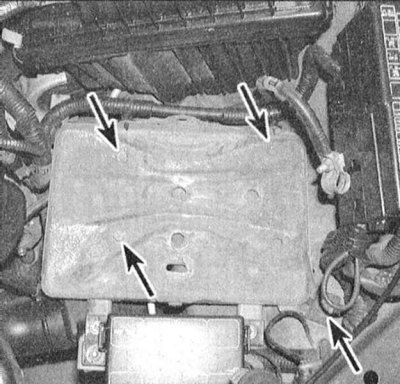
5. If necessary, loosen the fasteners and remove the pan from the engine compartment in order to remove corrosion products from it and carry out appropriate protective treatment of the metal (use zinc based primers).
6. When replacing, make sure that the replacement battery meets the performance characteristics of your vehicle.
7. Installation is carried out in reverse order.