


Sequence of tightening the bolts of the camshaft bearing journal covers
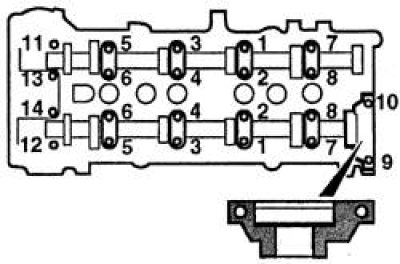
Apply sealant to the shaded areas of the left exhaust camshaft cover before installation.
Removal
1. Remove the ignition distributor.
2. Remove the camshaft sprockets.
3. The front and rear camshaft journal covers differ from the other journal covers. On late production cars, identification symbols are cast in the upper part of the covers (for the exhaust camshaft E2, E5, for the intake valves – I2, I5). On early production cars, the numbers on the camshaft journal covers may be missing, so before removing them, it is necessary to apply marks that should indicate the serial number and orientation of the cover.
4. Loosen the camshaft journal cover bolts in the reverse order to that shown in the diagram. Loosen the bolts in several steps, one turn at a time. Once the springs have been completely released, the bolts can be completely removed. First remove the front and rear covers, then the exhaust camshaft covers. Remove the intake camshaft covers last.
5. Remove the camshafts.
6. Place the tappets and shims in separate numbered bags.
Examination
1. Inspect the working surfaces in the covers and in the cylinder head. Check for scoring and traces of deep wear. Check for traces of metal chipping on the camshaft cams (areas of bluish tint), deep grooves, chips formed due to wear.
2. Check the runout in the middle journal of the camshaft. If the runout exceeds the norm, replace the camshaft.
3. Use a micrometer to measure the dimensions of each camshaft cam and compare them with the standard. Replace the camshaft if there is excessive wear or damage.
4. Check the clearance in the camshaft bearing journals. This can be done in two ways - either by direct measurement or by using a plastic gauge.
5. When measuring the clearance using the direct method, install the camshaft journal caps into the cylinder head, maintaining their previous order and orientation. Tighten the cap bolts to the specified torque, in the sequence shown in the diagram.
6. Measure the inner diameter of the bearing surfaces of the covers and compare with the standard. If the inner diameter in any cover exceeds the limit, replace the cylinder head. The gap can be defined as the difference between the inner diameter of the hole for the journal with the cover installed and the diameter of the bearing journal of the camshaft.
7. When measuring the clearance with a plastic gauge, clean both camshafts and the bearing surfaces of the journals in the cylinder head and in the covers. Place the camshafts in the cylinder head.
8. Place pieces of plastic calibration wire along the bearing surfaces of the camshaft journals parallel to their axis, taking measures to prevent the camshafts from turning, install the camshafts and tighten the covers (see below).
9. Loosen the cover mounting bolts and carefully remove the covers, preventing the camshafts from turning.
10. Compare the largest width of the crushed wire from each neck with the scale on the gauge package.
11. Compare the measurement result with the standard. If the clearance exceeds the standard, measure the camshaft journal diameter with a micrometer. If the diameter is less than the maximum allowable, replace the camshaft and check the clearances in the bearing journals again. If the clearance is still higher than the standard, replace the cylinder head and bearing journal covers.
12. Check for signs of wear on the tappets and the inner surfaces of the cylinder head. If the necessary measuring instruments are available, the degree of wear can be assessed by the difference in diameter between the tappet and the hole in the cylinder head. Compare the resulting clearance with that specified in subsection 3.1.1.1. Replace worn parts if necessary.
Installation
1. Generously lubricate the tappets and tappet holes in the cylinder head. Carefully insert the tappets, without disturbing the original order of their installation. When installing, the tappet must be inserted into the hole without skewing. Insert adjusting washers into the tappets, make sure they are installed correctly, then generously lubricate the bearing journals and camshaft cams.
2. Install the camshafts. The exhaust camshaft is easily identified by the distributor drive splines on the left edge.
3. Make sure that the groove on the crankshaft pulley is aligned with the pointer on the front cover. Orient the camshafts so that the cams of the 1st cylinder are facing away from their corresponding valves. When the camshafts are correctly positioned, the dowel pin of the intake camshaft sprocket at the front of it should point to 9 o'clock (if you look from the right side of the engine), and the exhaust camshaft alignment pin must be in the upper vertical position (for 12 hours).
4. Make sure that the contact surfaces of the bearing journal covers and the cylinder head beds are absolutely clean, and that there are no scratches or oil marks on these surfaces. Apply a thin layer of sealant to the contact surfaces of the leftmost bearing journal cover of the exhaust camshaft.
5. Install the bearing journal covers using the marks made during removal as a guide (or existing).
6. Tighten the cover mounting bolts in the sequence shown in the diagram. Tighten the bolts evenly, gradually increasing the force, turning the bolts one turn at a time, until the covers contact the cylinder head. Then tighten the bolts to the specified torque. Tighten only in the specified order to ensure an even and gradual increase in force from the valve springs to the bearing journal covers.
7. Install the camshaft sprockets.
Caution! If the cylinder head and camshafts have been overhauled, check the valve clearances on a cold engine before installing the cylinder head cover.
8. Install the ignition distributor.
9. Check the valve clearances.