


Removal and disassembly
1. Remove the timing chain cover and the oil pump drive sprocket with chain.
2. Loosen the clamps and disconnect the fuel hoses. Seal the open ends of the hoses to prevent dirt from entering the fuel system.
3. Loosen the mounting bolts and remove the fuel pump from the engine.
4. Remove the mounting bolts and nuts and remove the oil pump from the front of the engine. Discard the O-ring.
5. Loosen the bolts securing the front and rear oil pump covers, remove the covers from the pump body (the components of the oil pump are shown in the accompanying illustration).
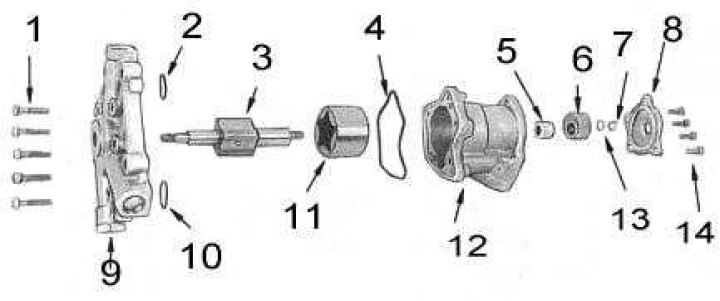
1 - bolts; 2 - sealing ring; 3 - internal gear (rotor); 4 - sealing ring; 5 - bearing; 6 - cam; 7 - nut; 8 - back cover; 9 - front cover; 10 - sealing ring; 11 - outer gear (rotor); 12 - body; 13 - washer; 14 - bolts
6. Loosen the fuel pump drive cam nut, then remove the washer and cam from the oil pump shaft. Remove the internal gear (rotor) assembly with the shaft and the external gear (rotor) from the oil pump housing.
7. Remove the pressure relief valve spring and valve plunger from the front cover of the pump (see accompanying illustration).
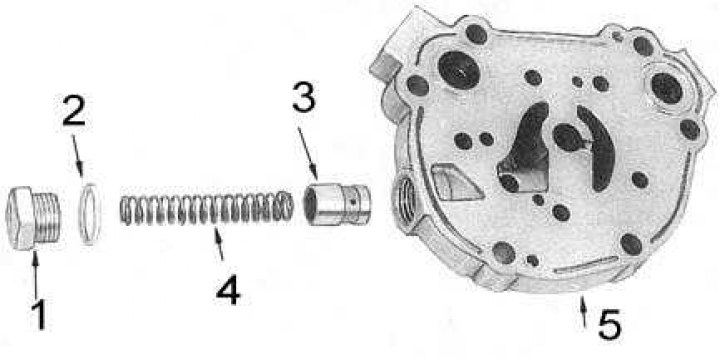
1 - cork; 2 - washer; 3 - plunger; 4 - spring; 5 - front cover
Checking the status
1. Wash the oil pump components thoroughly in solvent and dry them naturally.
2. Check the internal and external gears of the pump for signs of wear. Replace defective components.
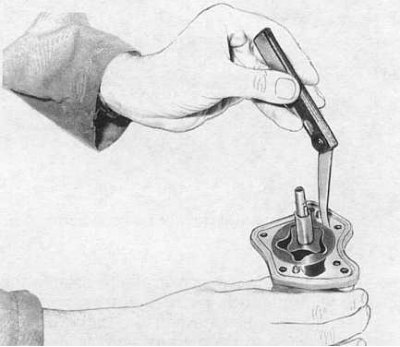
3. Temporarily install both gears back into the pump body and use a blade type feeler gauge to check the clearance between the outer gear and the pump body (see accompanying illustration). Compare the measurement result with the regulatory requirements (see size and adjustment tables at the end of the Manual). Replace the pump if necessary.
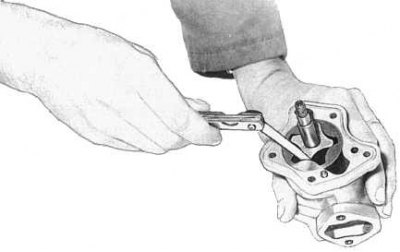
4. Measure the gap between the teeth of the internal gear and the shoulders of the external gear (see accompanying illustration). If the permissible value is exceeded, replace the pump.
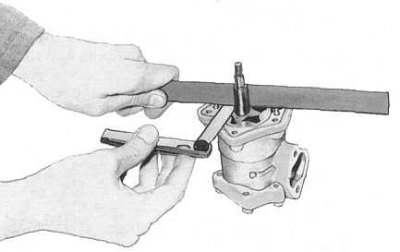
The material is taken from a web resource (www.NissanBook.ru)
5. Press the flatness gauge rib against the end face of the pump housing and measure the gear lateral clearance (see accompanying illustration). Replace the pump if necessary.
6. Check the plunger of the pressure reducing valve for burrs and scratches. The plunger should have a tight enough fit in the pump cover. Check the spring for loss of developing force and broken coils.
7. Inspect the fuel pump drive cam for cavities and scoring; replace if necessary.
8. Using a hammer and drift, remove the needle roller bearing of the internal gear shaft from the pump housing. Discard the bearing. Check the condition of the bearing seating surface on the gear shaft. If scoring or roughness is detected, replace the shaft.
Assembly and installation
1. Using a drift and a mandrel, install a new needle bearing into the pump housing.
2. Generously lubricate all components with engine oil and install the gears into the pump housing.
3. Install the front cover with a new sealing ring, tighten the mounting bolts in several stages with a force of 7÷8 Nm.
4. Insert the plunger of the pressure reducing valve with the spring(s) into the front cover of the pump, tighten the plug with a force of 39÷69 Nm, not forgetting to change its sealing washer.
5. Install the fuel pump drive cam and tighten the fastening nut with a force of 16÷19 Nm.
6. Place a continuous cushion of sealant with a cross-section diameter of 2÷3 mm in the groove in the rear cover of the pump, then press the cover to the pump body for no more than ten minutes and secure it with bolts. The tightening force of the bolts should be 7÷8 Nm.
7. Place a sealant cushion with a ø section of 2÷3 mm in the groove of the front cover of the pump, install new sealing rings on the cover, then press the assembly to the pump body. Tighten the fastening bolts with a force of 7÷8 Nm.
Note: Allow the sealant to dry for at least thirty minutes before starting the engine.
9. Install the fuel pump with the new insulation assembly. Tighten the mounting bolts securely.
10. Install the drive sprocket and chain assembly, timing chain cover and crankshaft pulley.