


Table of contents: Cleaning ↓ Checking the status ↓
Cleaning
1. Remove all attachments and sensors from the cylinder block. For cleaning, you also need to remove the plugs. To do this, drill a small hole in the plugs and screw a self-tapping screw into each. The plugs are removed with pliers by the screw heads, or with an impact puller.
2. Scrape off all remaining gasket material from the cylinder block and main bearing cap frame (in those engines in which the frame is provided), being careful not to damage the split sealing surfaces.
3. Remove all oil channel plugs (if provided). These plugs are a very tight fit, so they may need to be drilled out and then reamed. Replace all plugs when reassembling the engine.
4. In case of severe contamination of the cylinder block surface, steam cleaning will be required.
5. After steaming the block, repeat the cleaning of the lubrication holes and channels. Rinse all internal channels of the cylinder block with warm water until clean water begins to flow out. Dry the block thoroughly and lubricate all split and ground surfaces with low-viscosity oil to prevent rust. The drying process can be accelerated by blowing out the internal channels with compressed air.
6. If the surface of the cylinder block is moderately dirty, then you can limit yourself to washing the cylinder block with a hard brush and hot water (with a temperature that excludes burns) with soap or detergent. Take your time and thoroughly wash the cylinder block. Regardless of the cleaning method, thoroughly wash all internal lubrication channels and dry well. Lubricate the cylinder walls with oil to prevent rust.
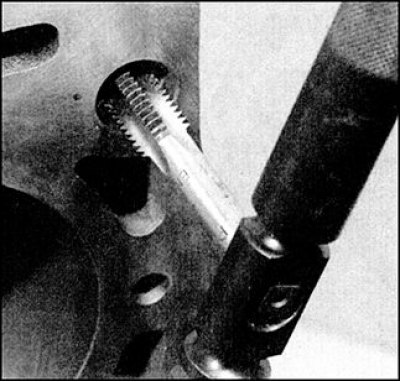
7. The threaded holes in the block should be cleaned to ensure accurate torque readings during assembly. Run a tap through the threads as this will clean the threaded holes of dirt, corrosion and sealant residue, and restore the threads. If possible, blow compressed air through the holes to remove any remaining material from the tap.
Caution! Good results are achieved by injecting water-dispersible lubricants into the holes under high pressure, which are available in long aerosol cans. Wear protective goggles when cleaning in this way.
8. Install new plugs into the cylinder block, after having lubricated them with a suitable sealant.
9. If engine assembly is postponed, cover the cylinder block with plastic film to prevent dirt from entering and rust from forming. Lubricate all separable sealing surfaces to prevent corrosion.
Checking the status
1. Visually check the cylinder block for cracks and traces of corrosion. Check the condition of the threads in the holes, mark the places with stripped threads. If there was a suspicion of a coolant leak inside the cylinder block, then the block should be tested for leaks, for which it is advisable to contact a specialist. If defects are found, repair the block (if possible), or replace.
2. Check for chips and burrs on the inner surfaces of the cylinders. Check for a rim at the top of the cylinder, a rim indicates increased wear of the cylinder.
3. Check for chips and burrs on the inner surfaces of the cylinders.
4. Measure the inner diameter of the cylinder at 10 mm from the edge of the cylinder parallel and perpendicular to the engine axis. Repeat the measurements at distances of 60 and 100 mm from the edge of the cylinder. Based on the results of these six measurements, determine the taper and ovality of the cylinder.
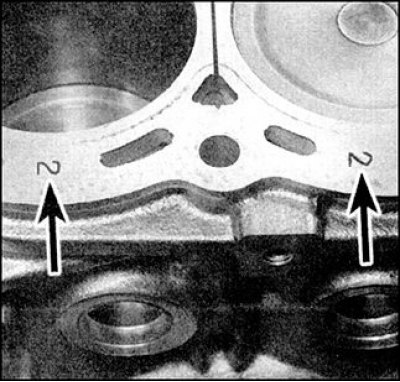
5. Designations of cylinder size groups (indicated by arrows) stamped on the split plane of the block under the cylinder head gasket, next to the cylinders.
6. Check the condition of the pistons and rings (see subsection 3.2.2.12). The clearance between the piston and the cylinder is defined as the difference between the measured diameters of the cylinder and the piston.
7. Compare the results with those given in (see subsection 3.2.1.1). If any of the measured values are outside the standard limits, the cylinder must be bored to the next repair diameter, and if this is not possible, the cylinder block must be replaced. To take the most correct further actions, consult a specialist. Only one repair size pistons are supplied as spare parts - 0.2 mm.
8. If the condition of the pistons and cylinders is satisfactory, and the wear is such that the clearance between the piston and cylinder is within normal limits, then only the piston rings will need to be replaced.
9. In this case, the cylinders are subjected only to honing, which ensures better running-in of the piston rings and their tight fit to the cylinder walls.
10. Honing is usually done with a honing head with spring-loaded stones that fits into an electric drill. Kerosene or honing oil and rags should also be available. During the honing process, periodically move the tool up and down in the cylinder, generously lubricating the cylinder walls.
11. After honing, a structure of fine lines intersecting at an angle of about 60° should form on the surface of the cylinder walls. Do not remove excess material; finish honing immediately after finishing the surface. If new pistons are installed, it should be borne in mind that the piston manufacturer may recommend processing the cylinder walls with a slightly different angle of intersection of the lines. In this case, follow the instructions of the piston manufacturer.
12. It is forbidden to remove the honing head from the cylinder during rotation – first wait until it stops completely. After finishing, carefully wipe the cylinder from oil. If you do not have a honing device, or if you are not sure that you can perform this operation qualitatively, you should contact a workshop where cylinders are honed for a reasonable fee.