


Types of wear of main and connecting rod bearings
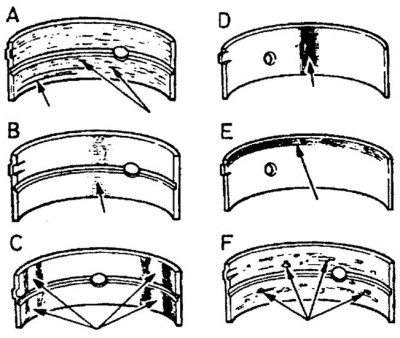
A. Scratches due to dirt embedded in the coating material; B. Insufficient lubrication, local wear of the bearing coating; C. Incorrect installation of bearings, shiny (polished) sections D. Tapering of journals, wiping of bearing coating from the entire surface along the length of the bearing; E. Formation of a flange on the edge of the bearing; F. Fatigue wear, cratering or pocketing
Despite the fact that main and connecting rod bearings are subject to mandatory replacement during major engine repairs, used bearings should be stored at the place of their installation for careful inspection, since traces of wear on these parts allow the general condition of the engine to be restored. Bearing liners are divided into size groups by thickness, belonging to each size group is indicated by color marking applied to the liners.
Causes of crankshaft bearing failure include insufficient lubrication, dirt and foreign particles, engine overload, and corrosion. Regardless of the cause of bearing failure, it should be corrected before final engine assembly to avoid repeated damage to these parts.
When checking the condition of the bearings, they must be removed from the cylinder block, crankshaft main bearing caps, connecting rod caps and connecting rods. Lay the liners on a clean surface in the same order in which they were installed on the engine. This will allow you to install the appropriate crankshaft support in which the bearing has been subjected to increased wear. When checking, do not touch the working surface of the liners with your fingers so as not to cause additional damage to them.
Dirt and foreign particles enter the engine for various reasons - during assembly, through filters or the crankcase ventilation system. Contaminants can also get into the oil, and from there - into the bearings. Contaminants often contain metal particles from mechanical processing of engine parts, or as a result of wear during normal engine operation. Sometimes contaminants contain residues of abrasive materials after lapping and grinding work, especially if the engine is not sufficiently flushed and cleaned after their completion. Regardless of the cause of origin, foreign contaminants are usually embedded in the soft alloy of the bearing and are easily distinguishable. Large particles will not be able to penetrate the bearing and lead to scratches and scoring on the surfaces of both the bearing and the crankshaft journals. The best way to prevent such wear is to thoroughly flush the parts and maintain impeccable cleanliness during engine assembly. To prevent premature wear, it is also recommended to change the oil and filters more often.
Insufficient engine lubrication ("oil starvation") can be caused by a number of interrelated reasons. These include engine overheating (causes oil liquefaction), overloads (cause oil to be squeezed out of the bearing surface) and pressure drop due to oil leakage (ejection) (due to increased clearances in bearings, wear of the oil pump, high crankshaft speed). Accelerated wear of crankshaft bearings is also caused by blocked oil passages, usually due to misalignment of the lubrication holes in the crankshaft bearings with the holes in the cylinder block and connecting rods, which causes insufficient lubrication and failure of the bearings. When insufficient lubrication is the cause of failure, the bearing coating material is wiped off or squeezed out of the steel base. The temperature rises to such a level that the steel base of the bearing is chipped from overheating, acquiring a bluish tint.
The durability of crankshaft bearings also depends significantly on driving skills. Bearings experience increased loads when driving with the throttle fully open, or at low speeds in high gear (in heavy engine modes). Under increased loads, the oil film is squeezed out. The bearings experience bending deformations, which cause microcracks to form (fatigue wear). As a rule, the bearing coating is torn off from the steel base in the form of small particles.
Short trips can cause corrosive wear of bearings, as insufficient warming does not allow condensed moisture and gases that cause corrosion to be removed. These components accumulate in the oil, causing the formation of acids and insoluble deposits. As the oil reaches the bearings, corrosion occurs under the influence of acids, causing the destruction of the bearings and their failure.
The text is published on the website [nissanbook.ru]
Incorrect installation of bearings during assembly also leads to their premature wear. If the clearance in the bearings is less than the norm, their lubrication is difficult, which leads to wear as well as due to "oil starvation". Dirt or small particles that get under the bearing liner lead to local lifting of the liner and to increased wear in this part.
When assembling, do not touch the surfaces of the liner with your fingers, otherwise you may scratch the surface or introduce dirt particles onto the liner.
As already noted, during a major overhaul of the engine, the main and connecting rod bearing shells must be replaced. Neglect of this rule and saving on repairs lead to extremely undesirable consequences.