


Table of contents: Selection of new main bearing liners ↓ Checking clearances in main bearings ↓ Final installation of the crankshaft ↓
Selection of new main bearing liners
Attention! The description concerns only standard size main bearings. Repair liners are not divided into size groups.
Codes of the size group of main and connecting rod bearings
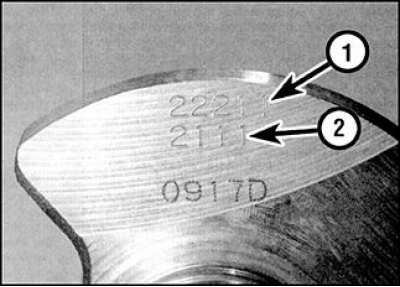
1. Main bearings
2. Connecting rod bearings
New main bearings are selected in accordance with the identification codes applied to the crankshaft and cylinder block.
On the crankshaft, the codes are applied to the cheek of the neck of the 1st cylinder (from the chain cover side). The five-digit code refers to the main bearing diameters, the first digit is the code for the 1st crankshaft main journal, and the fifth is the code for the 5th journal.
Please note! Some engines also have four-digit codes on the crankshaft cheek that indicate the size group of the connecting rod bearings (see subsection 3.2.2.10.2).
Codes of size groups of bores for main bearings
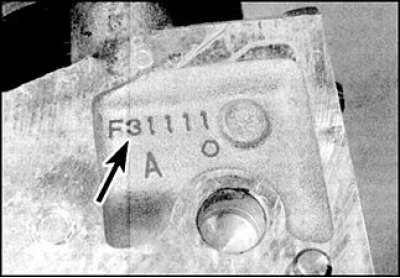
On engines, the codes for the size groups of bores for the main bearings are stamped on the base of the cylinder block (indicated by an arrow).
On the cylinder block, the size codes are stamped on the base on the flywheel side. On engines, there is only a five-digit code, the first digit in this code refers to the 1st crankshaft main journal, and the fifth to the 5th journal.
To select main bearing shells, you need to find out the size group for boring under the shell, stamped on the cylinder block, and the size group code of the corresponding main journal, which is applied to the crankshaft, and then, using the attached table, determine the required shell, focusing on the color marking, which is applied in the form of a dot on its side surface.
| Code on the crankshaft | Code on the cylinder block | Main Bearing Marking |
| 0 | 0 | black |
| 0 | 1 | brown |
| 0 | 2 | green |
| 0 | 3 | yellow |
| 1 | 0 | brown |
| 1 | 1 | green |
| 1 | 2 | yellow |
| 1 | 3 | blue |
| 2 | 0 | green |
| 2 | 1 | yellow |
| 2 | 2 | blue |
| 2 | 3 | pink |
| 3 | 0 | yellow |
| 3 | 1 | blue |
| 3 | 2 | pink |
| 3 | 3 | white (or missing) |
Checking clearances in main bearings
1. Clean the outer surface of the new main bearings, the surfaces of the bearing bores in the cylinder block and in the main bearing caps.
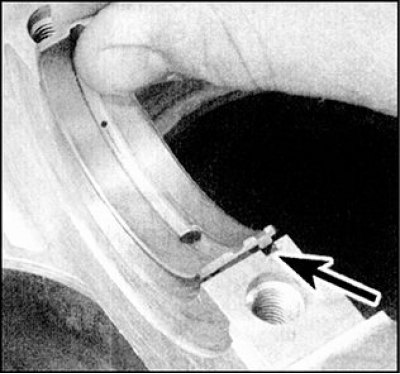
2. Press the insert into place, making sure the protrusion (indicated by the arrow) on the bearing shell has entered the recess in the cylinder block bore or in the main bearing cap frame. It is prohibited to touch the working surface of the bearing shells with your fingers.
3. Note that all upper main bearing shells have an oil groove and an oil supply hole. The lower shells are solid.
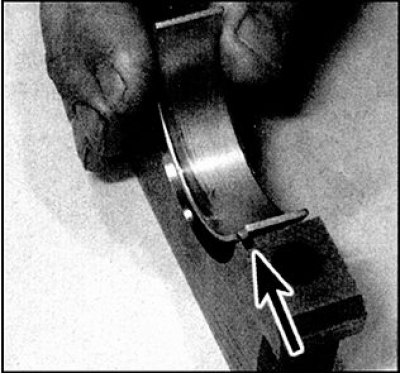
4. Install the lower liners into the lids (there is no groove or hole on these liners), also aligning the protrusion with the recess.
5. If the gap is to be checked on previously used liners, make sure that the liners are installed in their original places. The gap can be checked in two ways.
6. When determining the gap, the first method is to install the covers (or the frame of the lids) main bearings together with liners on the cylinder block (for measurements using this method, you will need special measuring devices - a bore gauge with a pointer indicator, or a telescopic micrometer, and a regular micrometer). Tighten the cap (frame) bolts with a specified torque and measure the inner diameter of each assembled pair of liners. The clearance in the main bearings is determined as the difference between the inner diameter of the assembled main bearings and the measured diameter of the crankshaft main journals.
7. The second way (more accurate) consists of using plastic calibration wire Plastigage of round cross-section (invented and produced in the USA). The wire is flattened between the bearing and the crankshaft journal. After removing the bearing cap, the wire remains flattened. By comparing the width of the flattened wire with the scale supplied with the kit, the bearing clearance can be determined. The calibration wire can be purchased from the dealer's service department. If the dealer does not have the wire, it can be purchased by inquiring with agents specializing in the supply of engine parts and obtaining information about the availability of this product in your area. Checking the clearance with a gauge is carried out as follows.
8. After installing the main bearings, carefully install the crankshaft. No grease is allowed on the crankshaft journals. The main journals must be dry and clean.
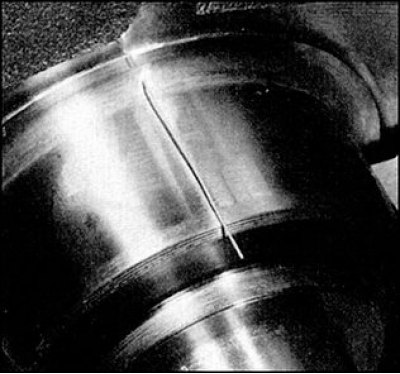
9. Prepare several lengths of Plastigage plastic gauging wire, slightly shorter than the width of the main bearings, and place one length on each crankshaft main journal parallel to its axis.
10. Install the covers with the lower inserts in place. When installing the covers, use the marks on them to orient yourself to install the covers in their original position.
11. Install the cast frame of the main bearing caps, screw in the bolts and tighten them. During tightening, the position of the wire should not change, and the crankshaft should not be turned.
12. On all engines, remove the cover mounting bolts. Loosen the bolts in reverse order, one turn at a time. Loosen and remove the bolts from the cylinder block.
13. Remove the main bearing caps (or the frame of the lids), again making sure that the position of the flattened calibration wires does not change and that the crankshaft does not turn.
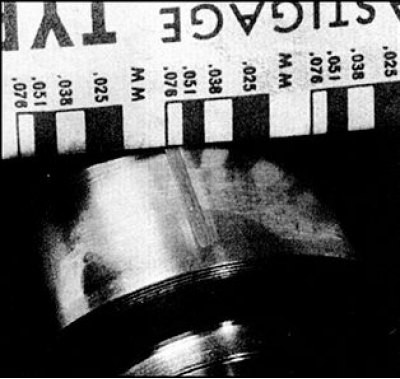
14. Compare the width of the crushed wires with the scale on the package and determine the clearance in the main bearing. Compare with the standard clearance.
15. Measuring the gap by comparing the width of the crushed calibration wire with the scale on the package
16. If the gap differs from the standard, the reason may be the incorrect selection of liners (or their increased wear, if the liners tested were previously in use). Before deciding whether the bearings need to be replaced, make sure that there was no dirt or oil between the covers or cylinder block and the bearing when measuring. If the width of the flattened wire is greater on one side, this indicates that the journal is tapered.
17. If the clearance differs from the norm when measured with old liners, then repeat the measurements with new liners. If the clearance exceeds the norm even with new liners, then you should consult the dealer's service department or a specialist in this engine to get advice on how to proceed. It is also possible that you will have to regrind the crankshaft journals and replace the liners with repair ones.
18. If necessary, purchase liners of the appropriate size group and repeat the procedure for measuring the clearance in the main bearings.
19. When finished, scrape off any remaining gauge wire from the crankshaft journals with your fingernail or a wooden chip, being careful not to damage the surface.
Final installation of the crankshaft
1. Carefully remove the crankshaft from the cylinder block.
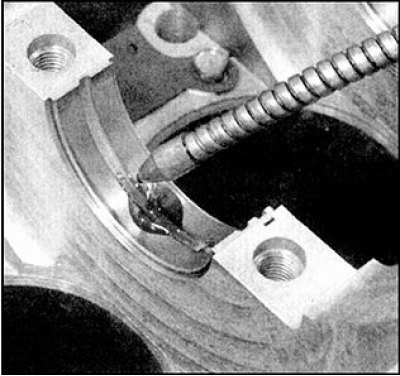
2. Install the main bearing shells in place, following points 5 and 6. If new shells are installed, wash them thoroughly in kerosene, removing any remaining preservative. Wipe the shells and connecting rods dry with a lint-free cloth. Generously lubricate the surfaces of the shells installed in the cylinder block with fresh engine oil.
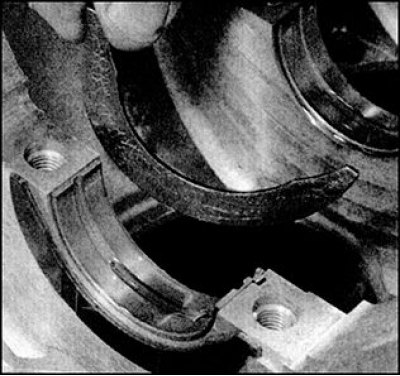
3. Apply a thin layer of grease to the thrust washers and attach them to both sides of the 3rd main bearing. Make sure that the oil grooves on both washers face away from the cylinder block.
4. Install the crankshaft into the cylinder block and check the axial clearance (see subsection 3.2.2.8.1).
5. Carefully clean the separating surfaces of the main bearing caps and cylinder block from grease.
6. Lubricate the lower bearing surfaces with fresh engine oil. Make sure the locating tabs on the bearings fit into the recesses in the caps.
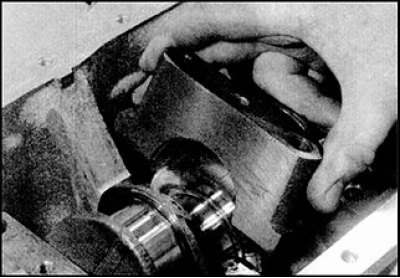
7. Install the main bearing shells in their original places, using the marks as a guide.
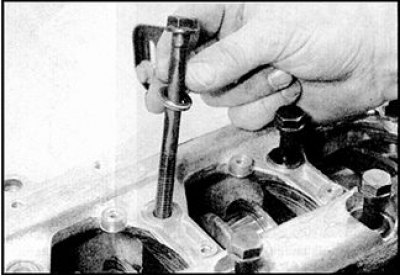
8. Install the cast main bearing cap cage, install the bolts and tighten them only by hand for now.
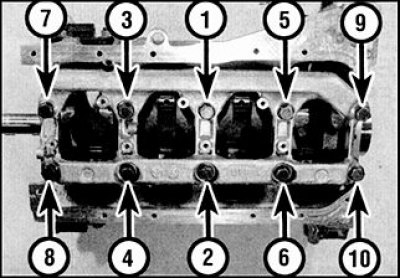
9. Tighten the cover bolts in the sequence shown in the figure to the specified torque of stage 1.
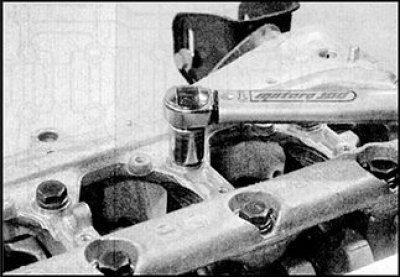
10. Using a socket wrench, tighten the cover bolts to the specified Stage 1 torque.
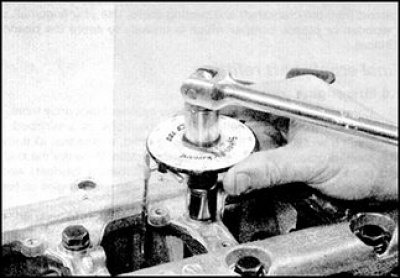
11. Tighten the bolts to the angle corresponding to the 2nd tightening stage, observing the specified sequence. If you do not have a wrench with an angle scale, tighten the bolts with a torque wrench to the torque specified for the 2nd tightening stage.
12. Check the crankshaft for freedom of rotation, then install the remaining parts (see paragraphs 13–16).
13. Check the cleanliness of the separating surfaces of the rear oil seal holder and the cylinder block. Make a mark indicating the depth of the oil seal seating in the holder, then remove the oil seal from the holder by prying it with a large flat-blade screwdriver.
14. Install a new seal into the holder, making sure that the lips of the working edges are facing the engine. Press the seal in with light hammer blows to a depth that corresponds to the mark made before removing the used seal.
15. Check for the presence of the guide pins, then apply a bead of sealant to the split surface of the seal holder. Place the seal holder on the crankshaft and install it on the cylinder block. Tighten the mounting bolts to the specified torque.
16. Install the flywheel, camshaft timing chains and oil pan.