


Comment. The crankshaft can only be removed after the engine has been removed from the vehicle. Remove the flywheel first (or master disk), idler pulley, chain, sump, oil receiver, oil pump (on V6), front cover and connecting rods with pistons.
1. Pre-check the axial play of the crankshaft (photo). To do this, move the crankshaft towards the rear of the engine, applying maximum effort, and in this position, set the indicator scale to zero. Then push the crankshaft towards the front of the engine and read the indicator. The amount of axial play is equal to the distance that the shaft has moved. If the axial play exceeds the standard value, then check the wear of the thrust surfaces of the crankshaft cheeks. If the wear is negligible, then the play must be compensated by installing new main bearings. The play can be measured with feeler gauges by inserting them between the end face of the 3rd main bearing (or 4th on V6 engines) and crankshaft cheek.
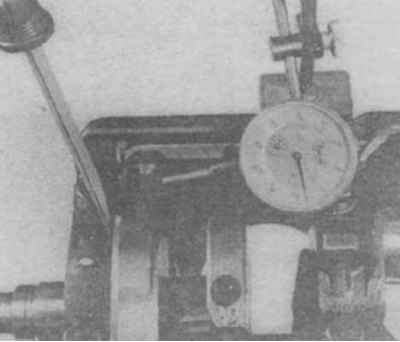
12.1a Checking the axial play of the crankshaft with an indicator...
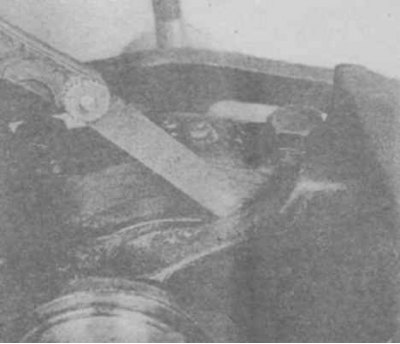
12.1b... or with a probe
2. Check up presence on covers orientation arrows and markings of number of the cylinder. Usually the covers are numbered starting from the front of the engine. If there is no marking, then mark with a core. Loosen the cap bolts 1/4 turn at a time in reverse order (photo), until the bolts turn away by hand.
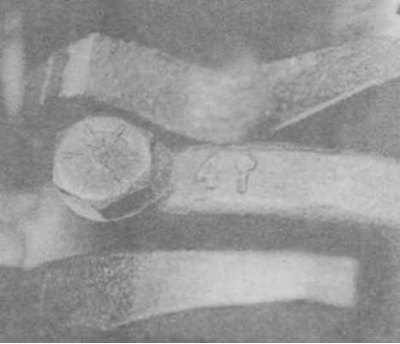
12.2a Marking of main bearing caps
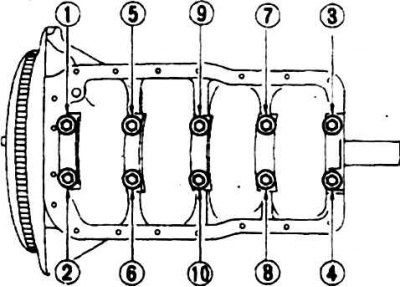
12.2b The sequence of releasing the cover bolts on 4-cylinder engines...
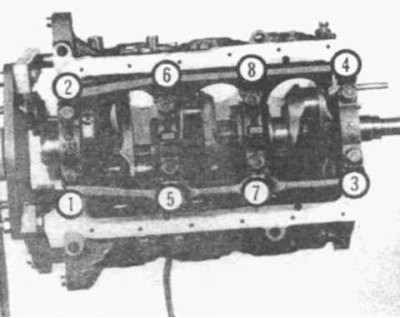
12.2v... and on V6 engines
3. Carefully shift the main bearing caps and remove them together with the loose leaf. On 4-cylinder engines, the rear and middle bearing caps are removed with a tool (photo). On V6 engines, the covers are molded into a single frame.
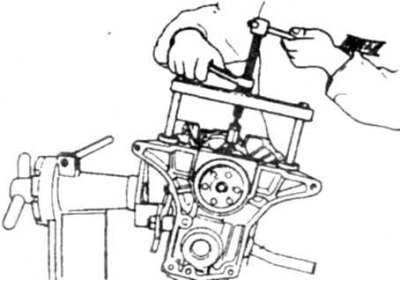
12.3 Removing covers on 4-cylinder engines
4. Carefully remove the crankshaft. Reinstall the bearing caps in the same order and hand-tighten the bolts.