


2. Remove all traces of gasket material from the head split surfaces, being careful not to damage the surfaces. Remove carbon deposits from the combustion chambers and scale from the cooling system passages. Clean and flush all threaded holes.
3. Wash all valve mechanism parts, shafts and rocker arms with solvent.
4. Remove carbon deposits from the valve heads.
5. Carefully inspect the head, check for cracks and signs of coolant penetration. If cracks are found, replace the head.
6. Check the deformation of the split surface of the head (photo). If the deviation from the plane exceeds the norm, the head should be re-ground in a car service workshop.
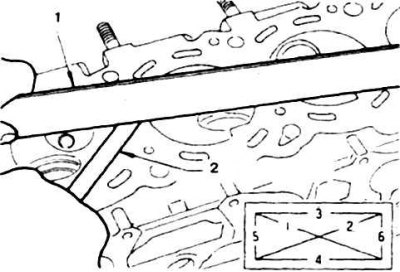
9.6 Checking the split plane of the head
1. Caliber; 2. Probe
Caution! In the V6 engine head, the split surfaces of the manifolds should also be re-ground. In this case, during assembly, check the freedom of rotation of the camshaft by hand. If you feel noticeable resistance to rotation, replace the head.
7. Check the condition of the valve seats. If there are pitting, cracks, burn marks, the head will need to be repaired in a workshop.
8. Check the valve clearance in the direction parallel to the rocker arm axis (photo). If the total clearance on the indicator exceeds the norm, then the clearance between the bushing and the valve should be checked (performed in a car service).
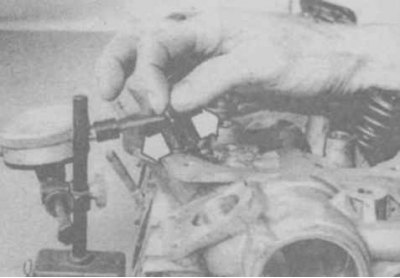
9.8 Checking the valve swing
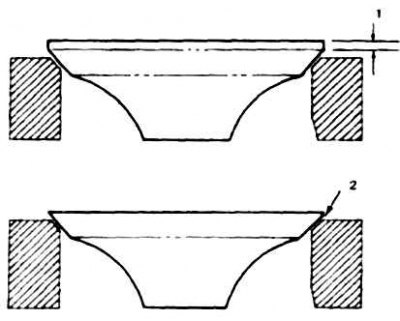
9.8 Valve edge band width
1. Belt; 2. The belt is missing
9. Check the condition of the camshaft supports.
10. Carefully inspect the valves, check for cracks on the valve chamfers, traces of uneven wear, metal erosion and burnout. Check for cracks on the necks and rods, as well as bending of the rods by turning the valve in the guide bushing. Check the wear of the rod ends. The presence of any of the above defects indicates the need to repair the valves in a car service workshop.
11. Measure the width of the edge band of each valve and compare it with the standard value (photo). If this distance is less than 0.8 mm, the valve must be replaced.
12. Check for signs of wear and pits on the ends of each valve spring. Measure the length of the spring in a free state (photo). Before installing the springs on a repaired engine, they must be tested under load on a special stand (performed in a car service workshop).
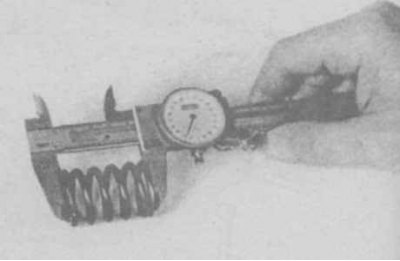
9.12 Measuring the length of a valve spring in a free state
Information obtained from the website [nissanbook.ru]
13. Check the verticality of the springs (photo). If a deviation of the spring from the vertical and a deflection along the length are detected, the spring should be replaced.
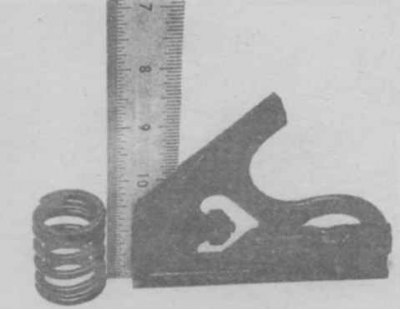
9.13 Checking the verticality of springs
14. Check for visible signs of wear and cracks on the spring plates and crackers. Replace parts with any defects.
15. Checking the rocker arms and rollers is described in Parts B Ch. 2.
16. If the inspection reveals that the wear of the parts does not exceed the norm, then assemble the cylinder head, installing the parts in their original places. Cylinder head repairs of any complexity should be performed at a car service center.